
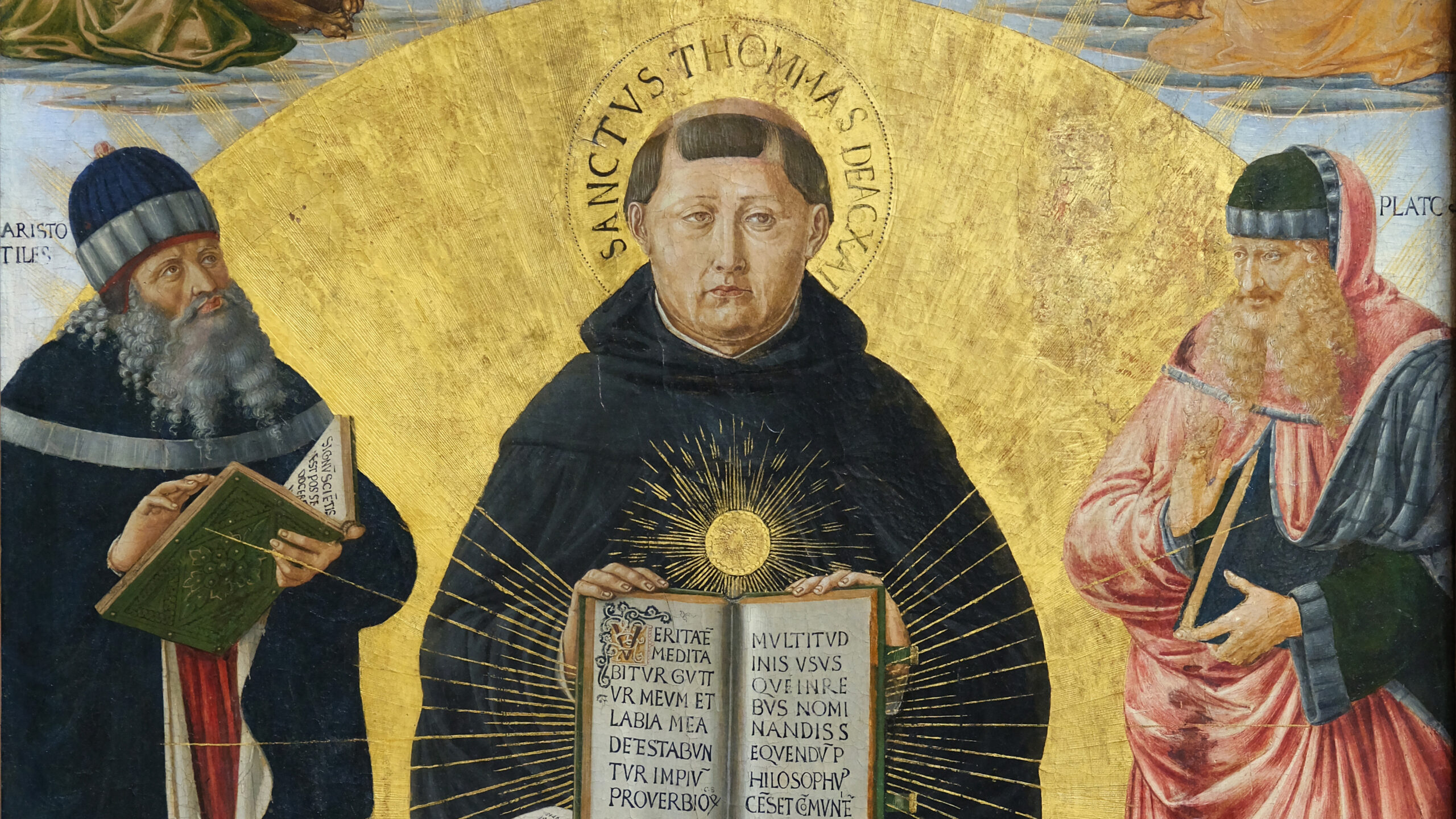
When I was in Calvinist seminary, multiple courses briefly introduced us to ancient Greek thought, such as Plato’s understanding of forms or the influence of Greek philosophical categories on the ancient formulation of the Trinity. As a young Presbyterian eager to defend the teachings of what we often termed “historic Christianity,” I was grateful to know there was some philosophical connection to our theology, though I couldn’t help but wonder: What makes the Greeks right? Is the Christian importation of Greek philosophy into its theology a good thing?
Louis Markos, Houston Christian University professor of English, aims to answer these types of questions in From Aristotle to Christ: How Aristotelian Thought Clarified the Christian Faith, a sequel to his earlier book From Plato to Christ: How Platonic Thought Shaped the Christian Faith. From Aristotle to Christ explores the influence of “the philosopher,” as Aquinas called him, across a variety of Christian themes, cleverly structured in sections on the true (logic), the good (virtue), and the beautiful (the arts). As an introductory guide to the intersection between Aristotle and Christ, it is accessible, fascinating, and highly relevant to contemporary debates. Nevertheless, despite Markos’s respect and appreciation for Aristotelian thought, by the end my question still lingered: How do Protestants evaluate if and when Greek philosophical influence is beneficial or detrimental to Christian belief and praxis?
Certainly Markos, a self-identifying Platonist, has many positive things to say about the “overwhelming genius of Plato’s greatest student” and the “essential contributions he made to Western and Christian philosophy and theology, ethics and political science, psychology and sociology, cosmology and aesthetics.” Though Luther and Calvin had less than commendable things to say about Aristotle—reflecting a general antipathy toward a scholastic tradition they viewed as enigmatic and superstitious—Markos observes that the early Reformers were decidedly standing in the tradition of Aristotelian logic, ethics, and political theory.
We also have Aristotle to thank for his explanation of syllogistic thought, hylomorphism, and contingency.
For example, the so-called philosopher of common sense in his Metaphysics is responsible for articulating the law of non-contradiction, a principle that is foundational to logic. There he writes: “If all are alike both wrong and right, one who is in this condition will not be able either to speak or to say anything intelligible; for he says at the same time both ‘yes’ and ‘no.’ And if he makes no judgment but ‘thinks’ and ‘does not think,’ indifferently, what difference will there be between him and a vegetable?” We also have Aristotle to thank for his explanation of syllogistic thought, hylomorphism (the idea that the soul and body are intrinsically linked), and contingency (the idea that some things rely on others for their existence).
Markos effectively links these ancient Aristotelian concepts to Christian thinkers across the tradition, be it Augustine, Aquinas, Chaucer, Dante, C. S. Lewis, or Dorothy Sayers. He also notes that modern science as we know it could not have arisen without the Aristotelian conclusion that the objects, patterns, and motions we observe are directly correlated to the evidence of our senses, and thus make all theorizing regarding scientific principles and laws possible. Moreover, secular critics of Christianity “often dismiss the deductive claims and conclusions of Christian thinkers because they rely on premises or principles or assumptions that are not provable by empirical, inductive means,” failing to recognize that modern science also presumes deductive claims.
We also owe Aristotle thanks for his explanation of the four causes: material, formal, efficient, and final. For it is upon these causes that Aristotle (and later Christian thinkers such as Aquinas), articulated logical proofs for the existence of God. In his Metaphysics, for example, Aristotle describes the reality of an unmoved mover, one who is responsible for setting the universe in motion. By extension, the concept of God as pure act also derives from Aristotle: “one actuality always preceding another in time right back to the actuality of the eternal prime mover.” It is upon such thinking that Aquinas in turn argues for the existence of God based on efficient causality: “If there be no first cause among efficient causes, there will be no ultimate, nor any intermediate, cause.”
Nevertheless, Markos is not entirely sanguine regarding this Christian philosophical appropriation of Aristotle, which, he posits, “threaten[s] to place on the cosmic throne a static, passive, inert God who is uninvolved and uninterested in the actions and decisions of his creatures.” He continues: “By positioning God as the necessary endpoint of a series of logical deductions, Aristotle established a dangerous precedent by which God is reduced to the solution of an intellectual riddle—one in which his only job is to start things going.” Thus is Aristotle supposedly unintentionally responsible for deism. Yet the reasoning here seems inadequate: Because Enlightenment deists rely on Aristotelian principles for their error, “the philosopher” is to blame? One might as well blame the Bible for slavery and genocide.
In his section on virtue, Markos explains how Aristotelian concepts such as the golden mean (that the ideal human behavior is between two extremes), that volition matters when evaluating man’s conduct, and the excellences of friendship all informed Christian thinking, including that of C. S. Lewis in texts such as Mere Christianity and The Four Loves. Aristotle’s discussion of property rights even features a proto-doctrine of original sin, because, as he writes, conflicts over property “are due to a very different cause—the wickedness of human nature.”
Aristotle also argued that contemplation is the highest and happiest form of life because “objects of reason are the best of knowable objects” and because “we can contemplate truth more continuously than we can do anything.” This seems an obvious precursor to the beatific vision. His teaching that “the activity of God, which surpasses all others in blessedness, must be contemplative; and of human activities, therefore, that which is most akin to this must be most of the nature of happiness” in turns seem to justify the Christian elevation of the contemplative life.
Yet Markos has criticisms of Aristotle’s thinking on virtue similar to his criticisms on logic. For example, Aristotle’s conception of the ideal man led him to assert, “Those who say that the victim on the rack or the man who falls into great misfortunes is happy if he is good, are, whether they mean to or not, talking nonsense.” This, of course, is at odds with Christian thinking regarding Christ and the cross, but given Aristotle lacked access to divine revelation, faulting him for failing to anticipate this paradox is a bit like criticizing someone who logically deduces monotheism (which is possible) for not also logically deducing the Trinity (which is not).
The section on political philosophy persuasively demonstrates how a line can be drawn from Aristotle to the framers of the Constitution.
The section on political philosophy—touching such luminaries as Aquinas, Hooker, Hobbes, Locke, Montesquieu, Burke, Tocqueville, Hamilton, Madison—persuasively demonstrates how a line can be drawn from Aristotle to the framers of the Constitution. For example, Aristotle’s teaching on written and customary laws—and the use of reason and logic, distrust in human lust and passion—influenced Hooker’s Laws of Ecclesiastical Polity and Rutherford’s Lex, Rex, and by extension the founding fathers, especially Madison in The Federalist Papers.
However, Markos then claims that the Protestant doctrine of sola scriptura results in a more rational political paradigm than that informed by the Catholic view of religious authority encompassing Scripture, Tradition, and the magisterium. “Whether in church or state, the Protestant mind has tended, in good Aristotelian fashion, to favor lex over rex, legal over personal, objective over subjective, rational over mystical, deliberation over compulsion,” he contends. Yet without appeal to evidence that the Catholic political tradition disproportionately prioritized the subjective over objective, mystical over rational, or compulsion over deliberation, this amounts to little more than assertion.
Even more mystifying is Markos’s refashioning of an Aristotelian quotation on politics to attack Catholic thinking, writing, “Therefore he who bids the Bible rule may be deemed to bid God and Reason alone rule, but he who bids tradition and church hierarchy rule adds an element of the beast.” Yet the Protestant paradigm cannot help but leverage its own authoritative traditional interpretations of Scripture, nor help granting exegetes a type of interpretive authority that while not claiming to be magisterial, effectively operates as such on “essential doctrines.” Indeed, Markos even implicitly admits as much: “Although the Bible is the eternal Word of God, it had to be written down by inspired authors and collected and authorized by an inspired church.” If, in Markos’s view, the Church was “inspired” to collect and authorize the biblical canon, what is the Protestant means of determining when the Church has this power?
The book ends by honoring Aristotle’s contribution to rhetoric—which Markos describes as effectively employed by such early Church figures as St. Paul and the martyr St. Polycarp—as well as to Western poetry and drama. It’s true: One cannot help but acknowledge Markos has well proven the point that Aristotle, like few other ancients, has left an indelible mark on the Christian tradition. Yet according to what criteria does the Protestant affirm this as authentically good?
Markos periodically hints at it when he speaks of what is “biblical,” which means many different things to many different Protestants. What to one Protestant is a doctrinally biblical conception of God, salvation, or sexual ethics is to another heresy, as recent fissures within Methodism or the Southern Baptist Convention demonstrate. In the Protestant paradigm, all beliefs and practices are evaluated according to Scripture, but the “who” doing the interpretation of Scripture—and how to appropriate (or ignore) extrabiblical sources—is ultimately the individual Christian.
Without an objective, external authority to determine the Bible’s true meaning, and how various philosophical systems might align or depart from it, Christian appropriation of Aristotle (or any Greek thought for that matter) seems subjective and ad hoc. Why Aristotle’s hylomorphism or causality, and not something else? Why three hypostases and one ousia to describe the Godhead, as did the Nicene fathers, and not some other formulation? The answer, at least to the Protestant mind, remains obscure.