
When Amy Coney Barrett was nominated as a federal judge for the Seventh Court of Appeals, she was grilled by the Senate Judiciary Committee, as nominees are required. During those meetings, one member of the committee, the late Dianne Feinstein of California, committed a serious constitutional faux pas. At one point she expressed her concern about Barrett’s Catholicism, saying, “The dogma lives loudly within you, and that is of concern . . .” This was a clumsy, euphemistic way of saying, “I am afraid you are too religious for this job.”
Feinstein was roundly criticized not only by Republicans but also by her fellow Democrats because Article VI, Clause 3 of the US Constitution prohibits a “religious test” for public office. This clause was added due to concerns about religious persecution and test acts in England and the colonies. It was included to ensure that religious belief (or lack thereof) cannot be a barrier to public office. The prohibition, the last clause of Article VI, reads,
the Senators and Representatives before mentioned, and the members of the several state legislatures, and all executive and judicial officers, both of the United States and of the several states, shall be bound by oath or affirmation, to support this Constitution; but no religious test shall ever be required as a qualification to any office or public trust under the United States.
The infamous Feinstein episode had two ironic consequences: First, for the most part, it made Barrett’s religious devotion off limits when she later went back before the Senate Judiciary Committee after her nomination to the Supreme Court. Second, it kicked off a cottage industry of merchandise that read “The Dogma Lives Loudly Within Me.” With that behind her, Barrett became a Justice in October 2022, although the formal investiture ceremony was delayed almost a year due to COVID.
Justices as Authors
There is a growing genre of books written by Supreme Court justices, which fall into a couple of categories. Some are primarily personal memoirs, including Clarence Thomas’s reflection My Grandfather’s Son: A Memoir (2008), Ketanji Jackson’s recent Lovely One: A Memoir (2024), and Sonia Sotomayor’s autobiography, My Beloved World (2013).
Other books are more thematic in focus. The colorful William O. Douglas wrote over thirty books—most, if not all, while he served on the Supreme Court. They tend to address his concerns about libertarianism, civil rights, and conservationism. A more recent example is Justice Neil Gorsuch’s Overruled: The Human Toll of Too Much Law (2024).

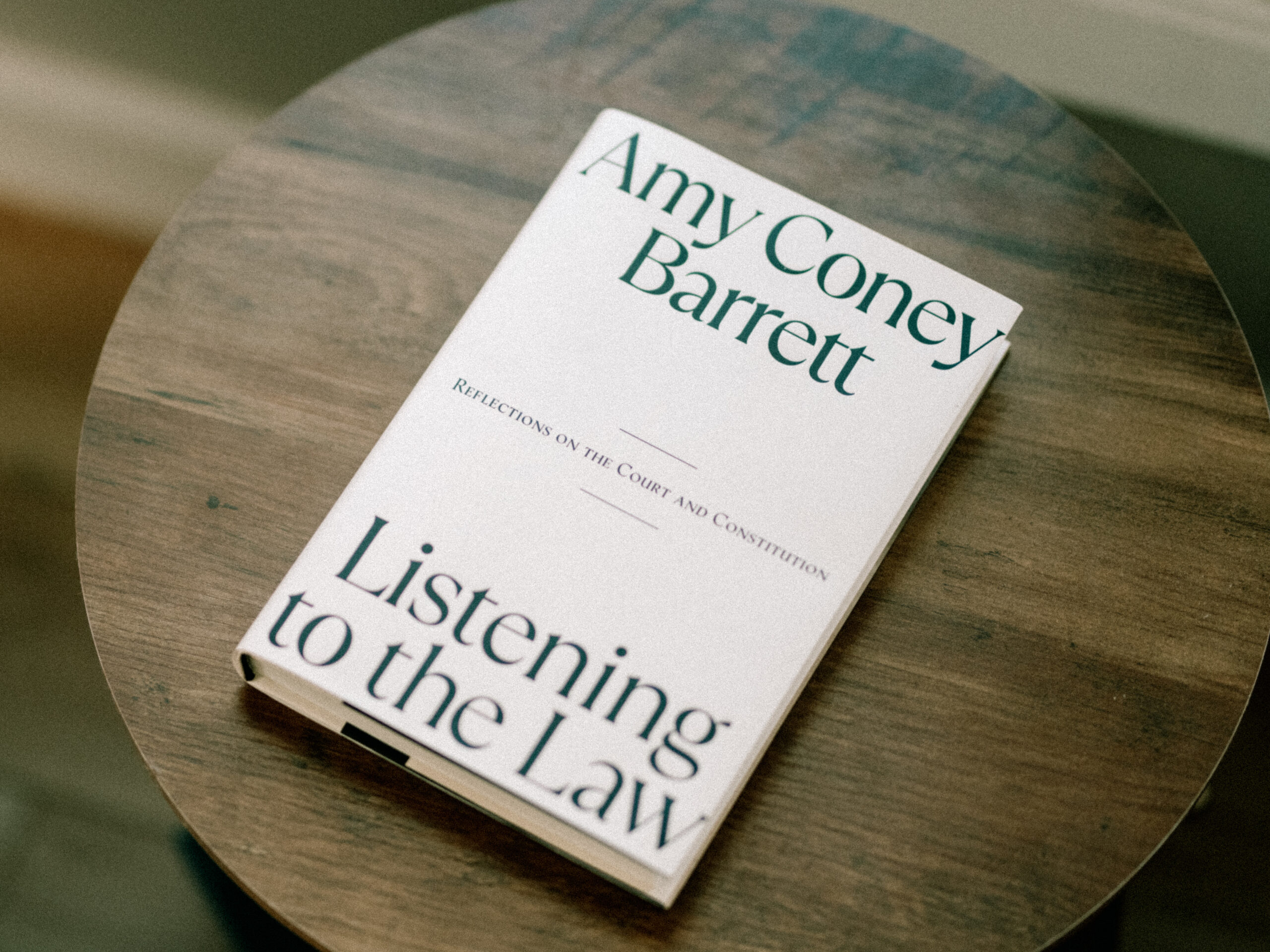
Justice Barrett introduces her book Listening to the Law: Reflections on the Court and Constitution (2025) explaining that, unlike her academic writing, she endeavors to offer something more accessible to the general public. She writes, “While I have produced much academic writing over the course of my career,” this book is written “in the first person . . . at a more accessible level.” For the most part she is successful, although the section on her jurisprudential philosophy is the most challenging. She further explains that she has three goals in mind: “the work of the Court and its justices, the Constitution and its impact, and my own approach to judging.”
The book is organized into three parts that correspond to these objectives. The first, “My Life in the Law,” is the most personal, although Barrett refrains from inviting the reader into her private life—as she should, given the harassment the conservative justices suffered after the Dobbs abortion decision was leaked to the public. Several members of the court had to temporarily move from their neighborhoods, and Justice Kavanaugh was the target of an assassination plot in June 2022. All of that said, Barrett does include useful anecdotes about her grandparents and analogies to her grandmother’s recipes for New Orleans cuisine.
You can take the justice out of the classroom, but you can’t take the classroom out of the justice: From start to finish, Listening to the Law is a pedagogical endeavor. Barrett, formerly a professor of law, wants to teach her readers the court’s history and procedures, and even more, in the second section of her book, the history of the Constitution. Given the sharp disagreements of the court over recent opinions, it is important to Barrett that her readers understand there is a great deal of kindness and consideration among the justices. She reports, moreover, that the court has agreed far more than it has disagreed:
In the 2022 Term, the Court was unanimous in about 47 percent of argued cases. That’s in line with the average rate of unanimity over the last decade, and significantly above the average percentage of unanimity over the last seventy-five years. About another 9 percent were almost unanimous, decided with only a single justice in dissent. So more than half of the cases on the Court’s docket were decided in total or almost total agreement.
She adds that “in the 2023 Term, the Court was unanimous in about 45 percent of argued cases,” which is “in line with the average rate of unanimity over the last decade, and again above the average percentage of unanimity over the last seventy-five years.”
Barrett was fortunate to clerk under Justice Antonin Scalia, and those who admired him are lucky that she did, because she is his rightful heir.
Originalism and Scalia’s Mantle
In part 3, Justice Barrett discusses her judicial philosophy—originalism—which was largely shaped by Justice Antonin Scalia, for whom she clerked from 1998–1999 and whom she identifies as her mentor. Not only did Scalia influence Barrett, he also influenced the jurisprudence of the entire court. In 2010, Justice Elena Kagan admitted, “We are all originalists now,” although some complain that her comment is sometimes overinterpreted. Justice Kagan meant that, due to Scalia, even “non-originalists” must grapple with the Constitution’s original text and history more than they might have before. Barrett notes that while she was Scalia’s clerk, Washingtonian magazine published an article in which the Supreme Court clerks ranked their bosses. Scalia won top place, and the magazine concluded that Scalia’s chambers constituted the “‘intellectual nerve center’ of the Court.”
So, then, what is originalism? Originalism as a legal philosophy insists that the beginning point of constitutional interpretation is to identify and understand the intent of a law or constitutional provision based on its meaning at the time of its passage. This does not mean that the Constitution is an inflexible straitjacket, in which there is only one interpretation of a constitutional passage. Barrett distinguishes between “hard-and-fast rules” and “standards.” The rules are most often clear and can be taken at face value, but the more flexible standards allow for considerations of pragmatism, precedent decisions, and societal evolution. The “brevity” of the Constitution “leaves most matters to be worked out through the democratic process, which responds more easily to change,” although this limitation may not always be accepted by every member of the court. Justice Barrett explains that some justices may at times be guilty of “over-reading” the Constitution to achieve their desired conclusions.
Barrett admits that although “it may sound counterintuitive . . . making judgments about what the law requires isn’t always the same thing as deciding what is just.” For example, she is morally opposed to the death penalty, but it is clearly authorized by the Constitution so that, in general, ruling against it contradicts the Constitution—unless the Constitution were amended so as to exclude capital punishment. Originalism further means that, as Barrett explains, the oath she swore in her investiture is “a promise to leave personal preferences and biases at the courthouse door. The guiding principle in every case is what the law requires, not what aligns with the judge’s own concept of justice.”
“If our fissures run so deep that constitutional change isn’t possible—then the fault lies with us, not the Constitution.”
Barrett was fortunate to clerk under Justice Antonin Scalia, and those who admired him are lucky that she did, because she is his rightful heir. Justice Clarence Thomas might have assumed that role, but given his uncompromising approach to jurisprudence, he is easier for some to dismiss, and fewer justices are willing to sign on to his opinions. Accordingly, the next decade and beyond should demonstrate that Scalia’s mantle has fallen to Barrett.
The Court, Religion, and Us
In response to Feinstein’s concern about Barrett’s Catholic commitment, Barrett responded,
If you’re asking whether I take my faith seriously and I’m a faithful Catholic, I am—although I would stress that my personal church affiliation or my religious belief would not bear in the discharge of my duties as a judge.
Feinstein’s regrettable comment was even more inappropriate when we consider that out of nine justices, there are currently six Roman Catholics on the Supreme Court. Even Neil Gorsuch was baptized and confirmed in the Catholic Church, though he began attending Episcopalian services about fifteen years ago with family members. A friend has opined that Gorsuch “identifies as a Catholic who happens to worship in the Episcopal Church.” CNN reports, “Rosie Binge, Gorsuch’s aunt and godmother said her family was surprised to see media reports calling her nephew an Episcopalian. ‘I think once you’re a Catholic, you’re always a Catholic,’ she said.” Ketanji Jackson identifies as a nondenominational Protestant who has been involved with the Presbyterian Church, and Elena Kagan was raised a practicing Jew and attends the synagogue now. There are no nonreligious justices.
Barring the unexpected, Barrett will occupy her role for many years to come. That is significant, not only because of her jurisprudence but also because of her work ethic. In the three years she has served as a judge on the Seventh Circuit, she participated in hundreds of decisions and wrote the majority opinion in at least a hundred cases. She warns, however, that a divided society cannot be united by the Supreme Court. That is not the role of the institution:
Making laws, constitutional or otherwise, requires working with others to find common ground; it demands the ability to compromise and persuade. If Americans aren’t up to that task—if our fissures run so deep that constitutional change isn’t possible—then the fault lies with us, not the Constitution.