
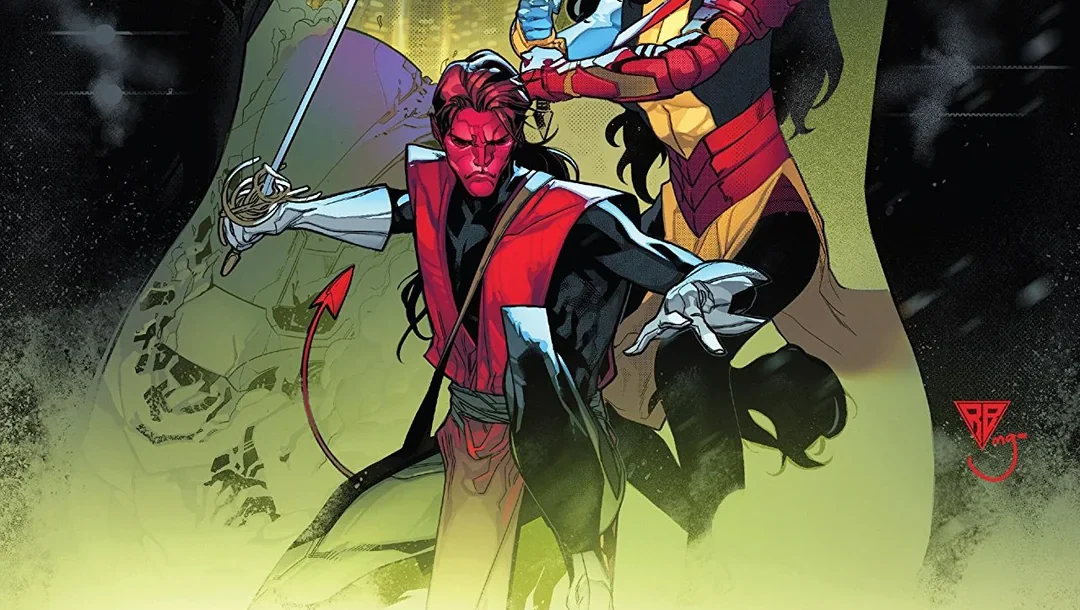
X-Men is one of the most iconic and enduring comics of all time. The series was created by the legendary Stan Lee and Jack Kirby for Marvel Comics and has become a major cultural force in the modern era, spawning countless comic book spin-offs, animated television series, and film franchises. Yet behind the colorful costumes, extraordinary powers, and weird and wonderful characters lies a sustained exploration into prejudice, alienation, identity, friendship, and faith. One of the franchise’s most fascinating characters is Kurt Wagner, the blue-skinned, demonic-looking mutant known as Nightcrawler. Beneath his fierce exterior is a character of Christian faith who inspires those around him to see the world through “different eyes”—a paradox that places him at the heart of the X-Men’s most enduring questions about humanity, otherness, suffering and the nature of the soul.
Stan Lee created the X-Men in 1963. Rather than creating individual origin stories, Lee conceived of mutants—individuals born with genetic mutations that gave them extraordinary powers. Nightcrawler was created by artist Dave Cockrum and debuted in Giant-size X-Men #1 (1975). Nightcrawler, or Kurt Wagner, is blue-skinned with yellow eyes, pointed ears, long fangs, a prehensile tail, and the power of teleportation. Unlike characters like Rogue or even Wolverine, who could conceal their mutant powers from human society, Nightcrawler cannot hide his appearance. He is forced to confront the fear and prejudice of humanity in a direct and personal way. Yet he never retreats into hatred or bitterness against his persecutors; rather, he responds with compassion, humility, and forgiveness, guided by his Catholic convictions.
Nightcrawler’s faith thereby provides a striking contrast to his outward appearance and his swashbuckling, musketeer-like persona. Writer Chris Claremont recognized something paradoxical at the heart of Kurt Wagner:
For all his extreme physiognomy, he’s one of the most human and decent members of the team. In many ways, he’s the emotional/spiritual center of the group.
In this respect, the character recalls Victor Hugo’s The Hunchback of Notre Dame (1831) or David Lynch’s depiction of Joseph Merrick in The Elephant Man (1980). Like Quasimodo and Merrick, Nightcrawler challenges society’s tendencies to judge based on outward appearances; what appears monstrous does not diminish the God-given dignity of the person, and beneath a frightening exterior may be extraordinary beauty.
He never retreats into hatred or bitterness against his persecutors; rather, he responds with compassion, humility, and forgiveness, guided by his Catholic convictions.
The story of Kurt Wagner is one of abandonment, ostracization, and courage in the face of prejudice—perhaps best remembered in the X-Men Animated Series, season 3, episode 18 (1995). The episode’s writer, Len Uhley, described it in his estimation as “the first mainstream cartoon that dealt with issues of faith.”
The episode follows Rogue, Gambit, and Wolverine as they travel to the Bavarian Alps, where reports of a “demon” lead them to a Catholic monastery. Wolverine tracks the creature and discovers Kurt Wagner (Nightcrawler). The episode explores Kurt’s tragic past: Abandoned by his mother, Mystique, he is forced to perform as a freakish acrobatic attraction in a traveling circus before fleeing and discovering refuge in the monastery. He finds solace in the community of Catholic monks who judge him not according to his appearance but the beauty of his heart. This provides the foundation for one of the most remarkable explorations of faith in the history of comic book animated television. Wolverine—a cynical, violent, and traumatized anti-hero whose suffering and anger has driven him away from God—confronts Nightcrawler about his Catholic faith, resulting in a remarkable dialogue:
Nightcrawler: Though all people are flawed and struggle with the capacity for sin, none like to be reminded of our shared human weakness. My appearance does not make it easy.
Wolverine: Doesn’t it make you crazy?
Nightcrawler: It did once, but then I found peace by devoting my life to God. He directed me to this place where they value the character of my heart, not my appearance.
Wolverine: What are you talking about? God gave up on us long ago!
Nightcrawler: No, my friend, God does not give up on his children—human or mutant. He is there for us in our times of joy and to help us when we are in pain—if we let Him. . . . We are alike, you and I—angry at the world. My pain drives me to seek God, yours drove you away.
Wolverine (pops his claws out): Don’t tell me about God! What kind of God would let men do this to me?
Nightcrawler: Our ability to understand God’s purpose is limited. But we take comfort in the fact that His love is limitless!
Wolverine (sheathes claws): I used to buy into all of that. But I’ve lived too long and done too much.
Nightcrawler: Life will always be hard. I understand this better than most. Yet, despite it all, people of every faith believe there is a God who loves them. Can so many be wrong? Open your heart, Logan. Would it hurt so much to see the world through different eyes?
This dialogue shows the stark contrast between the two characters. Wolverine is unable to reconcile his pain with the existence of a loving and omnipotent God. However, Nightcrawler recognizes that Wolverine’s doubt and cynicism is rooted not simply in intellectual doubt but in lived suffering.
Nightcrawler: Our ability to understand God’s purpose is limited. But we take comfort in the fact that His love is limitless!
Wolverine’s position recalls the classic formulation of the problem of evil articulated by St. Thomas Aquinas in his Summa theologiae:
If, therefore, God existed, there would be no evil discoverable; but there is evil in the world. Therefore God does not exist.
Nightcrawler’s response finds a striking parallel in Aquinas’s answer to this objection, which draws from St. Augustine:
Since God is the highest good, He would not allow any evil to exist in His works, unless His omnipotence and goodness were such as to bring good even out of evil.
Rather than judging Wolverine, Nightcrawler responds with pastoral compassion and understanding. He invites his newly found friend to see with “different eyes” beyond his own pain to recognize that he is a part of God’s broader human family. The exchange presents two radically different responses to suffering, pain, and loneliness; Wolverine’s pain drives him to anger and isolation, while Nightcrawler’s brings him closer to God.
As the episode progresses, one of the monks betrays Nightcrawler and informs the townspeople that a “demon” is living in the monastery. The villagers arrive with pitchforks, blades, and fiery torches. In the fury and chaos, the mob sets the monastery ablaze. Nightcrawler confronts the monk who betrayed him, and rather than seeking revenge, he responds in a Christlike manner with forgiveness and understanding:
It is not for me to judge you, Brother Reinhardt, the question is how will God judge you? Look around you, this is the fruit of your labors, not mine.
It is at this moment that Wolverine begins to see the power of Nightcrawler’s faith. As the monastery’s embers smoke and rise in the sky, Nightcrawler hands Wolverine a Bible, culminating in an extraordinarily profound exchange:
Nightcrawler: Thank you, my friends. Your presence here was a great blessing.
Wolverine: What do you mean, blessing? Look at this place! We blew it!
Nightcrawler: I disagree with you. Brother Reinhard understands his tragic mistake and has repented. The townspeople no longer look at me with fear in their hearts. There was no loss of life. All are reasons to be thankful.
Rogue: What about the monastery?
Nightcrawler: A great tragedy. But it was only stone and mortar. The foundation God has built in our hearts can never be destroyed.
Wolverine: Man, I don’t get you.
Nightcrawler (hands Wolverine a Bible): Here, I’ve marked a few passages you may find rewarding. Remember, Logan, “different eyes.”
The episode’s conclusion echoes the Augustinian principle outlined by Aquinas: Something good can come from evil. In this case, the good culminates in Rogue finding Wolverine alone in a Catholic church. Wolverine is praying and reading from Nightcrawler’s Bible, intoning the words from Isaiah 12:1, “I will give thanks to you, O Lord, for though you were angry with me, your anger turned away, and you comforted me.”

This is a remarkable moment in comic book and animated television history. X-Men: The Animated Series (1992-1997) reached an enormous audience of children and young adults and has since experienced renewed interest through the contemporary reboot X-Men ’97. Here was a mainstream animated series in which a Catholic character spoke openly about God and forgiveness, inspiring its archetypal violent, cynical, and rebellious anti-hero to pray and contemplate redemption—all within a single twenty-minute episode.
Nightcrawler’s Catholicism has remained one of the defining aspects of his character. Throughout his long tenure in the X-Men series, he has consistently been depicted as one of the most compassionate members in the Marvel universe. When writer Chris Claremont returned to X-Men in the early 2000s, he deepened Nightcrawler’s Catholicism by making him a Catholic priest in training. The character also appears prominently in the blockbuster movie X2 (2003), where his religious identity is emphasized by the markings on his body. In a memorable exchange with Storm, Nightcrawler observes Storm’s profound anger as she says, “Anger can help one to survive.” He responds simply, “So can faith.”
Nightcrawler has resonated with many comic book lovers for generations. He doesn’t merely pontificate but is an imperfect example in the traditionally secular world of comics of how to live according to the Catholic faith. His faith doesn’t exempt him from suffering but rather provides a way to endure it with dignity and hope. And there lies the fundamental paradox of Kurt Wagner/Nightcrawler: That which appears the most demonic is the most Christlike.
Perhaps Nightcrawler’s story offers an analogy for the experience of Christians living in an increasingly secular and atheistic world. Like him, Catholics may find themselves misunderstood, misrepresented, and even ridiculed for their beliefs. The outward signs of Catholicism can make religious conviction visible in a culture that may be hostile or dismissive of it. Like Nightcrawler, Catholics have a responsibility to meet negativity with love, forgiveness, and dignity.
The X-Men are a chosen family united to nurture, educate, and protect one another in the face of the evil they experience in the world, with Nightcrawler being an intrinsic member in that community of mutants, exiles, and rejects. He is a character in the lineage of Quasimodo, the Elephant Man, and in a more profound sense, he recalls the lepers and outsiders encountered by Christ in the Gospels whom society considered unclean and excluded. In contrast to contemporary secular culture where people are often judged and evaluated by their outward appearance, Nightcrawler reminds us to see the world through “different eyes” and view human worth as endowed by God and the contents of their heart.