
“I just can’t see it all!”
People nearby looked at me strangely. Why wouldn’t they? Arching my back in an impossibly contortionist style and staring vertiginously into the heavens, my words spilled out in groans. But try as I might, from the structure’s vast footings, I just couldn’t quite capture the entirety of this majestic cathedral. Cologne Cathedral was simply too tall. Straightening up and looking around, I saw a long-haired street artist masterfully chalking a portrait of the Virgin Mary on the stone parvis. Tourists sporting their windbreakers and fanny packs milled about snapping pictures. And an oversized photo board boasted a World War II–era aerial shot with the cathedral’s defiant spires jousting the air while everything around them was reduced to ashen wreckage.
There was no mistaking it: Everyone was here for the cathedral.
I don’t know when I first fell in love with architecture, but it must have been that visit. Traveling throughout Europe on a college choir tour, we sang in some of the most soaring and sublime venues: Cologne Cathedral, Notre-Dame, Chartres, and the Basilica of the Sacred Heart of Montmartre, among others. It was otherworldly. Singing in Cologne Cathedral, an architectural wonder that took 632 years to build. Harmonizing in Notre-Dame, where the music of liturgical masters reverberated off its limestone walls for centuries. Vocalizing in Chartres, bathed softly in the light of the rose windows.
With their enormous pillars and mathematically precise arches, flying buttresses and tiled labyrinths, soaring spires and bellowing bell towers, ornate facades and brilliant windows, these cathedrals are more than sublime—they are a reminder of our Christian story: The Lord became incarnate; the Lord died on a cross; the Lord rose from the dead . . . for you. And as the bells would toll, they cried, “Come to Mass. Partake in the sacraments. Worship your Lord. Ease your mind. Be free. Be free.”
In those moments, I became Catholic. And I didn’t even know it.
These cathedrals are more than sublime—they are a reminder of our Christian story . . .
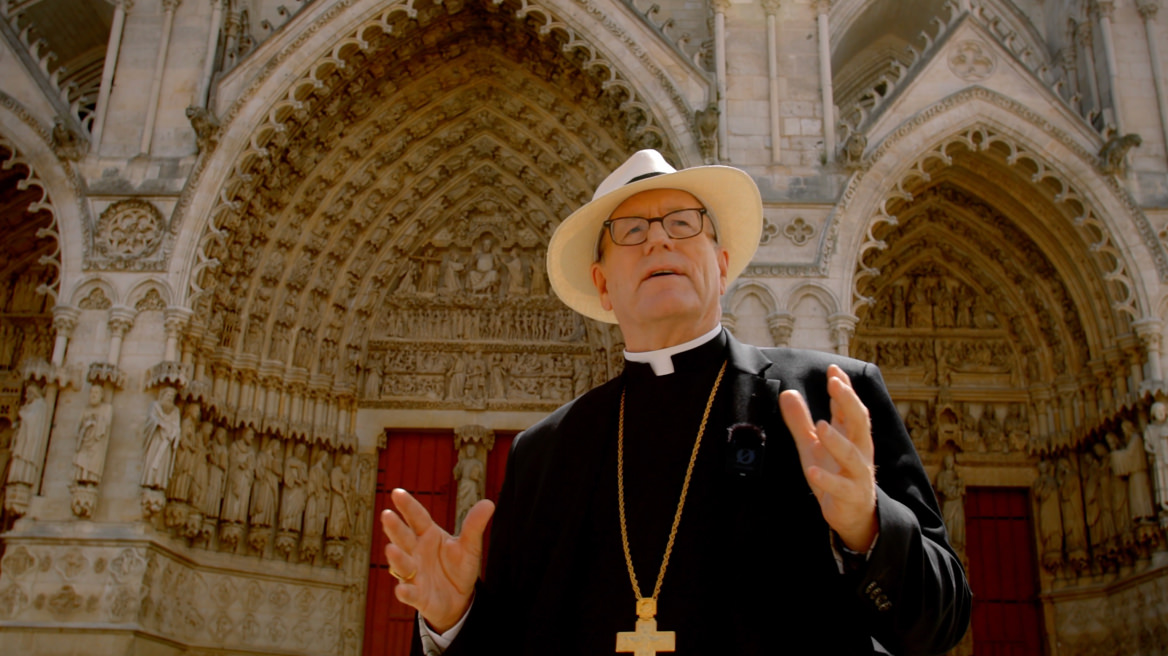
Bishop Robert Barron’s incomparable Heaven in Stone and Glass brings all of this back in sharp relief. This film is a tale of formation. But not the formation you expect. To be sure, the consuming fire at Notre-Dame Cathedral and its rebuilding figure centrally. The designs of Chartres, Notre-Dame, Reims, Amiens, and Saint-Denis are also unfolded. But if one gets caught up in the story of architecture—the very formation of stone and glass and marble—one might miss the greater story: the formation of the soul. For this film is about how you and I are formed by the beautiful. Namely, it is a film about how we are formed by timeless cathedrals and their ornate artistry that tells the story, offers the Mass, and houses the parishioners against the buffeting winds of fear and worry, war and revolution, pain and sickness, and the darkness of death.
It is one thing to say that the cathedrals are beautiful, for they are. Ask your favorite architect to tour with you, and you will marvel at the mathematical achievements. Invite your trusted museum docent to unpack the paintings and windows, sculptures and statuary, and you will wonder with an artist’s appreciation. A cathedral is more than beautiful. It is holy. Enlivened by the Eucharist, edified by the sacraments, breathing with the Body of Christ, and pregnant with missionary zeal, it is what the cathedral offers that exceeds what the cathedral is.
It is not simply stone and glass.
It is heaven in stone and glass.
In his timeless work, Orthodoxy, G. K. Chesterton captured this point brilliantly:
Christ prophesied the whole of Gothic architecture in that hour when nervous and respectable people. . . objected to the shouting of the gutter-snipes of Jerusalem. He said, “If these were silent, the very stones would cry out.” Under the impulse of His spirit arose like a clamorous chorus the facades of the mediaeval cathedrals, thronged with shouting faces and open mouths. The prophecy has fulfilled itself: the very stones cry out.
Next year, I will return to Europe over three decades after my first visit. And when I do, thanks to Bishop Barron’s exquisite film, I will see the cathedrals once again, but I will also see them anew. Once again, I’ll stand at the footings, arch my back (embarrassing my daughters), and groan, “I just can’t see it all!”
With heaven in this stone and glass, will we ever?