
A recent front-page story in The Wall Street Journal noted many people’s adverse reactions to having their name used in conversation, describing the tactic as manipulative, aggressive, and phony. Repeated name use, far from sounding sincere, often comes across as a shallow sales tactic. In his 1936 bestseller, How to Win Friends and Influence People, Dale Carnegie wrote that “a person’s name is to that person the sweetest and most important sound in any language.” He offers the anecdote of an office cafeteria worker who was all but invisible to the many employees passing through. She made the same sandwiches every day, monotonously and unhappily. One day a particular employee addressed her by name. Her face got brighter and his sandwich got bigger.
The advice seems to be a matter of simple courtesy, acknowledging an often overlooked personal dignity. The utilitarian assessment of many people quoted in the recent article, though, would likely not surprise Mr. Carnegie, whose advice on using names appears in a section titled “Six Ways to Make People Like You.” The merits or defects of using someone’s name, to close a deal or get a few extra sandwich slices, points to a deeper question about the significance of names. In social, political, and religious contexts, calling someone by name bespeaks, ironically, both authority and intimacy.
The use of someone’s name, either giving it or using it, expresses a power dynamic in a relationship beyond what either party may wish or intend.
In the first place, names are powerful. If knowledge is power, then knowing someone’s name gives leverage over and a claim upon that person. Certain fairy tales convey this, often as a challenge laid down by the one whose name is yet unknown. Rumpelstiltskin makes the discovery of his name the condition upon which he will return to the queen the child that she had promised him. In Puccini’s Turandot, the Prince tells the title character that if she can guess his name by sunrise, he will surrender not only his claim to her hand in marriage but his very life as well. (The dramatic wait through the night hours occasions the most famous aria in all of opera, “Nessun dorma.”)
Those terms, however, are self-imposed. The use of someone’s name, either giving it or using it, expresses a power dynamic in a relationship beyond what either party may wish or intend. It is because God gave Adam dominion over all the creatures on earth that Adam has the right and ability to name them. Likewise, God has the right to name, or rename, his own creatures, whether giving Abram the greater (longer) name of Abraham or stating that Simon shall henceforth be known as Cephas, or Peter. Jesus also assigned nicknames to the two other apostles who made up his inner circle, “James the son of Zebedee and John the brother of James, whom he surnamed Boanerges, that is, sons of thunder” (Mark 3:17). Such naming rights are not limited to divine authority. Parents share in God’s creative power by conceiving children, and they share in his authority by naming them. There are few decisions parents make that will impact a child more regularly than choosing a name, as it becomes early and deeply embedded in the child’s psyche. People can pick out the sound of their own name over the din of a crowd, and studies have shown that hearing one’s name releases endorphins. It feels good to be known.

The power differential plays out in the civic sphere as well. One of the more well-known examples in modern politics is former President George W. Bush’s penchant for assigning nicknames. (The casual accolade, “Brownie, you’re doing a heck of a job,” became a particularly regrettable line.) Bush’s appellations may have been terms of endearment, but they were even more so an expression of his authority. He could assign nicknames to those who worked for and reported to him; they could not do the same to him in return.
The role that authority plays in naming human persons applies to angelic persons as well. There was a fad in popular piety some years ago to name one’s guardian angel either by trying to discover the angel’s given name or simply assigning one. In the former scenario, the practice has a ring of Gnosticism to it, claiming access to knowledge that has not, in fact, been revealed. Angels already have names given by God. Some of these names he has made known to us—three, to be precise (Michael, Gabriel, and Raphael)—but the rest he has not. The latter scenario, simply assigning a name, is less spiritually dangerous but even more presumptuous. Angels are not pets. They are creatures with a vastly more powerful intellect and will, and we forget our proper place in the hierarchy of creation when we attempt to arrogate authority over them to ourselves. The Congregation for Divine Worship and the Discipline of the Sacraments issued a Directory on Popular Piety and the Liturgy in 2001, reminding the faithful: “The practice of assigning names to the Holy Angels should be discouraged, except in the cases of Gabriel, Raphael and Michael whose names are contained in Holy Scripture.” The word discouraged seems weak. While the Vatican website does not contain a “typical” (official) Latin text, the words in the Italian and French versions are, respectively, riprovare and réprouver; like the cognate reprove, both verbs mean condemn and carry a heftier weight than discourage.
Learning the demon’s name marks a major breakthrough in an exorcism, as the imprecations to depart now carry more power.
The situation is a bit different when it comes to fallen angels. In the rite of exorcism, the priest addresses the demon and commands it: “You tell me by some sign your name, and the day and hour of your departure.” Learning the demon’s name marks a major breakthrough in an exorcism, as the imprecations to depart now carry more power. We might think in human terms of a parent or teacher reprimanding a disobedient child: When the adult uses the child’s name, the message conveys greater seriousness and the child pays more attention. The demon often resists the command, not wanting to concede that advantage. The process of learning the name of a demon differs in important respects from the supposed discovery of a guardian angel’s name. The exorcist is duly appointed by his bishop and authorized by the Church, observing the legal formalities and hierarchical rights with which the evil one remains obsessed. Moreover, he follows the example of Christ himself, who asks the demons’ name before casting them out.
Thus far we have considered the use of names—bestowing them and using them—as a sign of power and authority that speaks to an imbalance in the relationship: Creator over creatures, man over animals, parents over children, leaders over subordinates. At the same time, though, and perhaps ironically, calling someone by name denotes an intimacy and familiarity. Some of this familiarity is lost in America’s casual culture, where almost everyone is immediately on a first-name basis, but historically, inviting someone to use a first name speaks to a new and closer stage in the relationship. Italians will use the invitation Dammi del tu—to use the familiar tu instead of the formal voi. English lacks the second-person distinction found in many other languages, but it hasn’t always. A common misunderstanding thinks of the antiquated thee and thy as relics of a stuffy, formal means of address. In fact, they were the familiar forms. It was always “Your Majesty” when addressing the king. Quakers, the Society of Friends, use thee in addressing each other, a holdover that denotes the equal status of all members. When we retain those forms in the Our Father and Hail Mary (“hallowed be thy name”; “the Lord is with thee”) we acknowledge the familiarity, the intimacy, that God desires with us. The first step in that relationship comes about by God sharing his own name. In the episode of the burning bush, God reveals himself to Moses as I AM WHO AM, saying, “This is my name for ever, and thus am I to be remembered throughout all generations” (Exod 3:15). The name that God reveals is descriptive: He is existence itself, a pure and necessary being. That name is so holy, however, that it remained unpronounced and unwritten. The Old Testament refers instead to the Lord, a means of avoiding direct address.

The covenantal relationship assumes a new closeness with the incarnation. Certain Fathers of the Church speak of Mary’s virginal womb as a bridal chamber, where God weds himself to the human race. Mankind can now see the human face of God and call him by name. The angel Gabriel revealed that name to Joseph, whose responsibility it was to name the child. “You shall call his name Jesus, for he will save his people from their sins” (Matt 1:21). Similar to YHWH, Jesus’s name is also his essence: He took on our flesh to save us. When Mary and Joseph formally name Jesus on the eighth day of his birth, they upend the power dynamic described above. Here are creatures naming their Creator, who “was obedient to them” (Luke 2:51). The naming of Jesus forms part of his self-emptying, humbly taking on our humanity, and making himself subject to the laws of nature and of man.
The New Testament makes frequent mention of the reverence we owe to the name of God and of the Son of God, from the Magnificat (“Holy is his name,” Luke 1:49) to St. Paul (“At the name of Jesus every knee should bow,” Phil 2:10). A sadly lost custom is bowing the head at the name of Jesus, a gesture that fosters piety and acts as a safeguard against blasphemy. I remember as a young boy in school learning this practice, one that the students assiduously followed. When the class recited the Hail Mary, the name of Jesus induced a collective whiplash. That name has rightly been called the shortest, simplest, and most perfect prayer, for it is the name of God himself. The apostles left us a model in invoking the power of that name in their miracles and countless saints breathed their last with the holy name on their lips.
With his angelic intellect, the devil knows the power of that name more than the many who take it in vain.
No wonder, then, that the devil hates it. While he hates anything divine, the incarnation particularly irks him. That God would condescend to become man, a being much lower in the hierarchy of creation than even the lowest angel, and moreover make that same human nature the means of offering mankind the heavenly life that Lucifer squandered, is a source of endless demonic wrath. It comes as no surprise, then, that the devil trains his trademark inversion and mockery on the incarnational name of Jesus. How satisfying it is to him to hear that name invoked not as a blessing but as a curse. With his angelic intellect, the devil knows the power of that name more than the many who take it in vain.
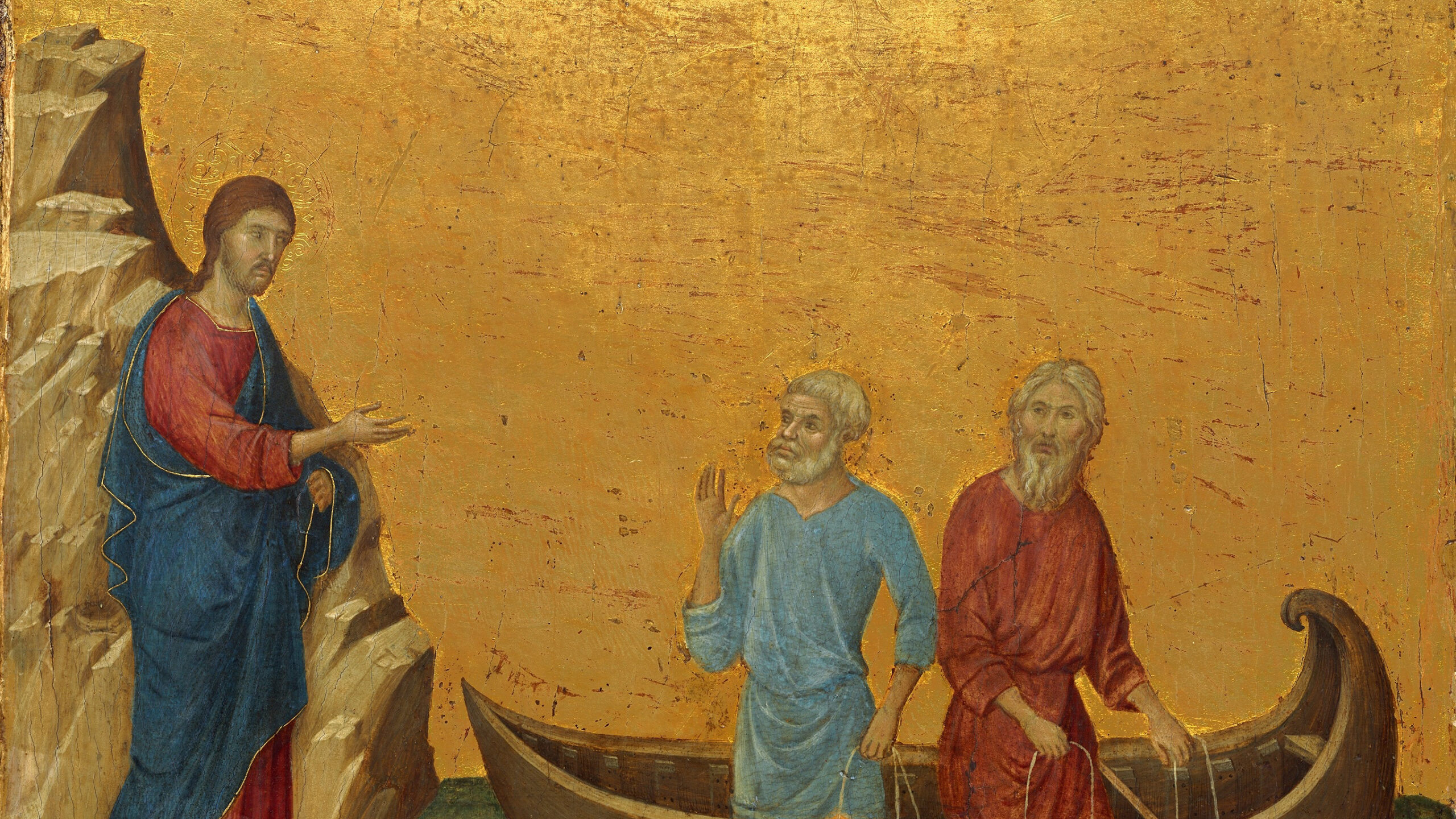
Jesus, however, does not merely allow his own creatures to call him by name. Over the course of his public ministry, he deepens the covenantal closeness by revealing and fostering its reciprocal nature: “He calls his own sheep by name” (John 10:3). That calling by name speaks not to a dynamic of authority, at least in the worldly sense, but to familiarity. Weeping at the empty tomb, Mary Magdalene fails to recognize the risen Christ; it is only when he speaks her name that her eyes are opened. There must have been a resonance to that single word, “Mary,” that made her realize that the one calling her knew and loved her deepest self. It is because of that knowledge and love that Jesus no longer calls his disciples servants, but his friends (John 15:15). That is, he elevates them to a place of equality with himself, an equality in status without which no true friendship can exist. The invitation is shocking, like a king inviting a peasant to dine with him and address him as a peer. Such is the radical effect of divine grace that conforms us to Christ. That divinization, raising us to the plane of equality upon which friendship depends, requires our cooperation. Thus, Jesus lays out the terms: “You are my friends if you do what I command you” (John 15:14). Every relationship is a living thing and requires effort to foster and nourish it. The work needed on our part is what St. Paul describes as dying to the old self and putting on Christ, conforming to him so closely that Jesus sees in each one of us another self, the classic definition of a friend. St. Augustine speaks to this identification when he writes that, in the end, “there will be one Christ loving himself.”
The Christian faith is riddled with paradoxes that it alone can resolve: one and three, God and man, virgin and mother. A similar paradox exists with the dynamics of names. Calling someone by name can be an act of authority or of intimacy, demonstrating a power imbalance or the deep love and equal status of friends. That paradox is uniquely resolved in the person of Jesus Christ, the Almighty God who calls us friends. When Jesus speaks our name, he addresses our true identity, for he knows us better than we know ourselves. It is precisely as an exercise of his divine power that he freely invites us to share in his own identity, as the one who saves us and draws us to himself. In his divine vulnerability, he invites us to call upon his own name and thus takes the first step toward the communion that he desires. This reciprocity reflects the Trinitarian love and mutual indwelling that Jesus wishes to share with us. He calls us by name and extends to us the privilege of returning the favor. In so doing, he initiates a divine dialogue, a conversation he hopes will never end.