
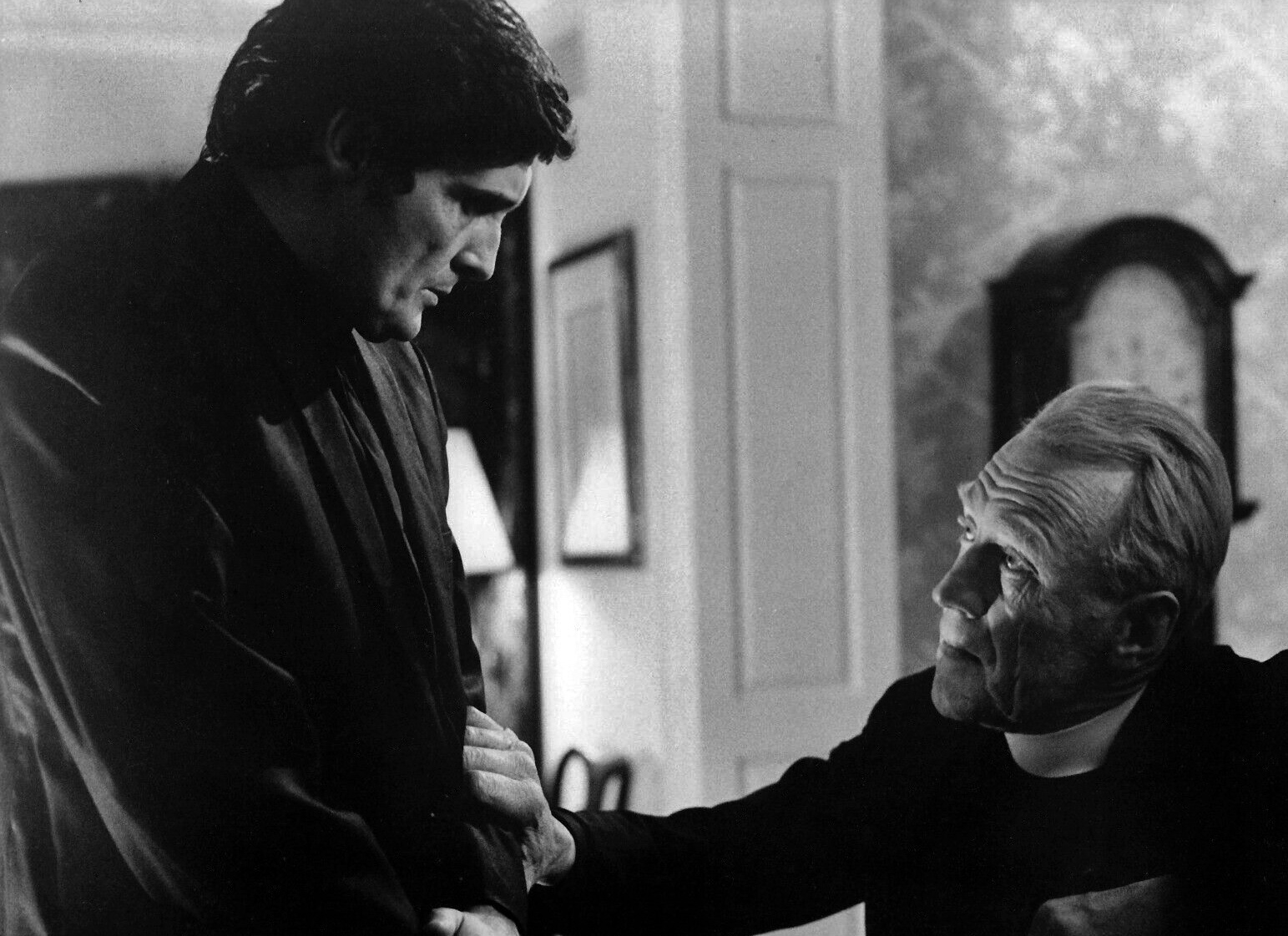
Whether or not one is a fan of horror films, it is likely that many readers are familiar with images and phrases taken from the 1973 film The Exorcist. Regan MacNeil’s head spinning 180 degrees. Exorcists sprinkling holy water and intoning, “The power of Christ compels you!” Projectile pea soup vomit striking a priest squarely in the face. Such scenes have infiltrated—or possessed—the popular imagination. Many of us watched The Exorcist or read William Peter Blatty’s novel in search of an entertaining thrill. In this piece, I would like to propose that beneath the film’s special effects we can find a theological insight—with the help of Jesuit William Lynch—that can serve as a light and a source of hope in trying times.
The climactic scene of the novel The Exorcist and its film adaptation begins when an elderly Jesuit, Fr. Lankester Merrin, arrives at the MacNeil residence to conduct an exorcism on Regan. Assisting Merrin is Fr. Damien Karras, a Harvard-educated psychiatrist who struggles with faith. As they prepare, Merrin offers a sobering insight into their adversary’s strategy:
The demon is a liar. He will lie to confuse us; but he will also mix lies with the truth to attack us. The attack is psychological, Damien. And powerful. Do not listen. Remember that. Do not listen.1
The demonic mixture of truth and lies creates a potent tonic to advance a dark and divisive agenda. This attack exposes and exploits a rift between fact and fiction, truth and falsity, between light and darkness. Any seasoned spiritual director, along with any serious spiritual seeker, knows well this tactic of the one St. Ignatius of Loyola calls the “enemy of our human nature.” Because we are made to be in communion with the Truth, diabolic forces target our ability to trust and to have faith.
As the exorcism proceeds, it appears to have little effect. Fatigued, the two priests take a break from the ritual. This brief pause allows for a theologically rich and spiritually insightful exchange. Fr. Karras asks, “Then what would be the purpose of possession? What’s the point?” The elderly priest, who has faced this demon before, responds.
“Who can know?” answered Merrin. “Who can really hope to know? And yet I think the demon’s target is not the possessed; it is us . . . the observers . . . every person in this house. And I think—I think the point is to make us despair; to reject our own humanity, Damien: to see ourselves as ultimately bestial, vile and putrescent; without dignity; ugly; unworthy. And there lies the heart of it, perhaps: in unworthiness. For I think belief in God is not a matter of reason at all; I think it finally is a matter of love: of accepting the possibility that God could ever love us.”2
Merrin identifies the contents of the demonic cocktail. The truth is that we are fragile and finite creatures. The truth is that we are “wonderfully made” (Psalm 139:14) by a Creator who sustains us even though we are “dust” (Psalm 103:14). Yet the lie, Merrin notes, is that our frailty and contingency is unworthy of love. By degrading and causing the grotesque disintegration of Regan’s body, the demon enkindles doubt amongst observers: If this is what we really are—vile and vulgar creatures—how could anyone, let alone any God, love us?
Because we are made to be in communion with the Truth, diabolic forces target our ability to trust and to have faith.
Merrin continues to counsel Karras in words that should give all of us pause. For Merrin, demonic activity need not be signaled through dramatic sights or sounds. He notes, with sadness:
There it lies, I think, Damien . . . possession; not in wars, as some tend to believe; not so much; and very rarely in extraordinary interventions such as here . . . this girl . . . this poor child. No, I tend to see possession most often in the little things, Damien: in the senseless, petty spites and misunderstandings; the cruel and cutting word that leaps unbidden to the tongue between friends. Between lovers. Between husbands and wives. Enough of these and we have no need of Satan to manage our wars; these we manage for ourselves . . . for ourselves.3
Were Merrin counseling us today, he might include the way we use texts, tweets, and various forms of social media to stoke the fires of resentment and rage against one another. It is true that we are more connected today than ever before in history. Yet, simultaneously, the very means of communication that have the potential of uniting us as a community too often and too easily are turned into instruments of division, mistrust, and despair.
In Images of Hope, Fr. William Lynch offered a compelling description of this diabolical dynamism. Lynch coined the term “absolutizing instinct” to capture “the instinct in human beings that tends to absolutize everything, to make an absolute out of everything it touches.”4 The drive of this instinct is to magnify, to exaggerate, and to make things bigger than they are in reality. For Lynch, the “absolutizing instinct is the father of the hopeless and that special feeling of weight that hopelessness attaches to everything it touches.” John Kane summarizes the absolutizing instinct by defining it as “the deep human tendency to escalate ideas and causes, fears and hopes, into absolute positions and thus into either-or polarizations.”5 Merrin’s glasses may have been clouded by Regan’s vomit, but his spiritual vision was clear. Indeed, I believe his insight into the demon’s ploys—with Lynch’s help—can help us to discern diabolical tendencies in our everyday lives.
The impulse of the absolutizing instinct is to turn a part into the whole. When this occurs, perspective is lost as the part becomes the dominant horizon of one’s imagination. Although this sounds abstract, examples from daily life abound. A politician mutters into a microphone, a celebrity makes an ill-informed post on social media, a college student’s stunt goes awry: Quick condemnations are followed by calls for the person to be “canceled.” An employee receives an overwhelmingly positive review but fixates on one negative comment (teachers, I think, are especially susceptible to this). A weary coach’s anemic “good job” is turned into an indictment of a player’s performance. In the presence of the absolutizing instinct, “each thing loses its true perspective and its true edges. The good becomes the tremendously good, the evil becomes the absolutely evil, the gray becomes the black or white.”6 When aroused, this instinct causes one to lose perspective on the nature of reality. Indeed, I cannot begin to count the number of times in confession when someone will recount a sin of the past they cannot move beyond. The fixation on a part of their life’s story fragments their lives and leads them to fall apart.
The very means of communication that have the potential of uniting us as a community too often and too easily are turned into instruments of division, mistrust, and despair.
In The Exorcist, the demon Pazuzu’s presence disintegrates Regan’s body and sows death and despair. The demon’s tactic, Lynch might observe, is to target the absolutizing imagination and to suggest that Regan’s decaying flesh undermines faith in a good, loving God. For how could a God who loves us, a God who is love (1 John 4:8), allow this to happen to a child? As Merrin notes, the mysterium iniquitatis, or “mystery of evil,” need not manifest itself in such a dramatic manner. Our imaginations are susceptible to the temptation to turn petty slights into unforgivable offenses that lead to hostility and violence. I wonder if, beneath the clamoring cries of social media outrage that pit neighbors against neighbors over trivial matters, we might detect the sinister sound of Pazuzu’s laughter.
The famous line from The Exorcist—“The power of Christ compels you”—is a fitting place to conclude. For Karras, this power compels him to trade his body for Regan’s. With hope extinguished and Regan’s fate sealed, Karras gives flesh to Jesus’s words, “No one has greater love than this, to lay down one’s life for one’s friends” (John 15:13). And once the demon becomes a part of him, Karras throws himself from a window and tumbles down the stairs. Before he dies, a fellow Jesuit arrives and invites Karras to make his confession. When the priest concludes with the final “amen,” Karras dies with a changed countenance:
The eyes were filled with peace; and with something else: something like joy at the end of heart’s longing. The eyes were still staring. But at nothing in this world. Nothing here.7
Perhaps here we see the grace of absolution, the grace that liberates us from the coils of our ancient enemy. In his final moments, Karras seems to have glimpsed the way the various parts of his life were fitted in a story not of his composition but a story in which he had a role to play. For Karras, as for us, the gift of God’s grace does not enable us to see different parts. Instead, God’s grace empowers us to see the parts differently and to imagine how they compose a whole that is not “bestial, vile and putrescent” but one called to be holy and in communion with the Creator and author of all.
1 William Peter Blatty, The Exorcist (Harper & Row, 1971), 332.
2 Blatty, 345.
3 Blatty, 346.
4 William Lynch, Images of Hope: Imagination as Healer of the Hopeless (University of Notre Dame Press, 1965), 105–106.
5 John Kane, Building the Human City: William F. Lynch’s Ignatian Spirituality for Public Life (Pickwick Publications, 2016), 247.
6 Lynch, 106.
7 Blatty, 368.