
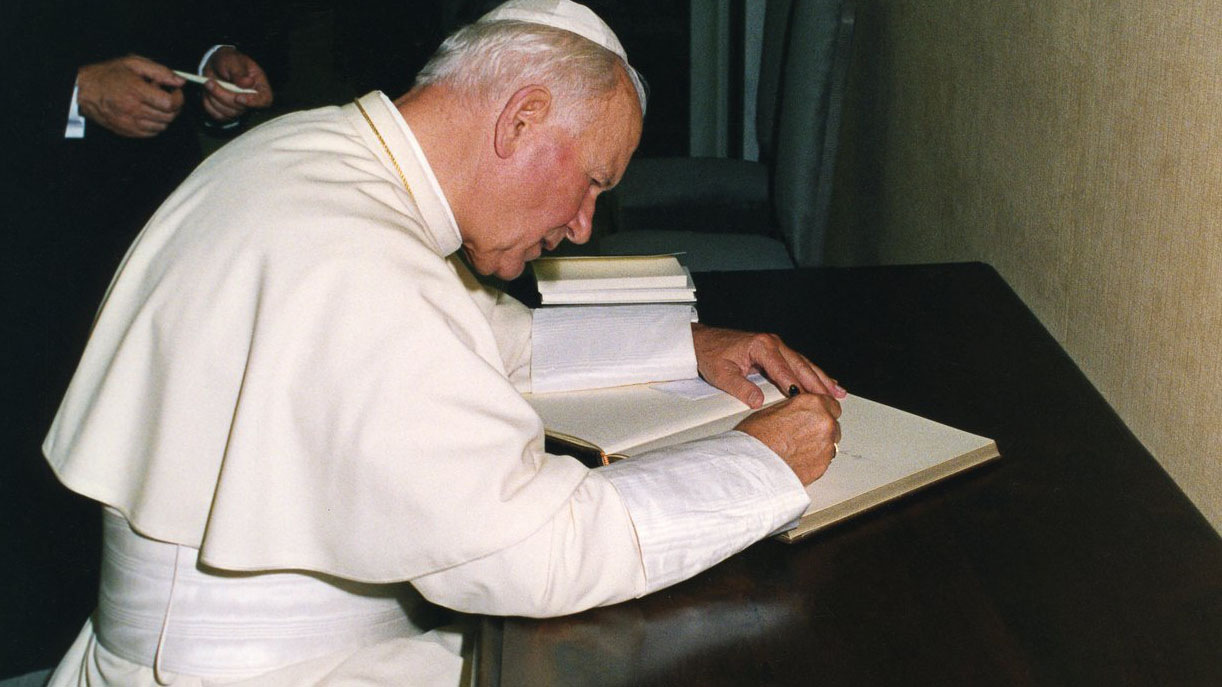
One Easter as a teenager, I received The Place Within: The Poetry of Pope John Paul II. It was probably the most memorable thing I ever found in an Easter basket. Having now spent a number of years with Wojtyła’s poetic voice, I have come to believe his poetry is a largely untapped source of inspiration with the potential to enrich Catholic arts and literature in profound ways.
This is not the first time Pope John Paul II’s poetry has been discussed in this forum. In his October 2022 article “St. John Paul II, the Polish Poet,” Robert Mixa unfolds for readers Wojtyła’s poetic heart and astutely notes, “My concern is that we in the West tend not to associate John Paul II with poetry whereas my experience in talking to Poles who knew John Paul II mostly describe him as an intellectual poet, reading his philosophy and theology as stemming from his poetic heart.”
Why might it be that for all the ways we’ve explored his encyclicals, letters, and even his plays, we have less familiarity with Wojtyła’s poetry?
George Wiegel notes in Witness to Hope that Wojtyła’s poems are difficult in both Polish and English. Jerzy Pietrkiewicz, translator of Wojtyła’s poetry, gives insight as to why this might be in his introduction to Wojtyła’s Collected Poems: “As regards metre [meter], the important thing to remember is that Polish verse is essentially syllabic; English, by contrast, is stressed. But within the Polish metrical system, Wojtyła’s verse is not at all typical. On the contrary, he shows a marked preference for long lines, some of them very long indeed, eighteen or twenty syllables, not common in Polish prosody.”
Add to this a poetic style that speaks with and circles back on itself—looking at an idea, concept, or person from multiple viewpoints—and we can understand why the initial approach to Wojtyła’s poetry might leave a reader scratching his head.
Another reason that the approach to Wojtyła’s poetry has perhaps been a bit slower in the West may be because Wojtyła typically published his poems under a pen name in Polish, and the first English translation of his poetry was about fifty years ago.
Active in the intellectual and artistic life as a priest, particularly in his early priesthood, Wojtyła contributed essays to the Catholic literary and intellectual journals Tygodnik Powszechny (Universal Weekly) and Znak (Sign). And it was to these journals that he also submitted his poetry, usually under the pen name Andrzej Jawień and sometimes Stanisław Andrzej Gruda. Wiegel notes that this was perhaps “to make a distinction between his literary work and his writing on religion, faith, morals, and Church affairs, which were always published under his own name.” Wojtyła also wrote, Wiegel reminds us, during a time of heightened political tension when some bishops disapproved of these journals, and the Communist party kept close watch on them. Weigel adds that Wojtyła “thought he had the right to have his work considered on its own merits, rather than as clerical curiosities.”
Performing Poetry, Meditating on the Word
Wojtyła’s poetic heart found expression not only in written poetry but in poetry expressed theatrically. In Collected Poems, Pietrkiewicz notes that “Wojtyła’s own writing for the theatre favored ‘a many-voiced monologue’ [a term first used by the Polish Romantic poet, Norwid], as if he wished to weld unspoken thoughts to the thoughts already encapsulated in words. A technique of this kind must, by virtue of repetitions or echoes, blur the outlines of direct speech.” Likewise, many of his poems take up a subject like thought or a biblical figure like Simon of Cyrene and examine the multifaceted nature of the subject or person.
Wojtyła’s first direction in life lay in the realms of literature and theater. When he entered college in 1938, he started studying Polish language and literature at the Jagiellonian University. On September 1, 1939, the Nazi invasion of Poland halted his education, so Wojtyła joined actor and theater director Mieczysław Kotlarczyk’s Rhapsodic Theater. As St. John Paul II says in his book Mystery and Gift, this form of theater focused on “the delivery of the poetic text.” Performing poetry was a common choice in this theater group’s repertoire. In a letter written to Kotlarczyk in 1939, Wojtyła expresses his passion for this type of performance: “Being an artist, I am not a sword-wielding man, but I want to build the Polish theatre and poetry, even if for next to nothing, with all my Slavic soul, with all my eagerness and youth, and with my sleeves rolled up.”
The embodied word imparts a life we cannot find from silent reading on the page alone.
How these Rhapsodic Theater performances looked is somewhat hard to imagine. But amazing things have been done with Wojtyła’s plays. The example of a 2025 performance of Wojtyła’s early play, Jeremiah, at the Angelicum gives us some idea. Wojtyła himself wrote about the elements of the Rhapsodic Theater in a 1952 essay entitled “On the Theater of the Word.” We learn that Rhapsodic performances don’t so much tell a story as unfold an idea. One example is Wojtyła’s poetic play, The Jeweler’s Shop, which meditates on the vocation of marriage. (While it contains a narrative, greater room is given to contemplating human love, as a line from Act III shows: “In the Bridegroom’s face each of us finds a similarity to the faces of those with whom love has entangled us on this side of life, of existence. They are all in him.”) Supporting the fact that the spoken word has precedence of place in Rhapsodic Theater, costumes and sets are minimal and movement is dance-like, serving to complement the word. Some parts are spoken collectively as a chorus.
“Reality [Cannot] be Grasped by One Instrument Only”
Theater, for Wojtyła, was one way of interacting with the word and the Word, offering in its embodied performance a particular perspective on reality. Poetry was another. Weigel highlights a point so important to Wojtyła’s worldview: “Reality could not be grasped by one instrument only.” While philosophy certainly has its place, “Literature, in crucial respects, was a more supple instrument for delving into the hidden depths of the human condition.”
One example of this is that in 1960, both Love and Responsibility and The Jeweler’s Shop were published. One is a philosophical and theological exploration of human love; the other, as has been noted, is a play that explores these themes through story. In a similar vein, in 1999, Pope John Paul II released his “Letter to Artists,” which he opens with the following:
None can sense more deeply than you artists, ingenious creators of beauty that you are, something of the pathos with which God at the dawn of creation looked upon the work of his hands. A glimmer of that feeling has shone so often in your eyes when . . . you have admired the work of your inspiration, sensing in it some echo of the mystery of creation with which God, the sole creator of all things, has wished in some way to associate you.”
It is likely that John Paul II wrote this letter on the artistic vocation near the time he himself was in the midst of an artistic endeavor—a return to poetry. Accordingly, in 2003, The Poetry of John Paul II, Roman Triptych: Meditations was published.
Theater, for Wojtyła, was one way of interacting with the word and the Word, offering in its embodied performance a particular perspective on reality.
Though Wojtyła did not write much poetry during his papacy, his love for language and poetic expression did not diminish. As close friend and author of Discovering the Human Person: In Conversation with John Paul II, Stanisław Grygiel, put it, “But only at the end of his life did he return to the ‘great lady,’ as he called poetry. He reproached himself for not having always remained faithful to her. In Roman Triptych, he immersed himself once again in the ‘torrent of beauty,’ to help us join him in contemplating his own Petrine ministry in the Church.”
This collection, in a thematic echo of the “Letter to Artists,” begins with a meditation on Genesis and a poem called “Stream.” A few striking lines from this poem follow:
The running stream cannot marvel,
and silently the woods slope down,
following the rhythm of the stream—
but man can marvel!
The threshold which the world crosses in him
is the threshold of wonderment.
(Once, this very wonder was called “Adam”).He was alone in his wonder,
among creatures incapable of wonder—
for them it is enough to exist and go their way.
Man went his way with them,
filled with wonder!
But being amazed, he always emerged
from the tide that carried him,
as if saying to everything around him:
“Stop—in me is your harbour”,
“in me is the place of meeting
with the Primordial Word”.
“Stop, this passing has meaning . . .
has meaning . . . has meaning”.
Performing Wojtyła’s Poetry
Inspired by Wojtyła’s performance of poetry in the Rhapsodic Theater, I have become convinced that Wojtyła’s poems are also meant to be performed. The embodied word imparts a life we cannot find from silent reading on the page alone.
In 2022 and 2024, I gathered a small group to perform Wojtyła’s poem cycle, “Profiles of a Cyrenean.” Published by Tygodnik Powszechny in 1957, the poem is broken into three distinct parts.
Part I explores the Simon of Cyrene, who is in all men, in each of us. As a line from this part of the poem reads, “I know the Cyrenean’s profile best, / from every conceivable point of view.”
In Part II, different facets of who Simon could have been are explored through fourteen different voices or profiles that range across types of people—“Melancholic,” “Actor,” and “Armaments Factory Worker”—to more abstract inner realities: “Man of Emotion,” “Man of Intellect,” and “Man of Will.” Each voice is occupied with a variation of the same question: “What is my relationship to the cross, to Christ?” “Will I carry the cross?”
Part III presents the moment in which Simon of Cyrene is taken from the crowd to help carry the cross. Wojtyła takes us into Simon’s thoughts as the drama of this scene unfolds. Simon must decide if he will remain mentally distant from the Lord or if he will allow the Lord to touch his mind and heart.
Parts I and III were performed in a reader’s theater-style chorus, whereas Part II was performed by individual actors.
As we performed “Profiles” during Lent, each actor was encouraged to pray into their Part II profile throughout the season, to learn the words by heart, and to bring to the performance the fruit of their prayer. Each participant was invited to choose his or her own costume and to interact with our only prop—a wooden cross—as he or she felt moved. We provided the audience with a preparatory introduction in which we invited them into prayer and meditation, almost as you would the Stations of the Cross. We also provided meditation guides, which contained a line or two from each poem alongside questions to bring to prayer. Knowing that the performance might be difficult for our audience to engage with, we invited them to listen for one particular voice or line that spoke to them. After the performance, we stayed to talk with the audience about what they had witnessed.
Karol Wojtyła’s poetry is an invitation to uncover what the “Word made flesh” looks like in our own creative lives.
These poems ring out with a truth that even today catches me by surprise, and various lines still linger in my thoughts. For example, the Melancholic’s opening line of “I would not carry it [the cross]” and the desire “to be more with Him, / more with Him, not merely with oneself,” resonates deeply with me; while it may be that “our reality is more magnificent than painful,” it also has great burdens from which we’d rather turn away. In the performed word—a word that needs our voices and bodies to enter the world in a comprehensible form—we see, meditate upon, and ultimately, share with others the Word that has inspired our own.
Wojtyła’s Poetic Legacy
As has been pointed out by Anna Kozłowska in her study of Wojtyła’s poetics, in Mystery and Gift, Wojtyła gives us the key to his love for language:
The word before it is ever spoken on the stage, is already present in human history as a fundamental dimension of men’s spiritual experience. Ultimately, the mystery of language brings us back to the inscrutable mystery of God himself. As I came to appreciate the power of the word in my literary and linguistic studies, I inevitably drew closer to the mystery of the Word—that Word of which we speak every day in the Angelus: “And the Word became flesh and dwelt among us” (John 1:14)
Karol Wojtyła’s poetry is an invitation to uncover what the “Word made flesh” looks like in our own creative lives. In a world increasingly given over to the intangible, the technological, and the non-human, Wojtyła’s poetry sparkles with life, involving the whole of us. Through reading his poetry and through prayerful performance of it (which I pray will become more customary in the coming years), we are invited to come close enough to ponder, like Simon of Cyrene, Christ’s closeness: “Who is to say which is which / when the weight knocks us both the ground— / me and him?” We are invited to discover him within us like the woman at the well (the focus of another of Wojtyła’s poem cycles) that “His recognition was different . . . / He saw me in himself, possessed me / in himself.”
Just as the subjects of Wojtyła’s poetry experience the deepening and transformation of perception, we too are called to be changed by the Word. As Rocco Buttiglione highlights in Karol Wojtyła: The Thought of the Man Who Became Pope John Paul II, Wojtyła’s poetry “shows the transformation of hearts, the implacable deepening of authentic personal reality which existence, honestly experienced, imposes.” Through the performance of his poetry, my prayer is that our own eyes, “transfixed more by light than by sorrow,” (to borrow a line from Wojtyła’s poem, “Song of the Brightness of Water”), may be filled by undaunted wonder, that the sorrow that weighs down our world may be met by Christ’s light within us.