
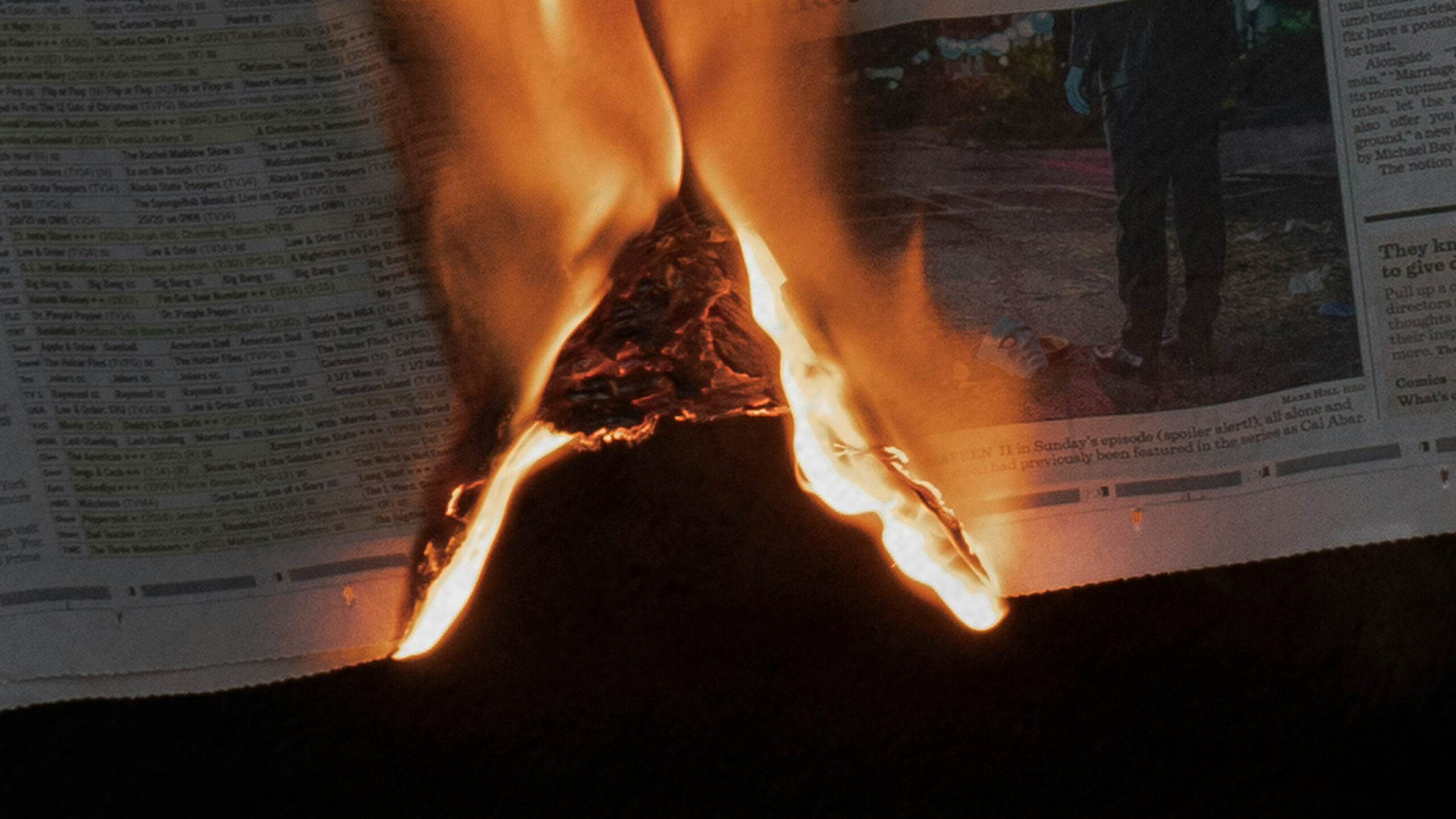
“If you don’t read the newspaper, you are uninformed. If you read the newspaper, you are misinformed.”
—Unknown
“A newspaper is a device for making the ignorant more ignorant and the crazy crazier.”
—H. L. Mencken
When I was a high school student, my father introduced me to Alan Pakula’s film All the President’s Men. A mesmerizing tale starring Robert Redford and Dustin Hoffman as intrepid Washington Post beat reporters Bob Woodward and Carl Bernstein, All the President’s Men unfolds the story of high political crimes unveiled by keen journalistic acumen. While investigating a local Watergate complex break-in, Woodward and Bernstein discover a complicated web of illegal entries, unwarranted wiretaps, and dirty tricks that embroiled a president and the men surrounding him.
Watching this film with the handsome Woodward, wise-cracking Bernstein, mysterious Deep Throat (played by Hal Holbrook), and the lion-like executive editor Ben Bradlee (brilliantly portrayed by Jason Robards) made me fall in love with “the noble press”—that is, the press as watchdog, the press as truth-teller.
In recent days, however, these childhood memories flooded back as news emerged that three hundred (over a third) of the The Washington Post’s journalists had been fired and many sections curtailed (including Sports and Metro) or eliminated (including Books and the Post Reports daily podcast). According to The New York Times, Washington Post executive editor Matt Murray insisted that “the company had lost too much money for too long and had not been meeting readers’ needs.” In the age of the internet and artificial intelligence, being a dominant print media in the twentieth century is no guarantee of untrammeled success in the twenty-first century. “We can’t be all things to all people,” Murray said, “but I think that kind of collaboration and that kind of work across the newsroom is going to continue and will continue to distinguish our journalism.”
Certainly, with the advent of the internet and social media, a sea change of news sourcing has occurred. The legacy media have unquestionably seen their share of readers contract as more people have sought quick bites of information from smaller sources with growing nontraditional platforms.
But I don’t think shifts in the media landscape and the grumbling complaint that “the times they are a-changin’” are entirely satisfactory explanations for the demise of The Washington Post (or other brethren in the legacy media).
As I see it, legacy media aren’t being murdered, they are committing suicide. By stepping away from the time-honored ethic of objective reporting and into the fray of the ideological framing of everything, the legacy media have frustrated, offended, and alienated readers. Thomas Sowell once noted, “The issue is not what various journalists or news organizations’ editorial views are. The issue is the transformation of news reporting into ideological spin, along with self-serving taboos and outright fraud.” Understanding that the human condition will never fully eradicate bias and blind spots, partialities and aversions, most of us have expected that at least journalists, ostensibly trained to give a hard-eyed look at “the facts,” would offer—at a minimum—the pretense (much less the practice) of objectivity.
Perfect objectivity cannot be truly attained. That includes our own. But our best news sources should try.
To be sure, the news media—on all sides—have sacrificed their fundamental commitment to objectivity and become too partisan. Today, Sergeant Joe Friday’s catchphrase, “All we want are the facts, ma’am,” from the classic series Dragnet would only elicit furrowed brows from many modern journalists. Journalism has been transformed from reporting to expounding. “I’m here to change the world,” journalists seem to preen, “not report on the world.” It is one thing if you are a dedicated op-ed journalist paid to vent your spleen; it is quite another if you are bringing the news. Today, bringing the news smacks of what 60 Minutes correspondent Wesley Lowery eerily tweeted in 2020:
American view-from-no-where, “objectivity”-obsessed, both-sides journalism is a failed experiment. We need to fundamentally reset the norms of our field. The old way must go. We need to rebuild our industry as one that operates from a place of moral clarity.
Bringing the news means bringing the news—what happened—with an exquisite discipline not to shade or hammer the facts with your own sense of moral clarity. Subtle violations of this code have forever included title framing, coloring adjectives, first paragraph emphasis, and selectively included/excluded facts. Now, reporting apparently includes unapologetic opinion commentary integrated into a news report. Trying to change the world is not reporting the news: That is crusading. Bringing the news means bringing the news. Period. To do otherwise kills credibility. This turns dismayed people away from the facts and toward their own favorite biased source. “If I’m going to be brainwashed,” consumers seem to sigh, “I might as well be brainwashed by the side with whom I tend to agree.”
We all know those voices we trust. They are those whose angles are quite difficult to discern. You know when you read this paper, watch that channel, or scroll that website, you have that barely conscious feeling making internal corrections for what are known biases in their presentation. And you also know those exceedingly rare sources (often boiled down to a few reporters or a website or two) whom you trust almost implicitly. Again, human bias will never be fully eradicated. Perfect objectivity cannot be truly attained. That includes our own. But our best news sources should try.
The Washington Post, like many pillars of the legacy media, has had its triumphs of reporting and its tragedies of integrity. The “noble press” of my youth is no longer so noble (and, frankly, upon closer analysis, never was). But it shouldn’t be warehoused. It should be reformed, reconstituted, and resurrected. Imagine a major news outlet that swore off partisanship, hired the best thinkers and writers, and went out into the world (instead of lazily consulting Google, AI, or the screed of their favorite source), where they talked with people face-to-face, asked hard questions, and then edited, re-edited, and re-edited again so as to meticulously weed out the slants.
Imagine reporting that vividly, accurately, and fairly told the story.
It might work.
And who knows? It might change the face of journalism for the better.
But only if our newsmen and women raise their standards. And we, the consumers, raise ours as well.