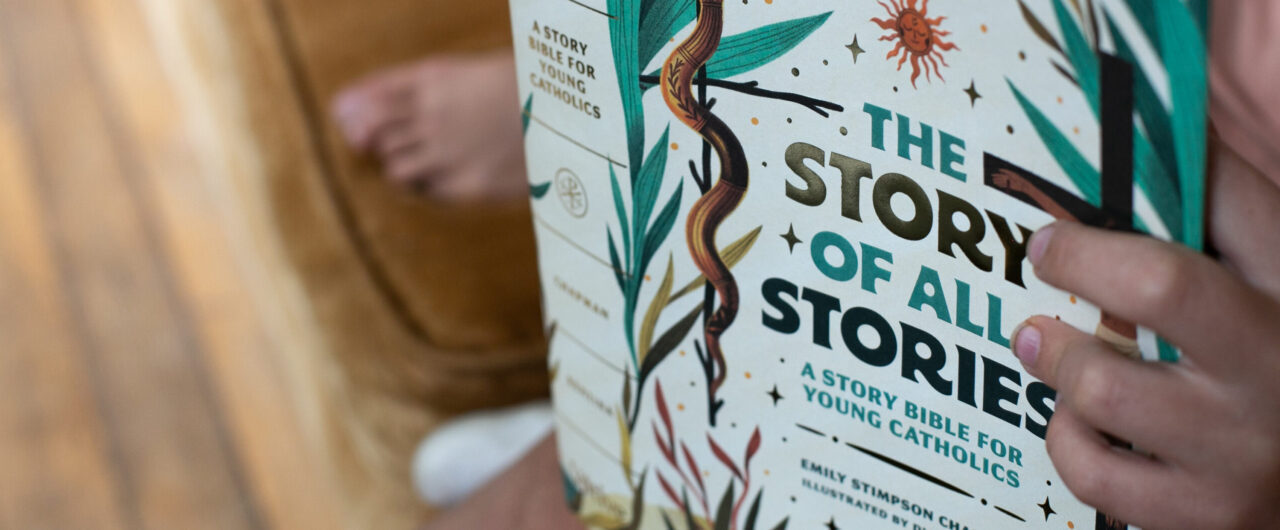
Today marks the release of The Story of All Stories: A Story Bible for Young Catholics, written by Emily Stimpson Chapman and illustrated by Diana Renzina. The following interview between Emily Stimpson Chapman and Haley Stewart, editor of Word on Fire Votive, describes the book’s creation and vision. The Story of All Stories is now available in the Word on Fire bookstore.
Haley Stewart: Emily, when we first pitched this book to you, you were in the trenches parenting three toddlers, swamped with other projects, and caring for aging parents. You turned us down initially (understandably considering everything on your plate!) but eventually changed your mind. What about this project stood out to you as important enough to prioritize amidst your many other obligations?
Emily Stimpson Chapman: When I said no, it was mostly because, at the time, I had a one-year-old, two-year-old, and four-year-old. But it also was because I didn’t understand Word on Fire’s vision for the book. I have seen so many children’s Bibles over the years, and none of them excited me. Some were beautiful but boring. Others were cute but overly simplistic. When I sat down with you and Brandon Vogt, however, to talk more about the project and you showed me the style of art you were considering, I realized that your vision for this story Bible was like nothing I had seen before. You wanted to create something that was beautiful, dramatic, engaging, and enchanting. That’s the kind of story Bible I wanted in my house for my own children, and I knew if I didn’t say yes to writing it and being a part of this project, I would be kicking myself for the rest of my life.
Haley: When you dove into this enormous project of writing a story Bible for young readers, what did you find were the challenges? What parts of your theological background did you find yourself reaching for? And how did immersing yourself in Scripture in order to craft this book affect you personally?
When I sat down with you and Brandon Vogt, I realized that your vision for this story Bible was like nothing I had seen before.
Emily: The biggest challenge was figuring out how to tell each story in a fresh, captivating way that still managed to respect the biblical narrative and remain true to it. So, it took some time to find the right way of retelling the stories without, in the process, losing the stories. To figure out how to do that, I drew heavily from the vision of Scripture I first acquired in my graduate theology classes with Scott Hahn at Franciscan University. This vision is one where we recognize that the Old Testament and New Testament are inextricably connected; where every book in the Bible is part of the same story, the story of salvation history; and where we see that we aren’t standing apart from that story but are part of it. It’s our story, as much as it is Abraham’s and David’s and Mary’s, because it’s the story of God’s love for us and his work in time to draw us to himself. That shaped everything because, more than anything else, that’s what I wanted children to take away from The Story of All Stories—that salvation history is not just something they read about in a book but a story they are participating in every day of their life. It was such a blessing to get to write about that because, of course, to write about it is also to be reminded of it daily. And I need that reminder as much as anyone!
Haley: What struggles do you think parents and grandparents face today in passing on the faith and in getting children interested in Scripture? As a writer and a mother, what are your hopes for this book? How would you like it to impact your readers and the work of evangelization? How do you want it to impact your own children?
Emily: I think too many Catholics of a certain age struggle to get their kids and grandkids excited about Scripture because they don’t know it well enough themselves. We might know a lot of the stories. We might have a working knowledge of some of the most well-known biblical verses. But we don’t see how it all connects. We don’t know the story as a story, with a plot and a purpose and character arcs. We also don’t always fully understand how that story is part of our own story: that we are a part of salvation history, not separate from it. Then, of course, there are some of the trickier passages and tough questions little kids can pose to us. We don’t always feel confident in our ability to navigate those passages and answer those questions. Last of all, a lot of times, we also don’t feel like the Bible is “ours”; that is, as Catholics, we don’t feel confident that the Bible is as much of the Church’s patrimony as the saints, the liturgy, and the sacraments. All of that combined can undermine our ability to hand on a love of Scripture to our children.
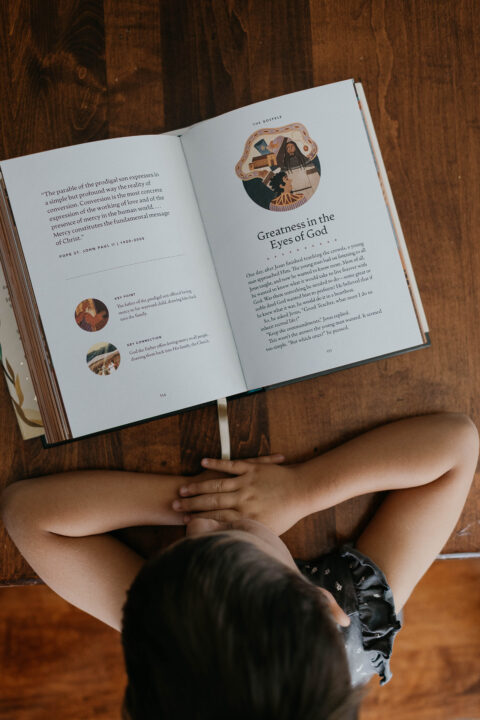
One story Bible, of course, can’t solve all those problems, but this one gets close! It gives parents and kids the “big picture” of the Bible, connecting all the pieces and helping readers see the stories that make up the Bible as the one coherent story that it is. It invites readers into the story, helping them see their story as part of the one great story. It does a fair bit of explaining and breaking down some of the tougher passages for young readers. And it draws upon the words of saints and doctors and popes, giving readers a glimpse into how the Church has read and taught Scripture for two millennia. As a mom, this Bible is simply one of the best tools I could hope for in introducing my own kids to Scripture. Not only are they going to know the story of salvation history from ages four, five, and seven on—something I didn’t know until I was in my twenties—but they also are going to grow up knowing how to read the Bible from the very heart of the Church.
It is beautiful and captivating, engaging and enchanting, dramatic and funny, and—through it all—larger than life.
Haley: One of the most fun parts of my job as editor of Word on Fire Votive is to see how illustration enhances and speaks to the text. I remember keeping you in the loop about possible artists for this project. What were your impressions of illustrator Diana Renzina’s samples for this project and of her final illustrations in the fully completed print version of the book?
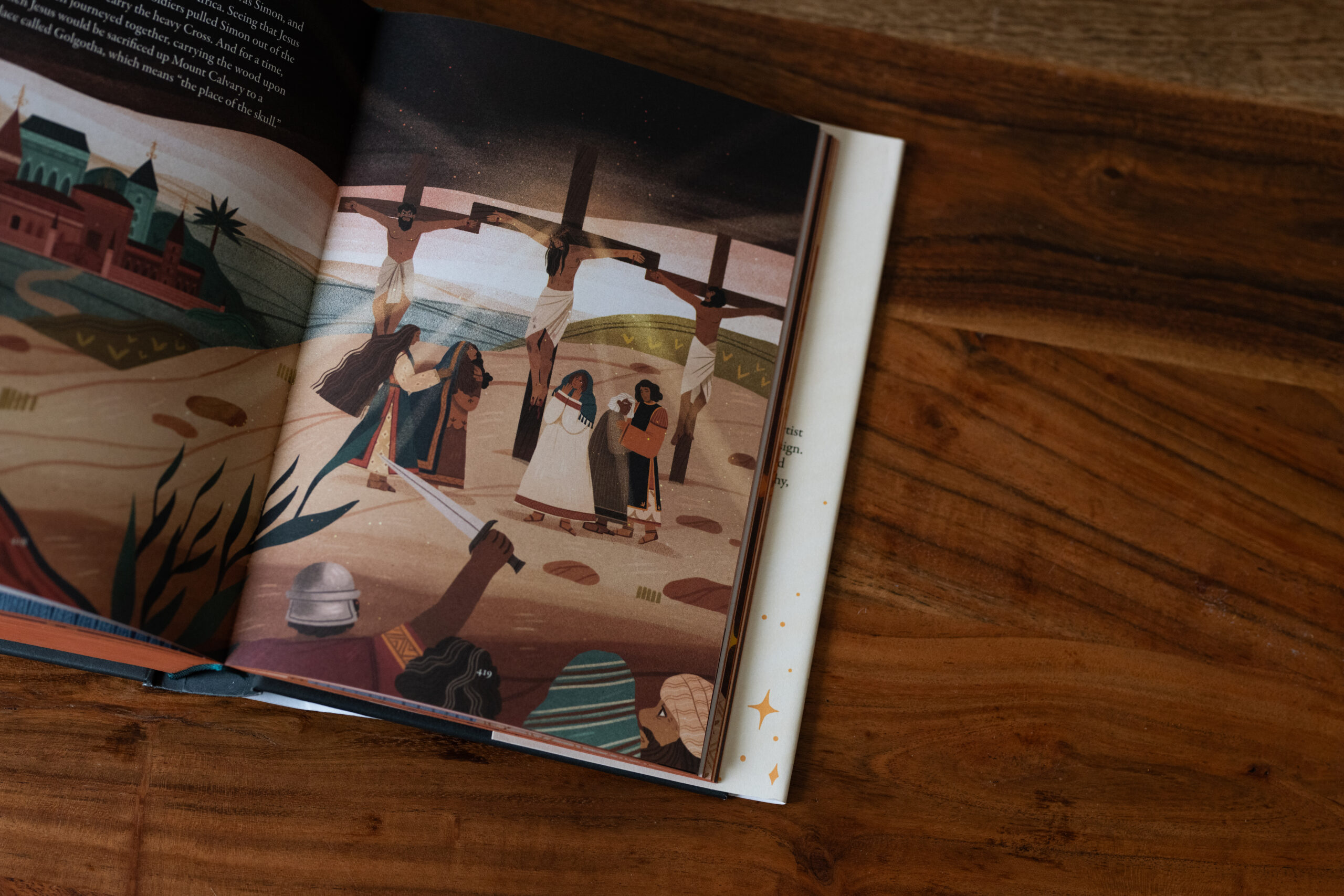
Emily: I was first introduced to Diana’s art when you and Brandon sat me down to convince me I had to do this project. I will never forget my first glimpse of her work. It took my breath away. From that moment on, I was convinced I had to do this book. And seeing it take shape in the hundreds of illustrations that cover practically every shape of the book has only confirmed that decision. My kids can’t stop looking at them. They aren’t cartoonish or simplistic. They are, in a sense, childlike icons that capture the mystery of the story in such a way that they point beyond themselves to the greater truths they represent. It is such an honor to have my words in a book with these illustrations.
Haley: What are the features of this incredible book that you think distinguish it from any other title out there? What makes it the book we’ve all been longing for our children to have in order to introduce them to the Bible?
Emily: It’s everything we’ve talked about thus far. It’s artwork that is enchanting and almost iconographic. It’s the explicit connections made for the readers between the Old and New Testaments. It’s the quotes from saints and popes, which help children understand that when we read the Bible, we’re not reading it isolated from the Church and Christian history but in continuity with the Church and Christian history.
It’s the length and breadth of it; seventy-five stories are told over five hundred pages, which really gave me room to frame a narrative and weave together a much more dynamic and reflective picture of salvation history than other Bibles for young readers typically do. And it’s the freedom you gave me to tell a story—freedom to draw out the humor and excitement and drama of the biblical books. That was such a gift to me, and now, as I’m reading it with my kids, I get to see how it’s a gift to them too. In so many ways, it is a story Bible that does justice to the Bible and the story of salvation history it contains. It is, as I said before, beautiful and captivating, engaging and enchanting, dramatic and funny, and—through it all—larger than life.
Thanks to the hard work of so, so, so many people—you and Diana and a whole team of theological editors—it is exactly what so many Catholic parents have been praying for and hoping for for literal decades. I still can’t believe I got to be a part of this project . . . or that I said no to it twice before getting talked into it. I am so grateful neither you nor God would accept my no!