
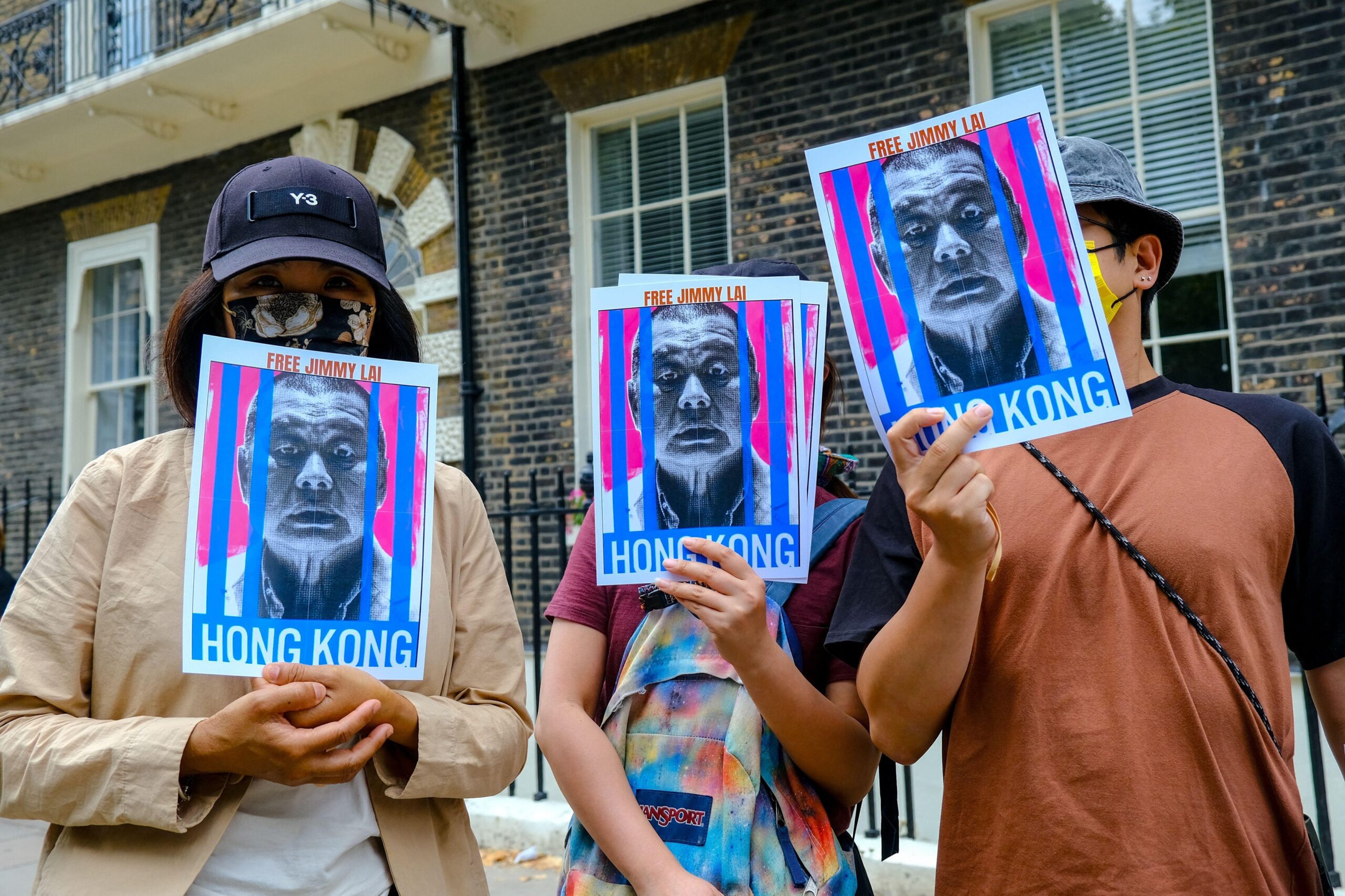
The following is a transcript of a live stream interview conducted by Brenden Thompson, UK Programme Director of Word on Fire, and Claire Lai, daughter of Jimmy Lai, the 78-year-old Catholic media publisher who has been imprisoned in solitary confinement in Hong Kong for five years and is serving a twenty-year sentence. This interview has been edited for length and clarity. To watch the hour-long interview, sign up for a free trial membership of the Word on Fire Institute.
Brenden Thompson: There are lots of dimensions of this story. It isn’t primarily a political story, although politics are of course a part of it. This is a story about a daughter and her father. So thank you, Claire, so much for being with us for this Word on Fire Institute live stream.
Claire Lai: Thank you so much for having me.
Brenden: Looking at this whole five years, and a lot of it in solitary confinement in a Category A prison, describe a little bit about the conditions of the cell and what those five years have looked like. What’s he in for the next twenty years if he’s able to live that long? Because your father is seventy-eight, is that right?
Claire: My father is seventy-eight, and he’s in failing health. To talk about the cell, the conditions in which he’s kept have just gotten worse. I mean, he’s been in solitary pretty much the whole time. Now he’s in a 60-square-foot cell. His window is blocked, so he doesn’t get natural sunlight or any fresh air. I mentioned that he reads the Gospel every morning, but at first they would turn on the lights for him so that he could read. Now they don’t, so he has to lean against the door, and he catches light from the corridor, which isn’t much. And it slows him down. It’s not good because he has to stand up to lean against the door, and it’s not good for his eyes because it’s not a huge amount of light, and it’s not good for his back or waist, but it brings him a lot of joy. So it’s that.
His visits amount to twenty-four hours a year. He has one hour of exercise, but that is in a sealed off environment, and his health has just gone from bad to worse. He has lost a huge amount of weight. His blood sugar is very infrequently checked. He has heart issues, which he didn’t have in the past. He has blood pressure issues. His nails are turning colors and falling off. He has rotting teeth and so on and so forth. And he is very much just sustained by his faith.
Brenden: What is it that he’s charged with exactly? And what do you think are the chances of the release in this twenty years? Hopefully, God willing, maybe Trump can do something, but what’s your assessment of the case?
Claire: Essentially, he’s charged with basically standing for the values that a lot of us hold dear. He’s essentially charged for his work of ensuring the free flow of information, the free flow of ideas. He was a pro-democracy activist. Hong Kong was promised democracy for fifty years in the Sino-British Joint Declaration, and it’s something that the Chinese side preached. Also, the last five years, you have just seen the rule of law in Hong Kong just take a complete nose dive. And I think Dad’s case has proved that. And it’s heartbreaking. It’s heartbreaking for a lot of people who wanted to still believe in the things that made Hong Kong once vibrant: the rule of law, market economy, all the things that made Hong Kong just a miracle that my father first found freedom in.
But it’s not. And I think most of us have given it every chance. Now we know that the only solution really is a sovereign-to-sovereign one. It has to be solved leader-to-leader. It has to be a political solution because ultimately the decision will be made by Beijing. It’s not something that will be decided in the courts in Hong Kong.
“Now in prison, I am led to the right path, to the kingdom of God, glimpses of true light and real joy in front of me, serving God, not myself.”
Brenden: What have you noticed between the kind of father that you knew growing up versus the one who’s been in prison for five years? What are the big differences or even maybe tiny differences that you’ve noticed in his character, in his health?
Claire: From the very first day I went to visit him, I remember I was extremely emotional because firstly, my dad was in prison. And also secondly, I remember the first day I went to visit. I mean, I was a novice, so I wasn’t really used to the prison system and I got a lot of things wrong. I think the only thing I got right was that I brought The Word on Fire Bible because we used to read it together as a family sometimes, so I knew exactly where it was.
But that was enough for him. And he said that he was in God’s good hands. The impact of God’s grace on him—it’s a continuous process and it’s just something I’m extremely grateful for. Even in little things, like some parts of his prayers or even in some of his earlier letters, he would quote from other authors or so on. And then later on, he started writing his own prayers. Even in the ways that his prayers have developed, it’s just been a real privilege to see. I wrote somewhere that humility might not have been something that my father would have previously been well-known for. And of course, on the first day he said that he was in God’s good hands, but in suffering, the act of surrendering—completely surrendering—is something that takes continuous effort, at least it did with him.
It is something that took a conscious effort. I was reading Fulton Sheen recently, and he described the Blessed Mother, Mary Magdalene, and St. John, the most beloved disciple, at the foot of the cross. And he said, “It’s hard to bear yourself at the foot of the cross. And it’s hard to recognize your own shortcomings, but it’s also the only thing that helps.” And there were times, in certain aspects, where Dad recognized that that was the only thing that helped. I think it does go hand in hand with humility.
And my father was always a reader, but he has read a lot more. He has read a lot more theology. He pretty much only reads theology, other than drawing books from artists to help him with drawing the crucifixion and the Blessed Mother and the Pietà. There are two episodes that come to mind where I know that Dad was feeling a bit down. And when he told me about them, he was so happy. Once when we had typhoon season in Hong Kong—and that’s usually end of summer, start of autumn—his entire cell was completely soaked. Once when he was just feeling extremely nervous and extremely down, he woke up before the crack of dawn to read the Gospel, and the only thing that had remained dry was his Bible.
And there was another where he was sleeping, and he had dreamed of being with us back in a big house with a lot of food for dinner and so on. And then he woke up to cockroaches climbing over his face, and he was feeling a bit anxious. He opened the Bible at a random page, and it was the rich man and Lazarus, and he just found so much meaning there. He found so much meaning in his suffering. And he was just so, so happy when he was conveying that to us.
Brenden: You were sharing with me before we began a beautiful, really self-reflective part of one of his letters when he talks about his early life. Would you be able to read that for us, on how he was looking back on his own life?
Claire: Absolutely. I’m just going to read directly from his letter. He said,
When I muse on my life, my heart fills with gratitude, for I have always been guided by a being beyond my comprehension to the way of light. I was deprived of formal education, yet curious of knowledge, and had a zealous zest for learning. Eventually, I became an intellectual, and actually this helps greatly in conducting my life and business. Family history and business predisposed me, as a matter of fact. No matter how small and humble, I should start my business with God’s blessing. In my incessant effort, I have had success in my family life and business life, albeit with setbacks. A poor and ignorant kid made it to be rich and intelligent is more than I could wish for. Then imprisonment thrusted upon me. I realized I was actually walking towards Emmaus, away from Jerusalem, the kingdom of God. Knowledge, wealth. I found meaning in things that had been so beneficial to me, I was actually walking under the shadow of material and ego’s galvanized gratification, a life serving myself as an idol. Now in prison, I am led to the right path, to the kingdom of God, glimpses of true light and real joy in front of me, serving God, not myself. This realization to serve the Lord as a true way of life, so lucky have I been going through life and ending up in the kingdom of God. Cheers, Dad. God bless.
Brenden: Of great interest to the Word on Fire Institute is evangelization. And I must admit, one of the things that really spoke to me quite forcefully: I want to continue to use this Lent to grow spiritually, as Jimmy is in prison. There’s a great witness and a model there, which is confronting in a beautiful way. But it’s also this sense of those pictures, drawing the pictures of the crucifixion and the Pietà, and then the instructions on the back encouraging others in prayer. I believe he had to be stopped by other people because he was trying to evangelize even in these circumstances. Really remarkable.
Claire: There are quite a lot of political prisoners in Hong Kong, and one of them is a dear friend of my father’s. And early on in his imprisonment, because his friend wasn’t in prison yet, he had gone to visit him. And even prior to that, Dad had tried to get him to convert, unsuccessfully. When his friend first went to prison, he asked a mutual friend of ours, “Jimmy says it helps to pray, so can you teach me how?” And I don’t know why, but that sentence just touches me so much.
Then Dad drew the crucifixion and asked me to get The Word on Fire Bible. And then some other books as well. I think I got This Is My Body by Bishop Barron for him. I think that was afterward, because I think that it was after he finished reading it. And then Seven Storey Mountain. And a few others, but not too many. And he would tell him how to pray. There were a lot of back and forth letters, but he converted. One day my dad got a letter saying, “I finally get what you mean. I finally understand what you mean by the grace of God when you talk about the grace of God.” And I’ve only ever been raised Catholic. If I went through intense suffering and was agnostic, I don’t know if I would’ve had the perseverance to continue trying the way that his friend did.
Obviously, some of the letters do go through me, but I don’t read other people’s letters that aren’t addressed to me. But I did ask about if he felt comfortable sharing some aspects of certain letters. And he said in one of the passages, “Both believers and unbelievers face the same dilemma. Neither can escape doubt nor belief. To believe it is to suffer doubt conquered through God’s grace and forgiveness.” And then he noted Little Thérèse’s example and he urged him to read Psalm 27 and ended the letter saying that since he started writing the letter, his heart feels light and joyful, that it must be the joy of proclaiming God’s good news. That just makes me really, really happy.