
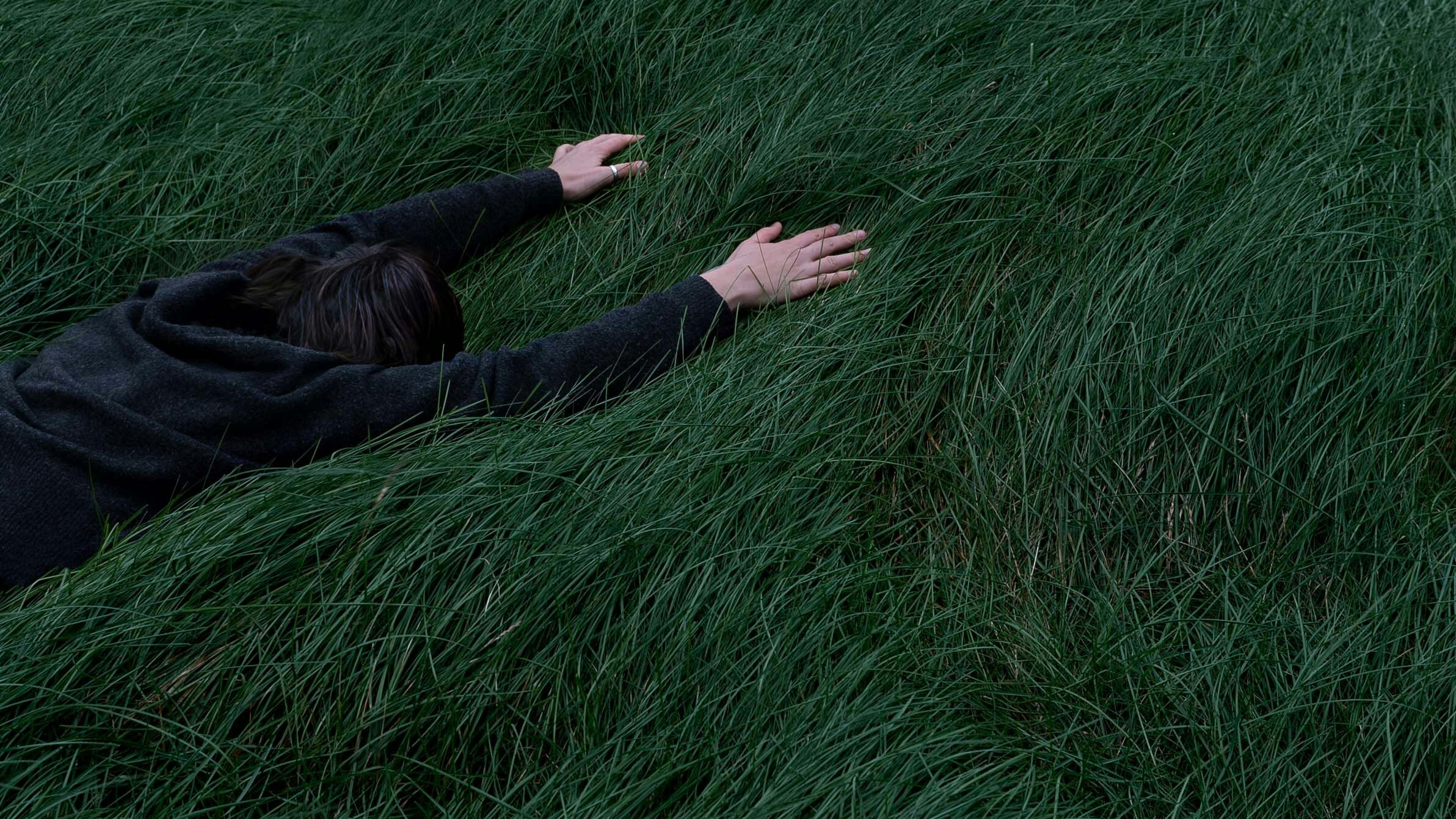
“Touch grass” has become a popular slang expression. It is used pejoratively to indicate intellectual or moral superiority over the phrase’s target. The implication is that the person being told to “touch grass” spends too much time on the internet and, as a result, is disconnected from reality, which is the cause of their ill-informed opinions. Whether the person saying “touch grass” is any less active on the internet or any more in touch with nature is, of course, dubious. Despite this axiom’s primary use as a form of condescension, there is some truth behind the expression. Hence, I would like to reflect on the wisdom of maintaining contact with nature.
A couple of decades ago, I was ruminating about the knowledge of God attained by reasoning from effect to cause. As St. Paul says in Romans 1:20, “Ever since the creation of the world his eternal power and divine nature, invisible though they are, have been understood and seen through the things he has made.” The Second Vatican Council references this passage when it says in Dei Verbum 3, “God, who through the Word creates all things (see John 1:3) and keeps them in existence, gives men an enduring witness to Himself in created realities (see Rom. 1:19–20).” This same dogmatic constitution reaffirms this a few paragraphs later: “God, the beginning and end of all things, can be known with certainty from created reality by the light of human reason (see Rom. 1:20)” (6). The Seraphic Doctor, St. Bonaventure, likewise says in The Journey of the Mind into God, “Whoever is not enlightened by such great splendor in created things is blind; whoever does not turn to the First Principle after so many signs is a fool” (Ch. 1, no. 15).
While reflecting on this matter, I began to wonder if there was a connection between this truth and the fact that atheism seems to be more common in urban areas compared to rural areas. I thought this phenomenon might be at least partially due to the fact that in big cities most of what people encounter in their day-to-day lives is what man has made: buildings, streets, automobiles, computers, etc. Thus, reasoning from effect to cause, man himself appears to be the primary source of what exists. Now, this is obviously very myopic, but it is nevertheless an existentially powerful experience. Compare that to people who live much closer to nature and might even be very reliant upon weather, the seasons, and wildlife: Much of what they encounter is not man-made but part of God’s creation. Hence, it might be easier to have an intuitive grasp of the existence of the Creator.
As with the effects of the industrial revolution, the AI/technological revolution is similarly threatening to thwart humanity’s relationship with nature and, through it, with the Creator.
Some years later, I was pleased to see that my theological hero, Joseph Ratzinger/Benedict XVI, had already made similar comments way back in 1961. I wrote about this in my book, The Mind of Benedict XVI: A Theology of Communion (150–151):
Ratzinger first notes man’s relation to nature for the vast majority of human existence. “In the history of humanity, the encounter with nature was always one of the most important starting points of religious experience.”1 He then expresses the shift from earlier history to recent times. “In all previous cultures, man lived in a close and direct dependance on nature. In most of the occupations which were open to him he was led into a straightforward, direct encounter with nature as such. That has largely changed since the breakthrough of technology.”2 As Jared Wicks notes, “The world we now encounter,” in contrast with former times, “bears the mark of human work and organization.”3
If man’s natural knowledge of God takes place by reason from effect to cause (from creation to the Creator), then the reduction of man’s direct contact with creation inevitably reduces the mind’s likelihood of perceiving the Creator. . . . As Wicks summarizes, “God was to be known through the things he made (Rom 1:20). But now we lack this significant source of religious existence, as shown by the decline of faith among modern industrial workers.”4
I saw Ratzinger’s writing and Wicks’s commentary as confirmation of my suspicions. At the very least, I was not the only one coming to this conclusion.
Recently, I found echoes of this same concern in a document of the International Theological Commission (ITC), Quo Vadis, Humanitas? (Thinking Through Christian Anthropology in the Face of Certain Scenarios for the Future of Humanity). The ITC states:
Our relationship with the environment is modified by synthetic reality, or rather by the artificial, which pervades all areas of life, from food (preservation of food; genetically modified organisms), to living space (urbanisation) to bodily transformations (biotechnology). The expansion of the artificial world, with materials not found in nature such as plastic, steel and concrete, makes our relationship with nature and its laws more fluid and indeterminate, and can create the illusion that only human freedom, based on the transformative power of technology, offers a right relationship with the real world. . . . It is not nature with its laws and limitations that regulates and directs development . . . but rather technological potential. (34)
As with the effects of the industrial revolution, the AI/technological revolution is similarly threatening to thwart humanity’s relationship with nature and, through it, with the Creator.
In light of this present danger, many of us would do well to “touch grass” more often than we currently do. Encouraging our children to unplug from the web and play outside is but one way to help them get back in touch with the real world and to be informed by it, lest virtual reality have more of an impact than actual reality. I am reminded of this funny but poignant Nickelodeon bit I saw in my childhood:
Obviously, I do not think touching grass is the only thing needed to recover a sense of the Creator. However, in this secular world, we can use all the help we can get. When I was younger, I probably would have thought advocating for spending more time in nature as a form of spiritual practice was hippie nonsense. But as I have grown older, I have become more appreciative of how impactful staring at beautiful, natural landscapes can be. To make such experiences even stronger, combining time in nature with prayer to the Most Holy Trinity can help boost our appreciation for the goodness of creation and the wisdom and love of the one who gave it all to us. It might sound trite, but we could all benefit from touching grass.
. . .
1 Joseph Ratzinger, “Das Konzil und die moderne Gedankenwelt,” in JRGS 7/1, ed. Gerhard Ludwig Müller (Herder, 2012), 81.
2 Ratzinger, 81.
3 Jared Wicks, “Six Texts by Prof. Joseph Ratzinger as Peritus before and during Vatican Council II,” Gregorianum 89, no. 2 (2008): 257.
4 Wicks, 257.