
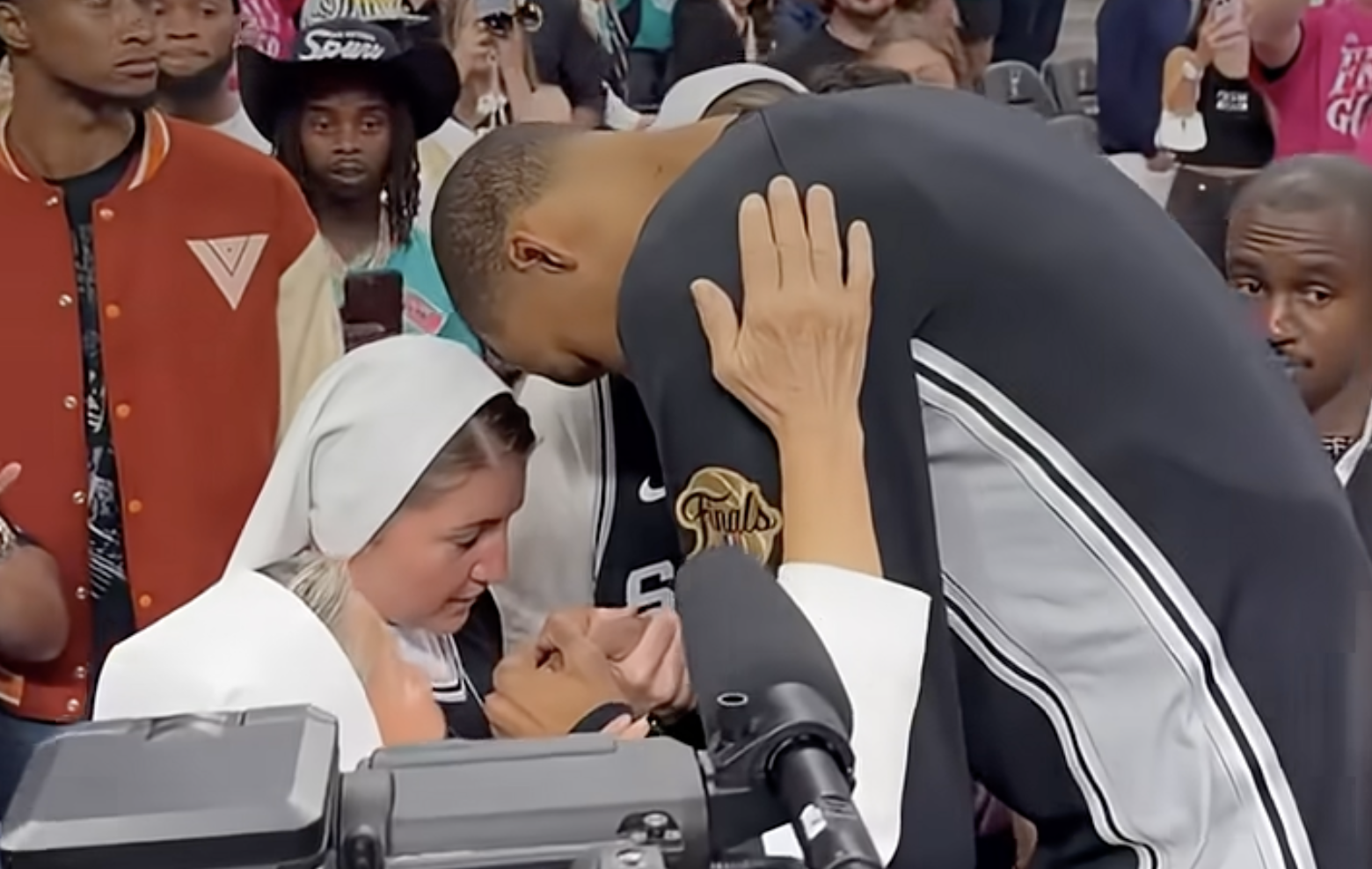
I’m not sure what was a more surprising sight: four Salesian sisters donning Spurs jerseys over their habits courtside at the NBA Finals or Victor Wembanyama, arguably one of the best players in the world, asking for their intercession.
While the “Spurs Nuns,” as they’ve been affectionately nicknamed by NBA fans, have just recently risen to stardom, their community has had a relationship with the San Antonio Spurs for the past two decades. They’ve attended games, prayed with players, and even pleaded with coach Gregg Popovich to control his temper. Not much has changed this year, except they are able to do all of this on a larger stage. Throughout this year’s unexpected run to the NBA Finals, the sisters have been on social media playing basketball and sharing the gospel in the stands, cheering, and even praying courtside with several Spurs players, including Luke Kornet and “The Alien,” Victor Wembanyama.
It may be fitting to hear of Luke Kornet, a committed Catholic, seeking the sisters’ intercession, but in the case of Victor Wembanyama—who spent weeks this past offseason with Buddhist monks meditating and training—many fans are bewildered. Why would one of the best players in the world feel the need to pause his warm-up routine, bow his head, hold hands with and ask for intercessory prayer from four Catholic nuns?
It’s impossible to know Wembanyama’s exact inner motivations; however, this should not catch us so off guard. After all, sports have a unique ability to open athletes up to the transcendent.
One of the primary ways sports can do this is through the asceticism required to advance. It is difficult to imagine a high-level athlete practicing no form of asceticism. They simply cannot be elite athletes without a certain degree of discipline, sacrifice, and self-denial. There may be cases where natural talent lowers the threshold for what is required, but there is no getting around it entirely. A necessary stripping of and detachment from distractions, indulgences, temptations, and even goods, at times, must take place in order to progress to the next level. Oftentimes, the greater the athlete, such as Kobe Bryant or Tom Brady, the more asceticism you see in their life. In the case of these two, even other professional athletes considered their extreme daily workout and diet regimens borderline insane. Yet it is precisely because of their ascetic practices that their jerseys are retired and not long forgotten.
As athletes strip themselves of vice, sacrifice for something greater than themselves, and pursue excellence, there is an opportunity for them to offer and unite all of it to God.
Void of any direction towards the divine, though, this asceticism eventually becomes destructive. As Fr. Steve Grunow recently said, it must find a god to worship. With proper guidance and direction, this can ultimately lead athletes to a recognition of God. As athletes strip themselves of vice, sacrifice for something greater than themselves, and pursue excellence, there is an opportunity for them to offer and unite all of it to God. Their sacrifice in sports both demands a god and can help them discover him. However, without this proper orientation, athletes are all too easily led to false, egotistical worship of themselves and their ability to perform. In these cases, athletes tend to develop a strong athletic identity, which the International Journal of Sports Psychology defines as “the degree to which an individual identifies with the athlete role.” In the same study this term was coined, researchers found that while athletes with a higher athletic identity measurement have the potential to be more motivated and driven in their field of play, they are also more prone to psychological dangers in the long term, especially when faced with injury or the end of their playing career. Unsurprisingly, then, when the International Olympic Committee studied recently retired elite athletes, it found that 45 percent of them suffered from an increase in anxiety and depression.
While sports in their distorted form tend toward this oppressive adoration of the self, they also have a way of shattering that false reality. At some point, each and every athlete meets his match: human nature. Sports have the remarkable ability to remind us just how limited we are. It may be another player or team, an injury, or simply old age, but the end is always the same. Eventually, athletes all discover the same resounding truth: They are not God. For the prepared, faithful athlete, this goes without saying; however, for the self-worshiping athlete, this experience can be tragic, as it is for those 45 percent struggling with anxiety and depression. The loss of control, power, esteem, and even their “god” often makes them question their entire understanding of themselves and life as they know it. While this may sound horrifying enough to convince some that sports are not worth the risk, there is hope. Though the asceticism found in sports paired with poor mentorship may have led the athletes into a destructive form of self-worship, it is also sports that can show athletes they need something greater to stake their lives on than themselves. It is in this struggle that athletes often lift their heads toward heaven and recognize their need for the transcendent.
It is through this lens that we can finally begin to understand why Victor Wembanyama would ask to be prayed over. He has obviously practiced some forms of extreme asceticism in his pursuit of basketball from a young age. Now, while he does not publicly identify with any religion, there are tells that this experience—paired with his upbringing—have opened him up to something outside of himself. During the offseason, while most players are enjoying a break or working out in a gym, he visited Buddhist monks for a two-week retreat. It is likely that his own ascetic practices fostered a level of curiosity and intrigue for him to conduct this retreat. Likewise, it makes perfect sense that he would be drawn toward the Catholic sisters this NBA Finals.
Despite having the body and skills that appear to come directly from a basketball laboratory, Victor Wembanyama has a deep understanding that there is something greater than himself. He may not fully understand what that is, but he knows there is something. The nuns in their habits not only embody the asceticism that likely speaks to and draws his heart, but they also embody the love and joy of Christ. It is no wonder this man, in his time of need, would look to these women for their intercession and help. Maybe their witness alongside his athletic pursuits will open his heart fully to Jesus Christ.