
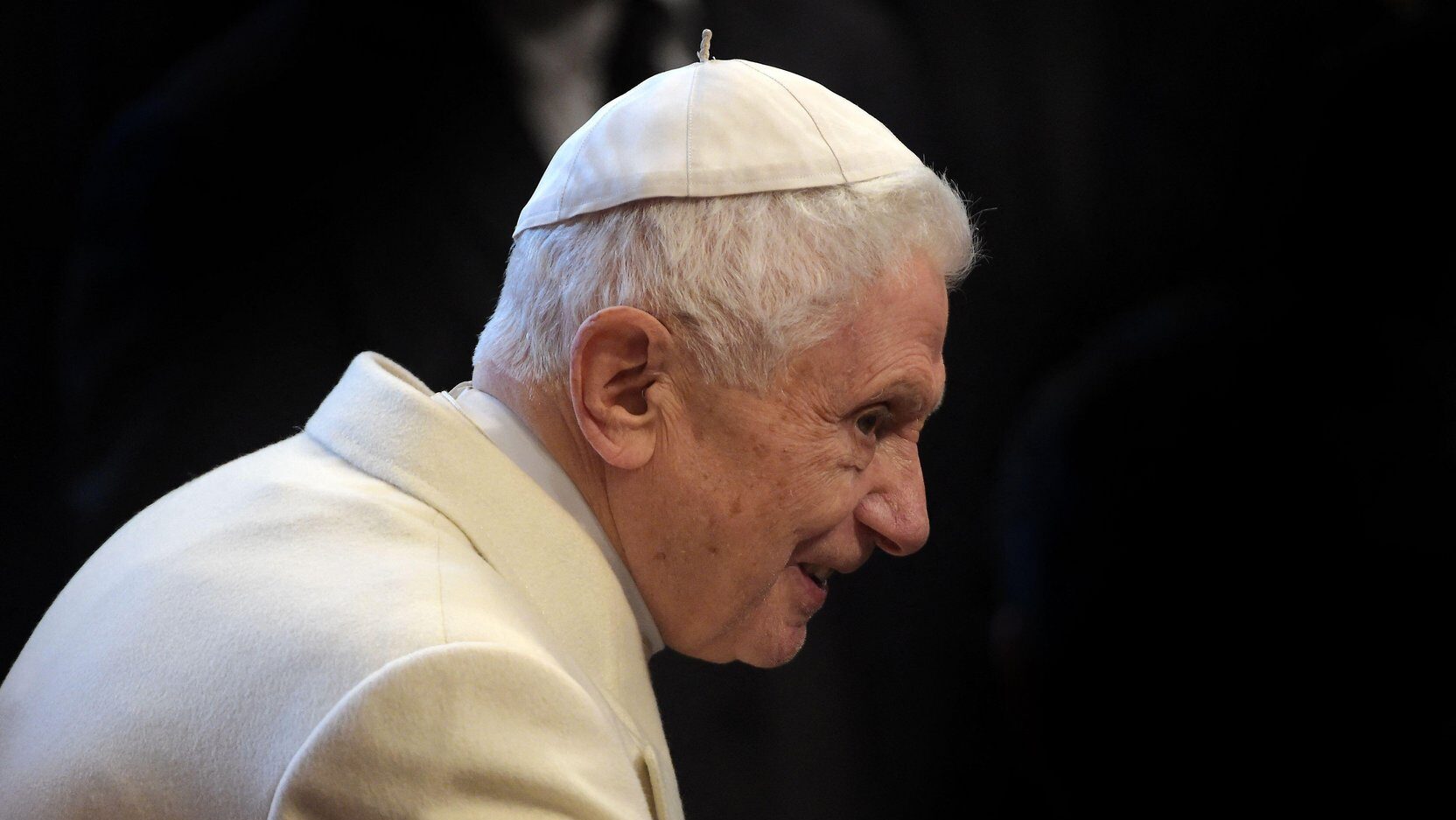
The year 2027 will mark the centenary of the birth of Joseph Ratzinger and celebrations—mostly in the form of academic conferences or musical soirees—are planned throughout the world. In the Anglosphere, the celebrations will also be spurred on by the publication of significant reference works that mostly deal with Ratzinger’s fundamental theology. They include the following:
- Joseph Ratzinger in Dialogue with Philosophical Traditions, Vol 1: From Plato to Vattimo, and Joseph Ratzinger in Dialogue with Philosophical Traditions, Vol II: From Aristotle to Žižek, edited by Alejandro Sado, Rudy Albino de Assunção, and Tracey Rowland. (London: Bloomsbury, 2025 and 2026).
Each volume contains essays by an international team of scholars who examine Ratzinger’s engagement with over twenty different philosophers and/or philosophical traditions. Taken together, these volumes cover some forty different philosophers and traditions whose names and ideas appear in Ratzinger’s publications. These essays are invaluable for understanding the relationship between faith and reason in Ratzinger’s theology.
- The Inspiration and Truth of Scripture: Testing the Ratzinger Paradigm (Catholic University of America Press, 2023), by Aaron Pidel, SJ.
This work offers a synthetic account of Ratzinger’s approach to scriptural theology in juxtaposition to three alternative approaches. The three alternatives are those of Pierre Benoit, Karl Rahner, and David Tracy. Pidel calls Benoit’s approach the Thomist-instrumental model, Rahner’s approach the Molinist-predefinitive model, Tracy’s approach the Heideggerian-disclosive model, and Ratzinger’s approach the Bonaventurian-ecclesial model. The first word in each model’s hyphenated name designates a school of thought, the second word is the way by which God becomes a true “author” of Scripture. Ratzinger’s approach comes closest to Tracy’s disclosive model, but Ratzinger and Tracy differ on the nature of the truth disclosed and the nature of the subjectivity receiving the disclosure. Heidegger’s disclosure model of truth requires one to adopt the right prejudice and thus the nature of the subject receiving the disclosure becomes very important. In Ratzinger’s thought, the Church—understood as the people of God—is the receiving subject.
Fr. Pidel further argues that this approach of Ratzinger incorporates the strengths of the other three models, along with insights from St. Bonaventure, St. John Henry Newman, Romano Guardini, and Erich Przywara.
Fr. Pidel’s book is likely to become the classical understanding of Ratzinger’s approach to scriptural exegesis and more broadly, the Scripture and tradition relationship.
- The much-awaited The Joseph Ratzinger Compendium (Ignatius Press, autumn 2026).
This is a collection of 104 essays written by seventy-two scholars. Each essay addresses one topic in the theology of Ratzinger. The essays are approximately 4,000 words in length and supported with a bibliography. The first edition of the Compendium will be in English, and there are plans for editions in Spanish, German, and Italian. The chief editor is Dr. Rudy Albino de Assunção from Brazil. The late Pope Benedict was made aware of this forthcoming publication before his death, and at the time, he joked about there being seventy-two scholars to summarise his works and seventy-two scholars to translate the Hebrew Pentateuch into Greek. He was amused by this fact that had never occurred to the editors.
- The Oxford Handbook of Joseph Ratzinger, edited by Tracey Rowland and Francesca Aran Murphy (2026).
The Oxford Handbook of Joseph Ratzinger was published in January 2026. It contains twenty-nine essays from an international cohort of scholars. It includes contributions by theologians who worked with Ratzinger during his days as prefect for the Congregation of the Doctrine of the Faith (Don Damiano Marzotto and Don Livio Melina); an essay by Fr. Aaron Pidel on Ratzinger’s understanding of the relationship between the Petrine Office and the Episcopacy, and an essay by Fr. Vincent L. Strand, SJ, on Ratzinger’s theology of priesthood. There are also contributions from two of the leading Ratzinger scholars from Africa: Fr. Maurice Agbaw-Ebai on “Ratzinger and the Johannine Concept of Logos” and Fr. Martin Ifeanyi Onuoha on “The Mariology of Joseph Ratzinger.” The 2024 Ratzinger Prize winner Cyril O’Regan contributed a chapter on Ratzinger’s Principles of Fundamental Theology and Fr. Emery de Gaál addressed the document Dominus Iesus. These are just some of the highlights of this collection.
- The Cambridge Companion to Joseph Ratzinger (Cambridge University Press, 2024), edited by Daniel Cardó and Uwe Michael Lang.
The fact that both Oxford and Cambridge University Presses have published handbooks or companions to the thought of Ratzinger speaks volumes about the late pontiff’s standing in the world of theology. There is so much that can be said that the two volumes are not, for the most part, ploughing the same fields and can be read as companions to each other. The Cambridge Companion offers twenty-one essays, including contributions from such luminaries as Bishop Rudolf Voderholzer whom Benedict XVI appointed to the See of Regensburg, Thomas Joseph White, OP, the Rector Magnificus of the Angelicum, Kurt Cardinal Koch, and Fr. Thomas Weinandy, OFM Cap.
- The Bloomsbury series T&T Clark Studies in Ressourcement Catholic Theology and Culture has published several works about Ratzinger.
Fr. Gregory Morgan’s Natural Law & the Secular Mythos (2025) will resonate well with people who share Ratzinger’s approach to the faith and reason, and nature and grace relationships. David Collit’s Hope and History: The Communio and Concilium Alternatives (2026) juxtaposes approaches to the theology of history found in the works of Josef Pieper and Joseph Ratzinger and those found in the theology of Johann Baptist Metz and Walter Kasper. Isabel Troconis’s Ontological and Historical Dimensions of Salvation According to Joseph Ratzinger (2025) examines the history and ontology relationship in the theological anthropology of Ratzinger, while Tomasz Dekert’s Liturgical Peace, Liturgical War: Benedict XVI’s Summorum Pontificum and Its Critics (2025) is focused on Ratzinger’s liturgical theology.
- John Henry Newman and Joseph Ratzinger: A Theological Encounter (Washington DC: Catholic University of America Press, 2025).
This is a collection of conference papers edited by Matthew Levering and Emery de Gaál. Each of the chapters showcases the intellectual affinities between Ratzinger and Newman. A similar collection on Ratzinger and Rahner showcasing the dissimilarities, collated by the same editors, will be published late 2026 or early 2027.
- The Lord Holds Us by the Hand: Private Homilies, Seasons and Feasts (Ignatius Press, 2026).
This is a collection of homilies delivered by Pope Benedict XVI in private chapels and have not, therefore, been in the public domain before this publication.
- Beyond the Crisis in the Church: The Pontificate of Benedict XVI (St. Augustine’s Press, 2024) by Roberto Regoli.
Roberto Regoli is the director of the Department of Church History and professor at the Pontifical Gregorian University and president of the Ratzinger Foundation. This work is not an exposition of Ratzinger’s theological teaching but a history of his papacy. It offers a deep-dive into the goings-on inside the Curia during the papacy of Benedict XVI. Significant observations include the intellectual affinity of Ratzinger and Newman and the role of Tarcisio Bertone, the Secretary of State, in the politics of the era.
- The Mind of Benedict XVI: A Theology of Communion by Richard G. Declue, Jr. (Word on Fire, 2024).
Richard DeClue offers a presentation of themes in the fundamental theology of Ratzinger, such as his account of the Trinity, Christology, revelation, and creation in such a way that the coherence of Ratzinger’s theological building-blocks shines forth. The concept of Communion is central to this coherence.
Finally, in addition to this top-ten list, when it comes to identifying circles of interest in Ratzinger studies, the countries of Central Europe have produced prominent scholars of Ratzinger’s thought.The Collected Works of Ratzinger have been published in Polish under the direction of Fr. Krzysztof Góźdź, who is a professor of dogmatic theology at the Catholic University of Lublin (KUL). Tibor Görföl from the University of Pécs has started the work of the translation of the Collected Works into Hungarian, and Alin Tat, a Greek Catholic theologian in the city of Cluj-Napoca (formerly Kolozsvár) in Romania, has translated numerous articles by and about Ratzinger into Romanian.