
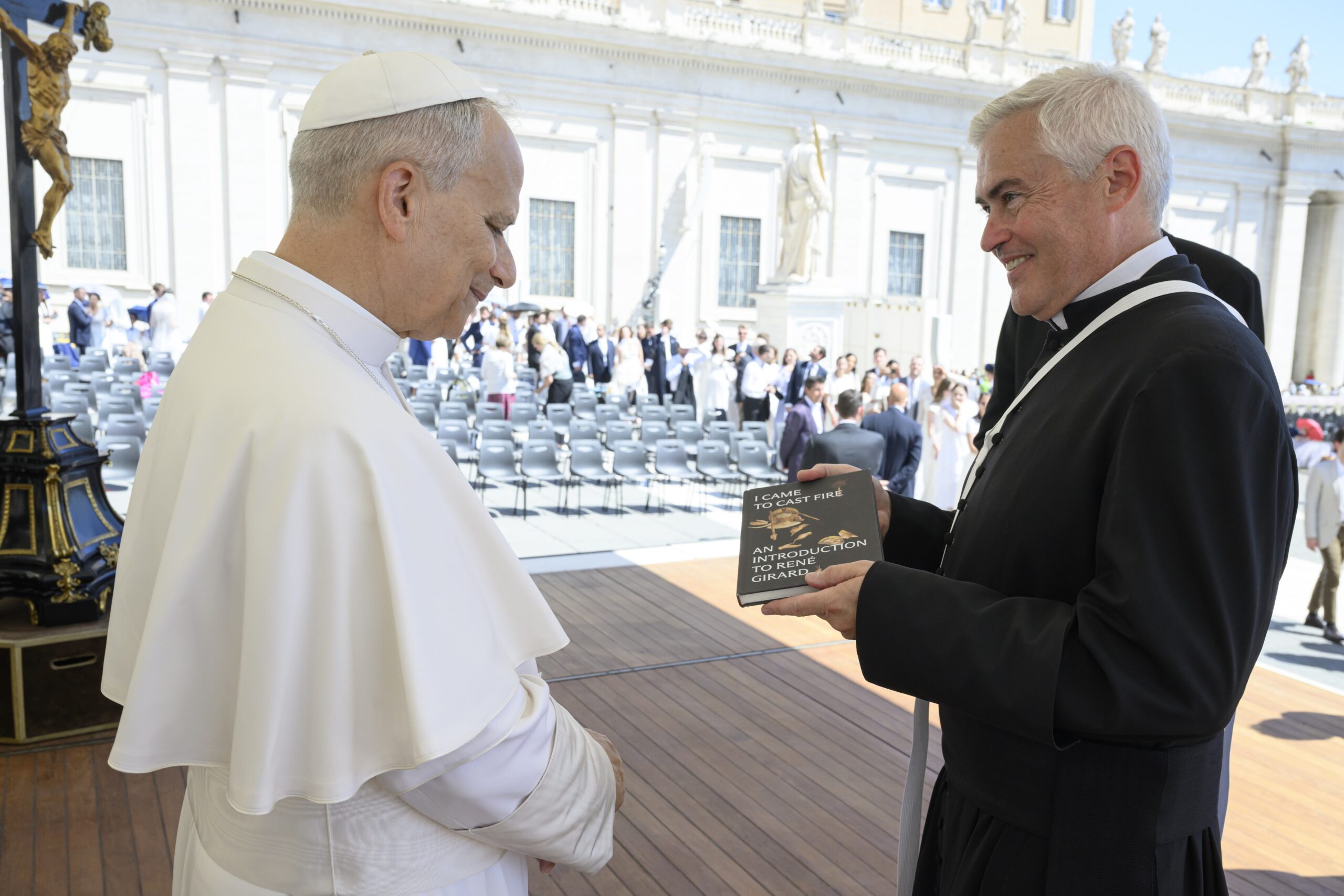
Father Elias Carr is a Canon Regular of Saint Augustine of Stift Klosterneuburg, Austria. He co-founded the Canonry of Saint Leopold in 2011 in Glen Cove, New York, and now serves as the Kämmerer of Klosterneuburg. He is also the pastor of the parish of Weidling. He defended his dissertation on the life and early works of Raymund Schwager, SJ, a friend and collaborator of René Girard, at the John Paul II Pontifical University in Krakow, Poland, in June 2022.
Note: Portions of this interview appeared previously in Norwegian at Katolsk infotjeneste.
What was it that made Saint Augustine so great? How has he shaped the Christian tradition as well as broader Western thought?
Saint Augustine lived at the turn of the age. He received a superb classical education, trained as a rhetorician. One has to keep in mind that this is no spin doctor or publicist. Aristotle understood this profession as essential to fostering the community because very few people are suited to learning truth through their own scientific exertions. Few have the time, talent, and resources to do so. Therefore, rhetoricians—or in his terminology, the endoxoi andres, the illustrious men—had a duty to present the truth through demonstrations, resting not only on words but also on their moral character as men. Augustine pursued this profession to the highest level of imperial government in Milan but did not find satisfaction. His search for truth in philosophy and various religions left him likewise disappointed.
Into this existential crisis came a clear answer. Bishop Ambrose of Milan provided it through his word and example. Augustine’s baptism already set him on a path of excellence, which he hoped to pursue in a community of likeminded philosophers. Yet God had other plans for this talented and passionate man. He was “forced” to accept ordination as a priest and then a bishop. Uncommonly, he preached as a priest; his first sermons on the beatitudes we can still read. Soon the Latin-speaking priest succeeded the Greek-speaking bishop of Hippo, and there he served. Augustine wrote extensively, addressing various theological controversies that shape our understanding of grace, the sacraments, and the Church to this very day.
Augustine shows us not only the value of the struggle but also, more importantly, the answer.
For most of history, The City of God was seen to be his most important work. It is an impassioned defense of Christianity against its pagan critics, who saw the sack of Rome by the semi-Arian Goths as a sign of the weakness of the Christian God and of the need to return to the old gods. Augustine witnessed the upheavals of the birth of a new world in which the Gospel and antiquity would through the Church shape peoples, both new and old, into Europe.
The pope highlights Augustine’s Confessions as a unique work of Western literature. What is it about Augustine, and this work in particular, that still resonates with people today, both within the Church and beyond?
The Confessions of Saint Augustine resonates with people today more than it did in the past because we are at the other end of a very long passage that resulted in the invention of the individual. We experience individuality in the West as something that is self-evident, which shows how little we are aware of its oddity. Individuality arose out of the encounter between the Gospel and the West over many centuries. Through practices and beliefs, the Church brought forth this new understanding of the person, even if this was not necessarily intended, or even perhaps desirable. This innovation was the precondition for modernity, not a product thereof. Augustine in the Confessions reflects on his interior life as an individual.
Augustine also shows us that God relates to us in many and varied ways, sometimes in very ordinary or even strange ways (such as the voice of a child telling him, “Take and read”). And he wrestles with the basic human questions, which gives his work a universal appeal. Seeking meaning and purpose defines the lives of most people, and given the seemingly limitless number of possibilities, this search can also be an agony. I think in particular of the challenges that young people face. Even as they have achieved their legal majority and their physical maturity, they often seemed overwhelmed emotionally and spiritually, leaving them paralyzed before critical decisions about their lives, the very ones that give the meaning and purpose from which we live. Augustine shows us not only the value of the struggle but also, more importantly, the answer.
How does the life (and Rule) of Saint Augustine impact your own life and vocation as an Augustinian Canon?
The canonical life is essentially coterminous with the priesthood as it developed in the West. Priests lived under various customs and traditions. Over time it became hard to distinguish between monks and canons, as many monks became priests (it was originally a lay vocation) and priests took on monastic practices. With the dissolution of order in the West at the end of the first millennium of Christianity, the spirit of reform stirred in hearts of many believers, which culminated with Pope Saint Gregory VII’s espousal of these reforms. It was during this time that many houses of canons adopted the Rule of Saint Augustine, thereby becoming Canons Regular of Saint Augustine.
The prologue to the Rule encapsulates beautifully the saint’s vision: “Before all else, dear brothers, love God and then your neighbor, because these are the chief commandments given to us.” The love of God and the love of neighbor are indivisible. Augustine then succinctly describes, in his brief and sweeping rules, the framework for fulfilling this vision of love of God and neighbor.
For us, the Rule of Saint Augustine shapes our vocation profoundly as we try to follow his example today. The year 2033 will mark the 900th anniversary of the coming of the Augustinian Canons to Klosterneuburg under the leadership of Blessed Hartmann.
What are your thoughts about the fact that our new pope, Leo XIV, is himself an Augustinian (of the Order of Saint Augustine)? How could this influence his papacy?
Our Holy Father, Pope Leo, has shown by his word and example his Augustinian spirit. For instance, he places a great deal of emphasis on unity: “I would like that our first great desire be for a united church, a sign of unity and communion, which becomes a leaven for a reconciled world,” he said. “In this our time, we still see too much discord, too many wounds caused by hatred, violence, prejudice, the fear of difference, and an economic paradigm that exploits the Earth’s resources and marginalizes the poorest.” In this statement, we can detect Saint Augustine’s sweeping vision of history and beyond in The City of God. Nothing is outside of the care and purview of the Church. I think we can expect that Pope Leo will work to restore unity within the Church, as well as with other Christian churches, by healing division and wounds.
It recently came to light that the Holy Father will have other Augustinian friars to join him in the apostolic palace. What is the importance of the common life for religious communities in the Augustinian tradition? How can this help shape the priesthood today?
The common life is the foundation of the Augustinian vocation. The passage from the Acts of the Apostles (2:42) that describes the first Christian community in Jerusalem is the reason: “They devoted themselves to the teaching of the apostles and to the communal life, to the breaking of the bread and to the prayers.” The “communal life” in Greek is koinonia. This is a very interesting word because it has a lot of profound meanings in the New Testament. Sometimes it is translated as “fellowship.” But it can also refer to the divine Fellowship that is the Blessed Trinity, and—because Jesus told us that what we do to each other, we do to him—the way human communities mirror or relate to the Trinity.
But the communal life also requires in this earthly life a basis; thus, it also refers to the sharing of property. Private property is replaced by common property. This was the critical innovation for the canonical life, as a corrective to the preceding period of decadence (the privatization of the common property of the houses of canons in the previous centuries). In the Rule, Augustine writes, “The main purpose for you having come together is to live harmoniously in your house, intent upon God in oneness of mind and heart. Call nothing your own, but let everything be yours in common.” Shared property is a shared future.
Communal life is the essence not only of the canonical life but also, I would say, the life of Augustinian friars. Thus, it is hardly surprising that Pope Leo would like to lead his life as pope in a community of disciples who are on the same way.
You recently had the opportunity to meet with Pope Leo and offer him your book. Tell us about the encounter and your impressions of him.
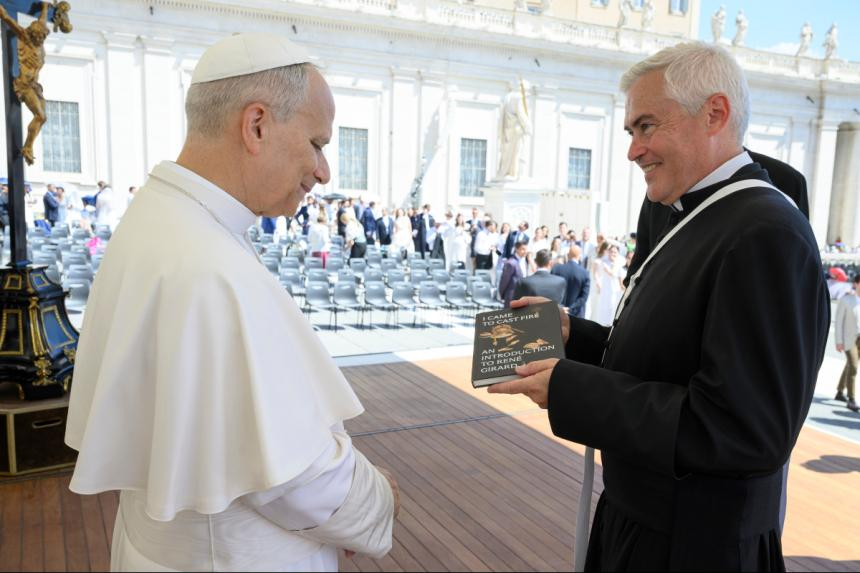
I had the profound honor to meet the Holy Father in late July to present him with a copy of I Came to Cast Fire: An Introduction to René Girard. As a New Yorker, I said, I am glad that an Augustinian (Holy Father) friar should meet an Augustinian Canon (me). With a great smile he pondered the book. Then my friend, Pater Simon de Keukeleare, a member of the Work (The Friends of Newman) asked the Holy Father if he knew of Girard, to which he replied, “Yes”—as if to say, “Who doesn’t?” The Holy Father was a model of hospitality. He would be receiving pilgrims for one and a half hours! I found him deeply peaceful and stable. He embodied in his demeanor Peter, the rock upon which the Church stands. I was overwhelmed by this grace.