
The College Beat: Article XI
. . .
Recent high school graduates hear all the time that the four years ahead will mark the real start to life. In many ways, this is true. College life has its thrills and grants young adults a totally different level of independence—the tempting feeling that they can do whatever they want.
But life at college isn’t really real.
One of the things I found most challenging to my spiritual life at college—and this was a curveball that caught me by surprise—was the lack of service obligations in my new lifestyle. I no longer had daily chores or siblings to pick up. Life at college suddenly became all about me.
My busy schedule left me little time in my dorm, and I rushed between classes, the dining hall, the library, and more classes with little on my mind except the next task. I quickly forgot what it felt like to be in a home where I had to constantly think, even on the most practical level, about those who lived with me.
The strange thing was that I didn’t seem to be doing anything wrong. Student services emphasized the next step—a career—almost as soon as I walked in the door. It became alarmingly easy to slip into a mindset that focused only on myself: my career, my friends, my classes, my GPA. After a while, I learned that service needed to be forced on me if I was to consistently live with a focus on others.
One of the ways I found I could do that, surprisingly, was through music.
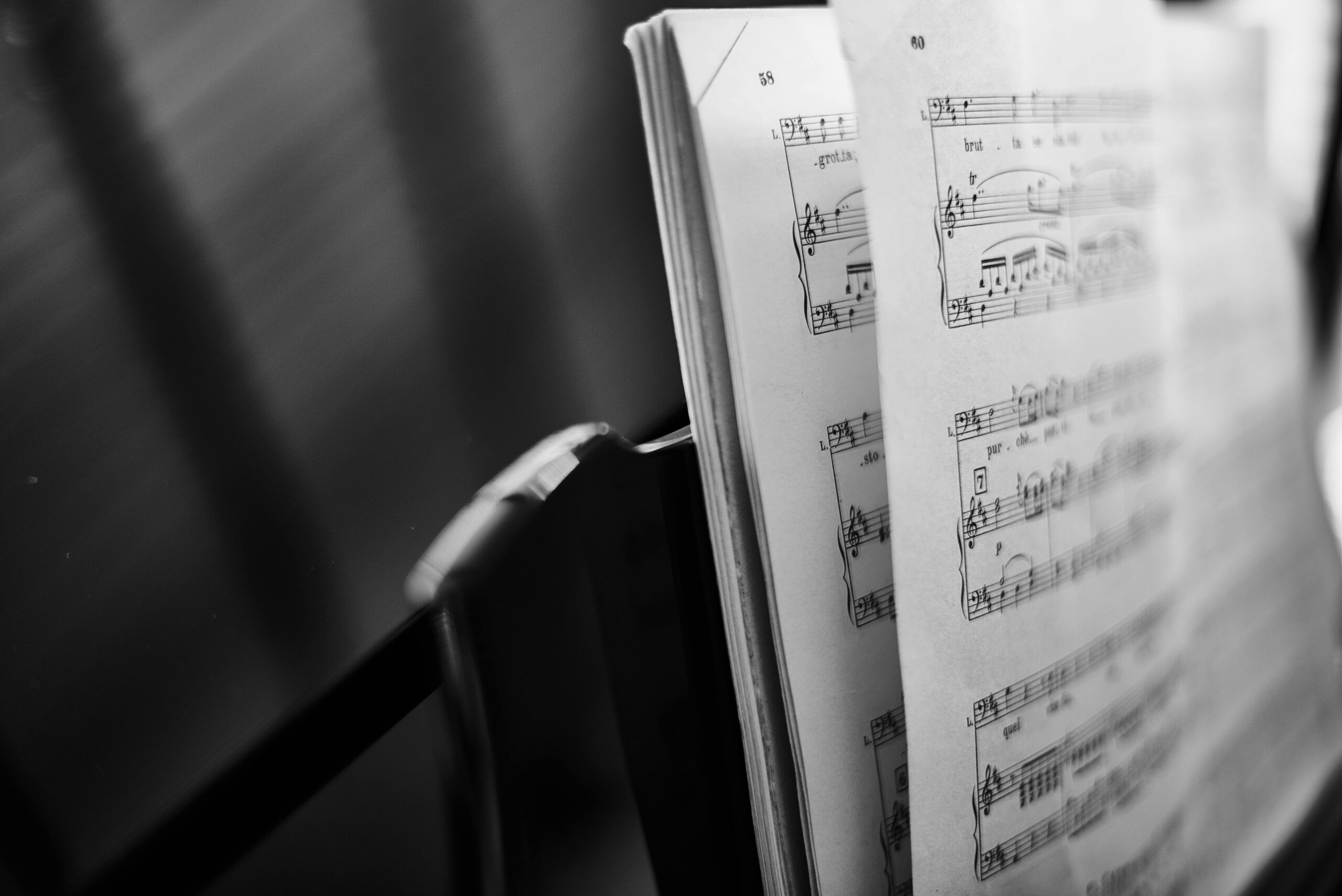
I’m a double major at the University of Notre Dame, studying great books and piano performance, with a minor in philosophy. I’ve been playing the piano almost my whole life, since the age of four or five. In my family, all ten kids were required to play an instrument through twelfth grade, so I didn’t really have the option to quit. But I grew up with a strong dislike for the piano bench, which I saw as the chain that kept me indoors, away from my siblings and friends.
Piano became an outlet for my soul and taught me the value of dedicated work.
It wasn’t until the COVID-19 lockdown during my freshman year of high school that I started to see piano as something of my own and began to really love it. There wasn’t anything else to do. I read a lot (Middlemarch in three days was my record, although that pace was because I had a bet with my mom), but beyond that I got pretty bored.
Piano became an outlet for my soul and taught me the value of dedicated work. It was oddly satisfying to drill a difficult four-measure passage for half an hour and then go back and play through it, noting the improvement. Playing works by the greatest classical composers exposed me to beauty in a singularly personal and creative way.
I distinctly remember the first time I saw my gift of music as a service, however. We have a close family friend who is blind. Unwittingly, he taught me a valuable lesson about music the first time I played the piano for him.
We held a small gathering in our family living room, our blind friend sitting on the couch where I could see him from the piano. I was playing Bach’s sixth Partita, and as the opening harmonies of the toccata cadenced through the room, he sat perfectly still. I’ll never forget the look on his face as I played—serenity, wonder, and quiet undisturbed on his features.
I thought about what it must be like to be blind. The inability to see beauty through the eyes gave our friend a greater appreciation for the beauty he heard through his ears. He gripped my hands afterward, telling me how much he appreciated my playing, and I saw then how important a moment of beauty was to a man like him.
I’ve always had horrible stage fright before and during performances, often crippling to my memorization of a piece. I dreaded performing. I was self-conscious about my talent, feeling, incorrectly, that any performance I gave was a kind of vulgar boast. I felt like a show-off.
Nothing could be further from the truth. I still dread performing, and often dislike it. But after that living room concert, I said, “Lucy, you need to get over yourself. It’s not about you. It’s about the beauty you can bring to others.”
My musicality is a gift from God and a way I can bring beauty to others. It’s a form of worship. The piano is my altar, and the music my incense.
At college, music has become one opportunity to serve. I play for friends in the lounge dedicated to my major. Students gather there all the time, continuing their discussions of Dostoevsky or Montaigne from the classroom. In that lounge, or with my friends in our dorm chapel, I try to bring the beauty of classical music.
We live in a world dominated by sound, which vies for our attention and leaves us, in the end, with splintered minds and brittle hearts. Most of the noise is meaningless: gas station ads that blare the second the fuel starts pumping, AirPods glued in the ears of isolated students, the tattoo of a bass drum you can feel from the next car over.
There’s a great space in classical music—perhaps because the music often lacks text—that fosters a contemplation literally surrounded with beauty. Beauty you can hear and feel as you think.
Our world is desperate for true beauty that points to God. Think of the day as an opportunity to fill the lives of those around you with that beauty. Our God-given talents are the most perfect of ways we can serve. I’m often reminded of Eric Liddell’s words to his sister in the classic movie Chariots of Fire: “I believe God made me for a purpose . . . but he also made me fast. And when I run, I feel his pleasure.” Any service that can bring beauty into someone’s life is the greatest of gifts.