
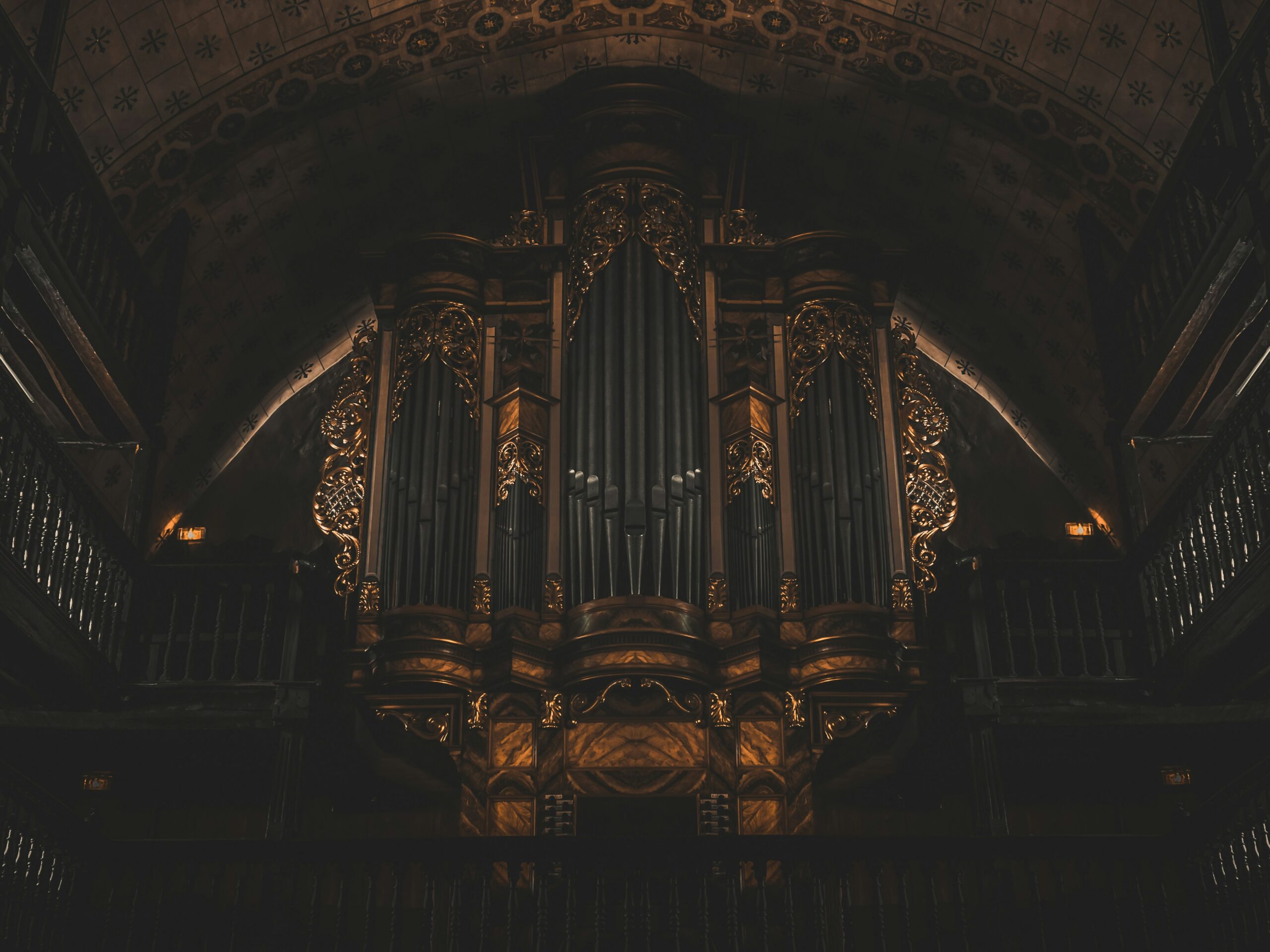
One line in St. Augustine’s Confessions succinctly summarizes my experience with Catholic sacred music: “Late have I loved Thee, O Beauty ever ancient, ever new!” Growing up, I didn’t have a good understanding of sacred music. The words “Christian music” meant little more than summer Bible school sing-alongs and catchy choruses I learned in elementary school. Even at church, it seemed like the dates of our available selection of hymns ranged from about the early 1970s to the late 1970s. Latin was an alien language.
For me and many others who grew up on that narrow range of church music, it may not have occurred to us that anything richer might exist. However, through my last couple of years in high school and especially as I began my college journey last fall, I realized the exact opposite was true. Suddenly, new and spontaneous experiences in church and school choirs introduced me to communities who strive for beauty in all things and care about the Church’s sacred tradition of music.
Similarly, more and more people in my generation, whether Christian or merely curious, are slowly realizing what we all had been missing out on in traditional sacred music—what conventional church music, for decades, almost completely excluded—by simply asking: “Was there more to this all along?”
Sacred music fundamentally connects us with God.
While I’ve pursued the answer to this question as a Catholic eager to learn more about the faith and its relationship to sacred music, three things have stood out to me that I hadn’t realized before: Sacred music fundamentally connects us with God, is more tangible and accessible than we realize, and supports and deepens our communities as a universal Church.
More Than Just the Smells and Bells
Gregorian chant and polyphonic sacred hymns achieve much more than sounding nice. What sets sacred music apart from even excellent secular music is that it ultimately points to something higher than ourselves. Everything in sacred music, including the musical beauty, the text, the composer’s intention, and the musicians and listeners alike, contributes to directing people’s minds and hearts toward God. What draws large, loyal congregations to traditional sacred music isn’t solely the atmosphere of candles and incense—the “smells and bells,” if you will. The Second Vatican Council writes:
The musical tradition of the universal Church is a treasure of inestimable value, greater even than that of any other art. The main reason for this pre-eminence is that, as sacred song united to the words, it forms a necessary or integral part of the solemn liturgy. (Sacrosanctum Concilium 112)
The direct appeal of sacred music to the faithful is the fact that, above all, it is sacred. It is not optional or decorative but an essential part of our worship.
Unlike secular music, sacred music, especially traditional liturgical music, has been used to nourish the soul and form a life of prayer and contemplation. Even simple Gregorian chants like “Veni Sancte Spiritus” and “Salve Regina” have timeless scriptural meaning, theological depth, and musical beauty—not because they were written to entertain but because they were meant to inspire souls by lifting the listeners’ minds to God.
More Approachable Than We Realize
Growing up, I thought sacred music in Latin, or anything composed prior to the twentieth century, for that matter, was abstract and lofty, its meaning hidden behind a veil that I just couldn’t penetrate. But in college, I’ve found the opposite to be true.
When one completely enters into sacred music, whether it be in the Holy Mass or even private listening, we can find we don’t need to understand it to be moved. Its beauty draws us in. Yes, there are barriers: ancient languages, complex harmonies, even the layered texts of Scripture or poems themselves. There will always be a mystery in sacred music, much like the mystery of our own faith. However, we shouldn’t let that deter us. We should rather let it encourage us to surrender and encounter the beauty of sacred music in a new way.
Today, through the internet, we have unprecedented access to choral works and can experience sacred music that, for centuries, people could only hear in certain parts of the world in some churches. Now, they’re a click away. But access is only the beginning.
Sacred music helps us encounter our faith not just intellectually but emotionally.
Sacred music helps us encounter our faith not just intellectually but emotionally. It moves us with joy, sorrow, awe, contemplation, hope, and love. For instance, reading about Mary at the foot of the cross is one thing; listening to Claudio Monteverdi’s seventeenth-century “Stabat Virgo Maria” is another. You don’t need to know Latin to enter into a mother’s raw grief through the cascade of soprano lines that almost imitate weeping. Likewise, Morten Lauridsen’s “O Magnum Mysterium” doesn’t just tell you about Christ’s birth, but it lets you fully enter, contemplate, and awe at the miracle of the incarnation—“O great Mystery, and wonderful sacrament, that animals should see the newborn Lord, lying in a manger!”
While sacred music should not supplant our reading of Holy Scripture, it can be an additional doorway to let our minds fully enter into the mystery of our faith. By receiving it before rushing to dissect it, we can allow sacred music to pull back the veil. We can enter into the Scriptures and liturgy through the part of us God made for beauty: the heart.
Sacred Music Can Unite the Church
Sacred music can support and deepen our communities as a universal Church through both time and space. Over the years, I’ve stood in Catholic churches around the globe and found myself completely in awe at how laypeople from entirely different places and cultures around the world can stand side by side and sing the same “Salve Regina” or “All Creatures of Our God and King.”
However, this isn’t just the result of shared childhood nostalgia. It’s evidence of the Church’s universality. Sacred music has woven us together across continents and throughout centuries, becoming an icon of the communion of saints: many voices, one song. It is Catholicism at its finest. Above all, the beauty of sacred music not only draws us deeper into our own faith but it can help bring others into the fold.
My parish priest recently hosted our church choir for a modest dinner get-together. Sometime in the night, he announced to us that in the month of June alone, eleven people had contacted him to tell him they were deciding to enter the Catholic Church. Every one of them explicitly mentioned the traditional sacred music that we choose to sing at our parish as part of what moved them toward the Catholic faith.
That moment reminded us: This music is a gift, but also a responsibility. Sacred music is simply ours to keep for the time being, and the laypeople of the Church are its stewards. While it may be tempting to take the easy route and replace the Church’s rich musical traditions with more “relateable” songs, we have seen the fruits of such a path. Rather, we must take up responsibility over this inestimable gift as a means for Christ to draw together a universal Church to himself.
Sacred music is not just good-feeling art or the smells and bells of traditionalism. It’s an essential part of our worship, the handmaiden of the liturgy. Above all, we as lay people have the opportunity to cherish, cultivate, and challenge ourselves with the music that glorifies God and of which we can continue to be fervent stewards: that same beauty, ever ancient and ever new.