
Last spring, I had the honor and joy of attending a Friday afternoon talk at Franciscan University of Steubenville by Dr. Matthew Breuninger, my former colleague in the Department of Psychology, author of Finding Freedom in Christ (Emmaus, 2022), and founder of Wellspring Counseling and Coaching. As a Catholic psychologist endorsing the complementarity and unity of faith and reason, specifically Catholic philosophical anthropology and the empirical findings of contemporary psychology, Dr. Breuninger’s talk on what makes for genuine healing featured a discussion of a remarkable finding relevant to how God has designed the human person: memory reconsolidation.
Contemporary psychology describes the phenomenon of memory reconsolidation as the process of reactivating long-term memories such that they become transitorily sensitive or amenable to agents that allow memory to be modified or interpreted prior to restabilization or, as the name suggests, reconsolidation. Simply put, psychologists have discovered that our long-term memories are intrinsically dynamic: They can be reactivated, given new information, and quite literally rewired. While the psychoneurological context of memory reconsolidation is contemporary, that our long-term memories are, on occasion, interpretively malleable is not; our memories are reactivated and rewired both by other people and by God. Other people—whether friends, psychotherapists, or anyone else besides—and God can remind us of things we know but chronically forget or cannot bring ourselves to willingly believe; through various means, they can help us challenge or reenvision encoded meanings we attach (or have had attached) into those memories.
Psychologists have discovered that our long-term memories are intrinsically dynamic: They can be reactivated, given new information, and quite literally rewired.
For example, let’s say I think the classes I taught went poorly because of critical evaluations at the end of the semester, and I then encode the generalization “my classes go poorly” into my memory (and let us envision that I hold onto this belief for some time). It usually takes a kindhearted reminder, often by students in those classes, of the good that happened, or a moment in prayer when I recognize that not every part went poorly even if some of it did, in order for me to “snap out of it,” as the saying goes. Or, to offer another example, in the midst of battling a difficult sin to kick, I may find myself beginning to believe falsehoods that become encoded into memories that sometimes happen concurrently with the sin itself: “This sin defines me” is one of the pernicious ones. Upon going to confession, the priest, in persona Christi, absolves me of my sin. I experience weight coming off my shoulders not only because I am forgiven but because I now no longer believe the lie initially attached to that memory. Perhaps only subconsciously, in the act of expressing one’s contrite heart—by voluntarily and remorsefully recalling or reactivating into the forefront of one’s consciousness the sin during confession—what takes place is God’s blueprint for one component of our healing: the ability to replace a memory’s attached false meaning with a true one. In each of these cases, respectively, memories with attached meanings get “rewired” by other people or God. What, if anything, does this psychological finding specifically mean for our faith as Catholics?
In its broader theological and metaphysical context, the discovery of memory reconsolidation in our cognitive blueprint is unsurprising on Christian theism, at least in part because it is an aid to spiritual transformation and psychological healing. Through the life, death, and resurrection of Jesus Christ, God desires to sanctify us and help us baptismally leave our former lives behind—and in the process, heal our wounds in a manner befitting to his providence and not our own, reflected in the old quip: If you want to tell God a joke, tell him your plans.
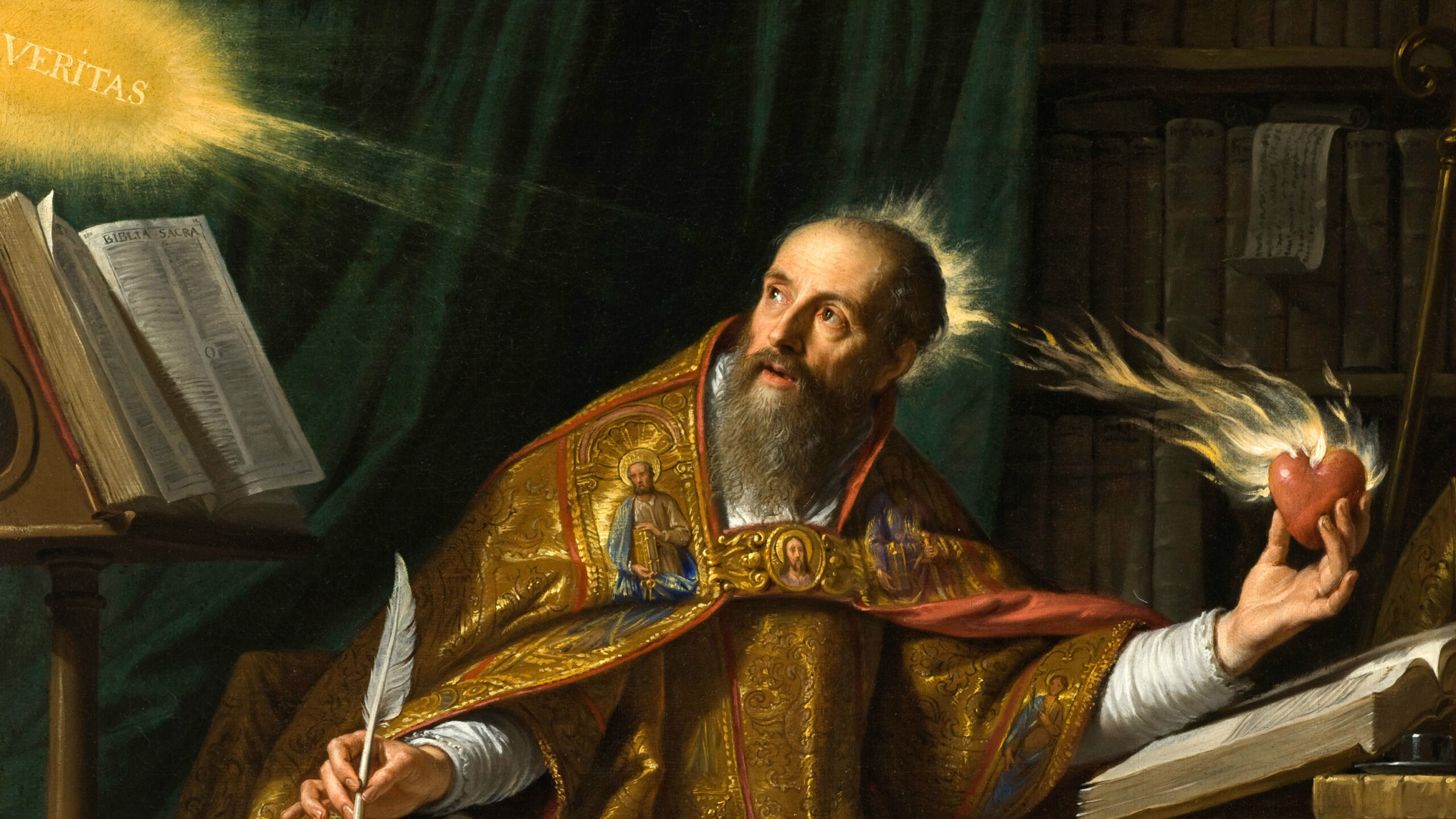
How, when, and through whom God desires to heal is variegated, but it comes as no surprise that our cognitive blueprint featuring memory reconsolidation may be yet another way in which he desires to heal human beings in a postlapsarian or fallen world. When Dr. Breuninger described the psychological phenomena of memory reconsolidation, I immediately considered what this finding would mean not only philosophically and theologically but in the lives of the saints, including—and especially—Catholic converts like St. Augustine, whose pre-Christian memories required a kind of integration into his Christian life. What does this integration look like, given the discovery of memory reconsolidation? Augustine is a case in point; his Confessions (c. 397) appears to be partially interpretable as an exercise in memory reconsolidation.
Augustine’s conversion experiences recounted in the Confessions include profound discussions regarding the reintegration of his pre-Christian past into his present Christian life: memories of childhood pear theft, delinquently lying to his mother, struggles with fornication, etc., must be fully reintegrated into his Christian life. This takes place not by merely renouncing the behavior nor repressing these memories but in the further components of metanoia: Seeing sinful behavior in the light of God’s love made possible through the theological virtue of faith, Ignatius-esquely seeing where God was present in those moments, and connecting those experiences to reasons for which God either caused or permitted those experiences. Augustine had to have had this in mind: “As I recall my wicked, wicked ways in the bitterness of remembrance . . . may You grow even sweeter to me” (Carolyn Hammond’s translation, modified; all translations will follow Hammond with my modifications).
By writing down his experiences, both pre- and post-Christian, Augustine reactivates many of his memories by making them explicit.
My somewhat experimental thesis is that Augustine’s Confessions, in fact, may be interpretable as an exercise in memory reconsolidation, albeit as an indirect goal of writing. That is, by God’s grace, and with God as his interlocutor, Augustine recounted the handiwork of God within his pre-Christian past through the act of writing and reactivating his memories. And this act, in the context of the Confessions, functions as the condition that makes possible the unearthing of God’s activity. By writing down his experiences, both pre- and post-Christian, Augustine reactivates many of his memories by making them explicit, with penetrating detail and expressive rhetorical power, so as to reinterpret them in light of God’s grace, activity, and sovereignty in his life. Consequently, Augustine begins to reintegrate the variegated experiences codified into his memories into the broader salvific theo-drama of God, and his role therein.
Augustine’s Confessions, as early as book 2, seems to motivate this interpretation. The entire opening of book 2, where Augustine discloses why he digs into his pre-Christian past, is worth quoting in full:
I wish to put on record the disgusting deeds in which I engaged, and the corrupting effect of carnal experience on my soul, not because I love them, but so that I may love You, my God. I do this because of my love for Your love, to the end that—as I recall my wicked, wicked ways in the bitterness of remembrance—You may grow even sweeter to me.
The structure of this paragraph, then, is in the form of voluntarily and truthfully bringing his painfully immoral memories into the light of truth before God, himself, and his readers in order not only to love God more but to see God in his memories and therefore “understand”—always in part—where God was and what his handiwork was doing in and through him. There are numerous examples in book 2 that let us see how this works for Augustine; our task will be to consult three.

First, in analyzing his moral weakness in the realm of purity and sexuality, Augustine writes, “You were always there, merciful even in your severity, sprinkling all of my forbidden pleasures with the bitterest of disappointments.” Augustine activates these memories of his “forbidden pleasures” so as to see that it was God himself making them utterly disappointing—an act of love to implore Augustine not to find rest in “forbidden pleasures” nor in creatura, since it is God alone who can satisfy the longings of the human heart.
Second, Augustine recounts that during the time he was living with his parents, “thorny growths of sexual immorality sprouted up higher than [his] head,” and despite his parents’ hopefulness for grandchildren, he nevertheless found his sinful condition pitiable: “Pity me! How do I even dare say that You were silent, my God, when I was the one withdrawing from You?” This seeming hiddenness of God is reevaluated in light of Augustine’s own sinful disposition: All those memories in which God seemed absent, making no mark on Augustine’s life and simply leaving him to the bitterness of his own sinfulness, are here reinterpreted as full of God’s activity. Not only was it Augustine’s sinfulness and consequent spiritual blindness—not God’s indifference—that accounts for his forlornness, Augustine says it was his mother, St. Monica, who was sent to give him Christian warnings about his wrongdoing. Ultimately, he comes to see it as God “speaking to me through her.”
Third and finally, after perplexing over the nature of sinful action in his infamous pear theft and unable to pinpoint any intelligibility in his sins, Augustine praises God for forgiving him. However, he then, in the context of remembering those sinful memories, implants gratitude—not only for the forgiveness of his sins but for God’s mercy limiting the evil he was committing: “I also count it a mark of Your grace all the evils I did not do. What was I not capable of?—I who even loved wrongdoing for its own sake!”
Augustine’s reactivated memories, by the grace of God, are reinterpreted as instances of God’s intimate, albeit sometimes tough, love.
Augustine’s reactivated memories, by the grace of God, are reinterpreted as instances of God’s intimate, albeit sometimes tough, love: Struggles with sexual impurity become to him evidence of God’s goodness in making his “forbidden pleasures” miserably disappointing; his spiritual and moral blindness were preambles to God’s sending Monica to his rescue; and even the unintelligibility of his own wrongdoing becomes an opportunity for gratitude toward God, who not only forgives him of his sin but also saves him from further sinning.
The claim is not that Augustine in fact had his memories reconsolidated; it is plausible he did, and he certainly gives that impression, but it is not beyond any psychohistorical doubt. Nor is the claim to prescribe, wholly out of context, spiritual advice about the writing of one’s autobiography. Rather, the claim, in sum, is twofold: First, that the empirical and psychological discovery of memory reconsolidation fits well into Christian theism, its philosophical anthropology, and its consequent implications for God’s design of our spiritual transformation and therapeutic healing. Second, that Augustine’s masterful text of self-interiority becomes all the more intelligible in the face of memory reconsolidation: Augustine, crying from the depths of his soul, recounts his sins before God, himself, and his readers, so as to reinterpret them in light of God’s grace, providence, and activity. And God has placed into this process itself his blueprint for our healing, mainly in part and often requiring many doses, but nonetheless an avenue in which he, by his grace and at his discretion, desires to heal us.
St. Augustine, pray for us.