
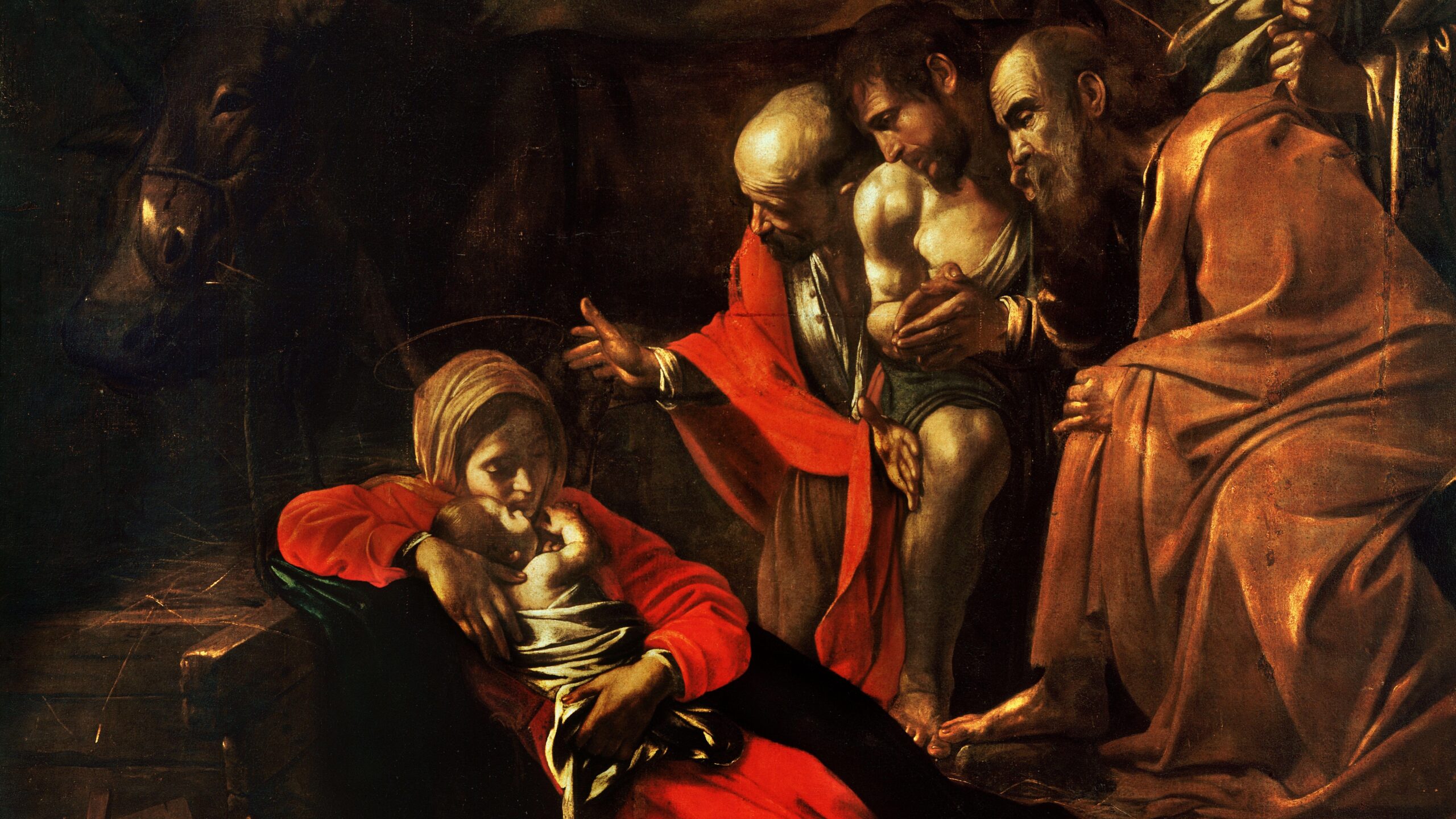
In a Christmas homily entitled “Setting Out into the Dark with God,” the twentieth-century Swiss theologian Hans Urs von Balthasar reflects on Luke 2:10–12, where the shepherds receive word from an angel that the Christ has been born in Bethlehem. The Gloria having been sung and the overwhelming light of the angelic host having already passed, the shepherds set out for Bethlehem carrying the seed of the word placed in their hearts by the angelic proclamation. With the glory of heaven at their backs, the shepherds make their way toward the city of Bethlehem, shrouded in darkness.
Compared to the birth of the forerunner St. John the Baptist, whose nativity was attended by family and friends, the birth of the Savior takes place in the most profane of circumstances—in a stable for farm animals, a grotto hidden beneath the earth. The Savior of the world is placed in a feeding trough for cattle. The cave toward which the shepherds make their journey is precisely the opposite of where the King of kings and Lord of lords would be expected to appear. To paraphrase the great G. K. Chesterton: Where before heaven was above the earth, in this case heaven, God incarnate, was below the earth. And unlike the popular paintings of the Christ child illuminated by an aureole of light, the child whom the shepherds found in the cave in Bethlehem was to all outward appearance a rather disappointing sight, except for the fact that he is the fulfillment of the promised sign:
And the angel said to them, “Be not afraid; for behold, I bring you good news of a great joy which will come to all the people; for to you is born this day in the city of David a Savior, who is Christ the Lord. And this will be a sign for you: you will find a babe wrapped in swaddling cloths and lying in a manger.” (Luke 2:10–12)
What are we to surmise from this rather embarrassing first encounter between the shepherds and God incarnate? Surely the Lord of the universe could orchestrate a more impressive debut on the stage of his earthly appearance? Indeed, God the Father would assuredly want to roll out the red carpet for his only begotten Son, through whom and for whom all things were created. After all, in the words of St. Paul’s Letter to the Colossians:
He is the image of the invisible God, the first-born of all creation; for in him all things were created, in heaven and on earth, visible and invisible, whether thrones or dominions or principalities or authorities—all things were created through him and for him. He is before all things, and in him all things hold together. (Col. 1:15–17)
How are we to make sense of this apparent contradiction? Perhaps the sign of poverty is precisely the manifestation of God’s presence in the world he came to save. Perhaps our idea of God, our picture of divinity, is misguided.
Perhaps the sign of poverty is precisely the manifestation of God’s presence in the world he came to save.
The Catechism of the Catholic Church (CCC) describes God’s omnipotence using three key words: universal, loving, and mysterious. Drawing on the passage from Psalm 115, “He does whatever he pleases,” the Catechism teaches first that God’s power is universal—“nothing is impossible with God” (Luke 1:37). Second, because God is precisely the Father Almighty, his power is loving. The third characteristic of God’s omnipotence is perhaps the most challenging for us to accept, though it is at the heart of God’s nature. The apparent powerlessness of God, the Catechism proclaims, is instead the greatest and most mysterious expression of his power: “In the most mysterious way God the Father has revealed his almighty power in the voluntary humiliation and Resurrection of his Son, by which he conquered evil” (CCC 272).
What can we take away from this? That it is precisely through the poverty of the humble stable that the glory of heaven was made manifest (CCC 525). Here, we can turn to the ancient Christ hymn of the first century memorialized in St. Paul’s Letter to the Philippians:
Have this mind among yourselves, which was in Christ Jesus, who, though he was in the form of God, did not count equality with God a thing to be grasped, but emptied himself, taking the form of a servant, being born in the likeness of men. (Phil. 2:5–7)
The key here is that the kenosis, the self-emptying love of Christ, is the direct opposite of Adam and Eve, who grasped after divinity when they succumbed to the lie of Satan. The self-emptying love of the Son sent by the Father is the undoing of our first parents’ sin, the love that is a “deeper magic from before the dawn of time,” to use C. S. Lewis’s phrase from The Lion, the Witch, and the Wardrobe. Moreover, this kenosis, which culminates in the paschal mystery of Christ’s cross and resurrection, is his self-identification with the lost, the least, those on the margins, and all who are forsaken. For it is only by going to the very depths of godforsakenness that Christ can lift the lost sheep on his shoulders and carry them to the Father’s heart.
For many, Christmas is a time of great anguish and loss. Those who have become trapped in the cycle of addiction and find themselves in profound suffering and disconnection from family. Those who feel swallowed by grief and the loss of loved ones, whose absence is felt most acutely in this season of togetherness. And those who have sunk into profound loneliness, pervasive sadness, and the experience of hopelessness. It is precisely for these that Christ was born poor, cast out, and in the very bowels of the earth. And, for the follower of Christ, it is precisely to these brothers and sisters we are called to go. The one who is sent from heaven to earth, to the hell of the lost, beckons each of us to go with him into these places of darkness and, with him, to serve those for whom he came. As Balthasar reminds us in You Crown the Year with Your Goodness,
In order that he shall find God, the Christian is placed on the streets of the world, sent to his manacled and poor brethren, to all who suffer, hunger, and thirst; to all who are naked, sick, and in prison. From henceforth this is his place; he must identify with them all. This is the great joy that is proclaimed to him today, for it is the same way that God sent a Savior to us.
This Christmas, let’s have the courage to set out into the dark with God. For if we reflect long enough, we will see that there is no other place for the Christian to be than where Christ is.