
“We are in the hand of God.”
These are some of the last words spoken by the Venerable Jérôme Lejeune to his children as he lay in his hospital bed dying of cancer just before Easter in 1994. As I begin this essay, his family, members of the foundation established to continue his work, and others were invited to an audience with Pope Leo at the Vatican to acknowledge the centenary of his birth, June 13, 1926.
Lejeune was the French geneticist who discovered in 1958 that Down syndrome is caused by an extra copy of the twenty-first chromosome. His discovery led to his rapid fame as a geneticist, but when he realized his discovery would lead to the prenatal diagnosis and death of tiny humans in their mothers’ wombs, his fierce prolife advocacy turned fame into infamy. He lost positions, lost funding for his research, and lost friends who knew that associating with him might put their own careers in jeopardy.
In his comments during the audience, Pope Leo said Lejeune “knew that technology can be used against medicine—which by its very nature is at the service of life—whenever it escapes essential ethical oversight and is governed instead by calculations of efficiency, profitability, or utility.” Those last three things were never Lejeune’s concern—only protecting life.
The venerable’s professional work of seeking treatments for individuals with genetic intellectual disabilities continues in Paris today, and the Fondation Jérôme Lejeune has provided millions in funding for other research around the world. His loving care for individuals with genetic intellectual disabilities also continues at the Institut Jérôme Lejeune in Paris and in other clinics that carry his name elsewhere in Europe and beyond. But it is his generous, loving heart and his bold defense of human dignity that remain at the heart of all their work. Pope Leo acknowledged this when he told those present in his audience, “I know that you regularly take part in social debates in order to protect every person in every circumstance of life. I also know that you are committed to promoting a culture of life through the International Chair of Bioethics, which provides academic formation for professionals in this field: healthcare workers, jurists, and philosophers.”
It was in the total dedication of Lejeune’s life to serve Jesus Christ through the vulnerable where the Church found confirmation of his heroic virtue.
The Lejeune International Chair of Bioethics in Madrid has organized a tribute to Professor Jérôme Lejeune with video testimonies by members of the Lejeune family, former associates and colleagues, and friends whose lives have been influenced by his legacy—including yours truly.
But it takes more than scientific discovery, doing research, and providing care to vulnerable patients to be named a venerable in the Church. When Pope Francis approved his case for sainthood to move forward in January 2021, it was in the total dedication of Lejeune’s life to serve Jesus Christ through the vulnerable where the Church found confirmation of his heroic virtue. Perhaps his dying words to his children best identify the source of his heroic life. The entire quote is this:
My children, if I can leave you with just one message, the most important of all, it is this: we are in the hand of God. I have had proof of this on several occasions in the course of my life. The details are not important.
Lejeune was a humble man, and we don’t know what those proofs he mentioned might have been. There are no claims of supernatural events during his life or following his death, but we do know that the Ven. Jérôme Lejeune always chose the narrow way—the way that Jesus said leads to eternal life. When presented with the opportunity to capitulate to the culture of death and thereby retain his fame and amassing fortune, he avoided that wide path of compromise and chose to be faithful and to defend vulnerable human life in the midst of a hostile culture.
Lejeune was blessed with many intellectual gifts, and his natural charisma and piercing blue eyes were effective natural weapons in his battle against the encroachment of legalized abortion in France. In fact, he was such an articulate and wise opponent of that culture that after participating in a televised debate on abortion one evening, one who was trying to defend the legalization of abortion said they would never invite him again. He was a far too effective opponent.
Lejeune lived during a very contentious time in France. Much like the 1960s and 1970s in the US, French culture, already weakened by their revolutionary past, was changing rapidly. France, once the “first daughter of the Church,” may have remained culturally Catholic, at least for a time, but politically it was committed to laïcité, or to a thoroughly secular state. Abortion was provisionally legalized there in 1975 and became permanent in 1979. France was the first country to declare a constitutional right to abortion in 2024.
Lejeune never subordinated his conscience to the demands of the secular state and remained firmly committed to his Catholic faith, which guided every aspect of his professional and private life. In that way, he is an excellent example for us today—not only for pro-life advocates but also for physicians and all those who may be tempted to acquiesce to secularizing trends rather than to stand firm against them. In their investigation of his cause, the Church determined that his courage and manner of life in the face of tremendous opposition was heroic.
For me, an especially valuable reminder is Lejeune’s example of how we should treat those we strongly disagree with. When his children asked why he didn’t hate or demean those who opposed him so fiercely, he reminded them that he was not “fighting people” but “false ideas.” He chose to follow Jesus’s admonition to love his enemies and to pray for those who persecuted him (Matt 5:44). That was a lesson his daughter Clara would say she remembered when she faced opposition in her own career simply for being Lejeune’s daughter. She said she was always guided by the example of her father’s “calm strength that walked straight ahead, without worrying about what was ‘politically correct.’”
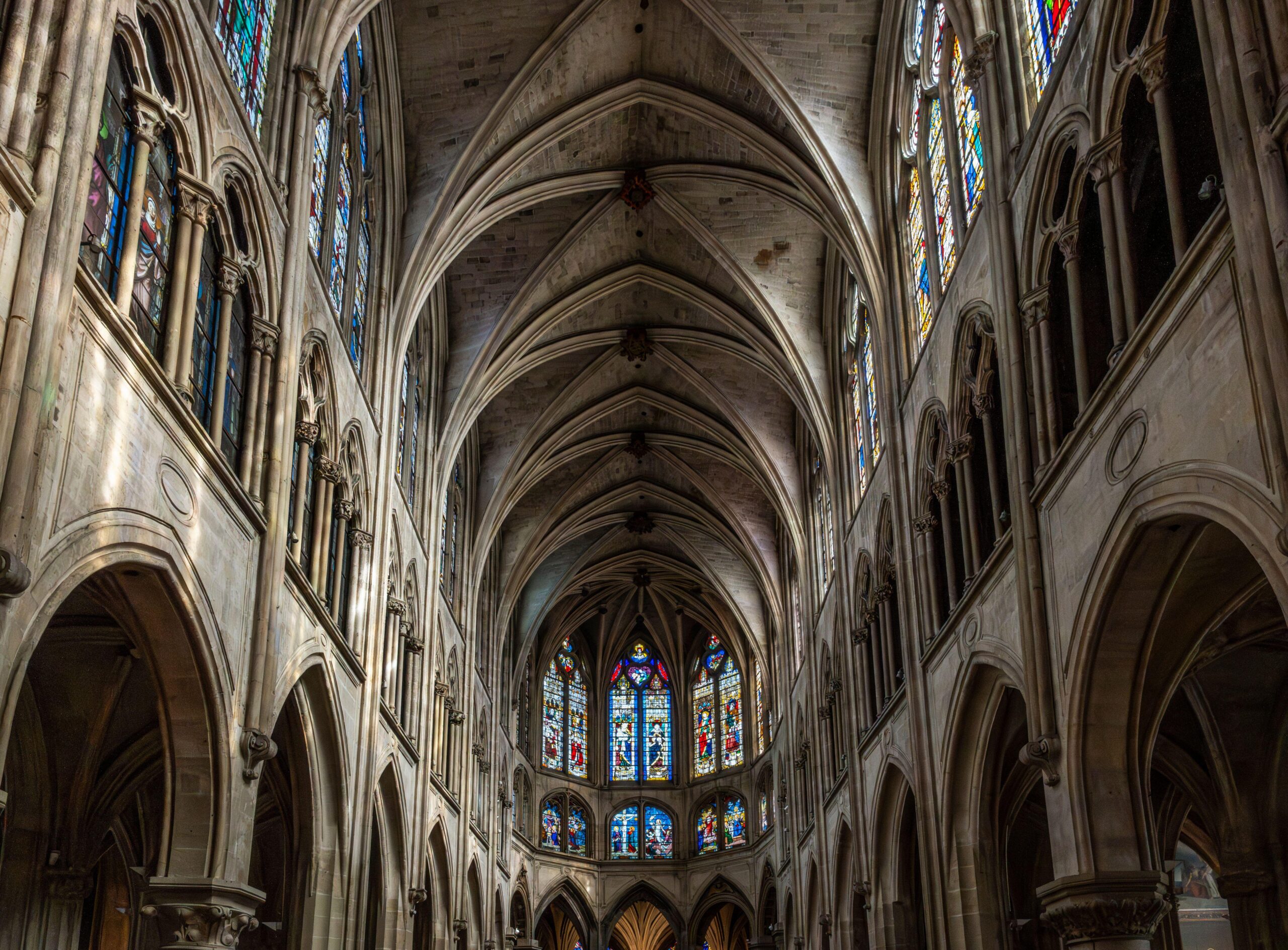
Word on Fire will be taking a group of pilgrims to France this October to celebrate the Ven. Jérôme Lejeune’s centenary. We will also be visiting three of the Gothic cathedrals that are featured in Bishop Barron’s forthcoming documentary, Heaven in Stone and Glass. For those who might like to join us, please see the brochure and contact me if you have any questions ([email protected]).
Lejeune was a close personal friend of Pope St. John Paul II, who named him the first president of the Pontifical Academy for Life. Upon his death, the pope wrote to the Cardinal Archbishop of Paris and concluded his letter with these words:
Christ said: “I am the Resurrection and the life. Whoever believes in me will live. . . .” We believe that these words were fulfilled in the life and death of our brother Jérôme. May the truth about life also be a source of spiritual strength for the family of the deceased, the Church in Paris, the Church in France and for us all, to whom Professor Lejeune has left the truly remarkable witness of his life as a man and a Christian.
As we continue to pray for the Ven. Jérôme Lejeune’s canonization, we pray that we too will be filled with the hope and spiritual strength that enabled this great man to love and to live for others, and to always fulfill our Lord’s wish that we care for the least of our brothers and sisters (Matt 25:30—46).