
In a coming-of-age novel about a neglected, introspective girl, a train slinks across the floor of an icy glacial lake, having careened off its tracks into the deep water below. A character named Helen abandons a young daughter, and a transient relative named Sylvie steps in, with varying degrees of commitment, to manage her care. An unusual painting, connected to the girl’s grandfather, hangs prominently from a wall, its earnest folk-art outlandishness imparting a note of wry absurdity. Nearby, a letter sits on a kitchen surface, conspicuously unread, as the specter of a transcendental eyeball (or something like it) looks on.
Meanwhile, in another world, an enigmatic, dream-like lake interlude gestures toward eschatological questions, toward a threshold that may represent either heaven or hell. And to mark its most mysterious, lyrical passages, the novel’s peculiar, largely affectless narrator repeatedly slips into a speculative mood, starting hypothetical statements with “Say . . .” As in: “Say the arrangement of my family was neither destined to be nor destined to last.”
Say that the novel in question is not Housekeeping, Marilynne Robinson’s breathtaking 1981 debut, but a brand-new novel from another debut novelist. The Hill, by Harriet Clark, is less an act of literary theft than an homage to Robinson, whose novel Housekeeping the author has said helped her make sense of her own adolescence. Set in New York City, The Hill tells the story of an eccentric family of disillusioned post-Soviet Jewish radicals, reconciling with a family member’s incarceration for a violent political crime—a setup “pulled” from Clark’s own experience growing up with a mother imprisoned for her role in the 1981 Brink’s robbery.
In the beginning of The Hill, 8-year-old Suzanna lives in an apartment overlooking the Hudson River with her grandparents. Her grandfather is a warm and quietly stabilizing figure, and her grandmother, feisty and emotionally stunted, the archetype of the wisecracking, disgruntled matriarch. The grandparents are popular: The apartment has a rotating door of their tight-knit cadre of aging revolutionary friends—gossipy, gin-drinking former comrades. Meanwhile, Suzanna’s mother, Helen, is serving a life sentence in a hilltop prison outside the city—not unlike Bedford Hills in Westchester—for a bank robbery gone wrong.
At first, Suzanna—having made a quasi-religious vow to visit her mother regularly—makes the long, wooded trips to the prison with her grandfather. After his death, the novel lurches into a tense matrilineal story, an intimate triangle between Suzanna, Helen, and Sylvie. Finally, in part three, the novel shifts again, this time into a broader network of surrogate mothers, adopted daughters, childless women, and spiritual kinships.
It treats many of the familiar pieties of contemporary literature with a certain amused detachment, as if seeing what was once edgy has become predictable.
It’s worth pausing here to note that within the context of contemporary storytelling, nothing could be more conventional than a broken family as a premise, and a protagonist’s subsequent mission to cultivate meaning and belonging by forging his or her own family with non-blood relatives. The “chosen family” has become one of the most dominant narrative tropes; what was once transgressive is now the default setting. This recurs particularly in plots centered on matrilineal lines, surrogate caregivers, and improvised communities of care. In this respect, much contemporary fiction functions as a literary expression of what some pejoratively call the Longhouse—a social order rejecting patriarchal authority in favor of therapeutic management, diffuse maternal authority, emotional safety, and skepticism toward hierarchy, risk, and familial continuity.
Where the Victorian novel typically began from assumptions of family continuity and inheritance, Modernism increasingly featured characters drifting from those structures into elective affinities and accidental encounters. Postmodernism often goes a step further: the stable familial order from which protagonists might depart is no longer present in the first place. Marriages are absent, fathers peripheral, and family continuity fractured before the story even begins. Within this framework, children frequently operate not as natural culminations of stories but as disruptive figures—iconoclasts—whose demands threaten protagonists’ autonomy. Children—noisy, needy, resistant to abstraction—introduce dependencies that interrupt efficiency and expressive individualism, representing commitments postmodernism often struggles to accommodate.
By some of these measures, The Hill—with its imprisoned mothers, disappointed grandmothers, surrogate caregivers, and lonely children—initially appears entirely conventional. Yet Clark’s novel eventually reveals itself to be after something quite different. It treats many of the familiar pieties of contemporary literature with a certain amused detachment, as if seeing what was once edgy has become predictable. Rather than treating familial rupture as liberating or chosen families as rebellious, The Hill remains skeptical of both. For all its postmodernist engagements—in tone, humor, playfulness, plot construction, intertextuality—the novel considers the possibility that familial bonds are not merely social constructions to be replaced or transcended, but realities that stubbornly persist. And that children indeed have a unique role to play as disruptors—but not of autonomous hero journeys, per se. Thematically, they can disrupt longstanding familial standoffs—and stylistically, the gimmick, bathos, and constipation that plague so many postmodern novels.
With respect to the postmodern instinct of regarding the nuclear family suspiciously—and treating that suspicion as evidence of one’s own profundity—no character embodies this more vividly than Suzanna’s grandmother Sylvie. Speaking a language of radical self-sufficiency, she tells Suzanna never to reproduce, fantasizes about abandoning family for travel, and burns photographs documenting the past. Most memorably, she insists “I gave birth to myself,” a declaration she clearly regards as profound. In one of the novel’s funniest passages, she rants against parents altogether: “No father, no mother, free of it all.” “You don’t need a father, Suzanna,” she says. “You need a self.” The speech is hilarious because of the degree of inherent contradiction. Sylvie preaches freedom from attachment while simultaneously revealing her own. She tells Suzanna to need nobody, yet cannot resist inserting herself: “I have my self and my grandma.” The supposed champion of radical autonomy remains invested in being indispensable.
The irony is heightened by Sylvie’s political history. A former Marxist, she once prioritized the collective; in old age she preaches the opposite extreme, a faintly Emersonian individualism. Yet in practice she reflects neither. As Suzanna observes, Sylvie insists that “the only life you could save was your own,” but continually places herself in service to others. She is devoted to her husband, protective of her friends’ relationships with their children, and preoccupied by memories of the parents she claims not to need. For all her ideological swagger and grand, self-mythologizing talk, Sylvie cannot help organizing her life around kin. Adorably, the novel does not condemn her for this. Rather, it gently pokes at the fantasy she represents. What once appeared as glamorous philosophies of liberation increasingly look, by the novel’s logic, like comic forms of self-deception—even if lovably so. What once appeared edgy now feels passé, eliciting a kind of affectionate “OK boomer” response.
Set against Sylvie’s chaotic contradictions is her equally stubborn, equally lovable foil, Sister Claudine. Tasked with shuttling Suzanna to and from the prison after her grandfather’s death, Sister is an aging nun with a penchant for stage makeup. Though she and Sylvie never actually meet, the two vaguely taunt each other through Suzanna. Both described as “determined,” both inveterate lecturers and questionable drivers, both punctuate their speeches with “believe me,” quoting literature to support their convictions—Sylvie invoking Gertrude Stein and Albert Camus, Sister Claudine, Virgil. Even their projections mirror one another. Sylvie performs independence through theatrical declarations about self-invention; Sister performs cheerfulness through layers of makeup concealing private desolations.
What separates them is not temperament but philosophy. Sylvie believes a person gives birth to herself; Sister Claudine, that human beings belong to one another. Sylvie preaches liberation from dependence; Sister insists that dependence is itself a kind of superpower. “You have to let yourself need,” she tells Suzanna. Needing the impossible “was the first step toward making it possible.” A longtime presence at the prison, Sister understands with startling clarity the sacredness of the parent-child bond. While the novel initially appears to inhabit the familiar world of broken households and substitute kinship structures, Sister resembles Sister Elaine Roulet, a real-life Catholic nun whose advocacy for prison nurseries, children’s visitation programs, and family reunification helped make Bedford Hills a model of family-centered incarceration during the time Clark’s mother was there. Like Roulet, Sister quietly insists that separation itself is a tragedy—and that parent-child reconciliation, however difficult, is worth pursuing.
The novel considers the possibility that familial bonds are not merely social constructions to be replaced or transcended, but realities that stubbornly persist.
Indeed, for Sister, familial reunion is not merely desirable but sacred. The hill itself becomes a place of holiness, of sacramentality—a site of impossible reunions, almost like an altar, with bridal imagery repeatedly invoked to describe relatives approaching it. “What God hath joined together let no man tear asunder,” Suzanna explains. “The family was one flesh and this made the prison, for Sister, as sacred a place as any. More sacred, really, as the hill saw week after week the sorts of impossible reunions expected more commonly at Heaven’s gate.” Fittingly, we learn that Sister keeps a “map of familial reunion” in her glove compartment, marking with stars the places she has delivered newly released women back to waiting families.
What ultimately distinguishes Sister from Sylvie, however, is that she has already borne the sacrifices Sylvie assumes she cannot understand. Several times Sylvie imagines Sister as having abandoned her own family in pursuit of her vocation. Instead, Sister’s backstories, when they gradually emerge, are some of the novel’s most affecting revelations. “I had a father,” Sister begins in one of her stories to Suzanna, in stark contrast with Sylvie’s “I have no father” a few pages earlier. What follows are tender details of Sister’s family that transform her from amusing eccentric into one of the book’s most moving figures.
Importantly, the effect is not merely thematic but aesthetic. Sister, who always projects cheer, has paid enormous costs to follow God’s call—and these revelations land with extraordinary force, providing exactly the sort of emotional payoff contemporary fiction often promises but fails to deliver. Sister’s past does more than explain her convictions; it illuminates them, revealing that love often entails not escaping attachment but bearing its risks.
Sister Claudine is, of course, a spiritual mother. Though she never bears children of her own, she spends her life mothering children and prisoners. Her vocation is maternal in every sense but biological. And she is hardly alone. The novel is replete with examples of “spiritual maternity”—in the sense articulated by Pope John Paul II (Mulieris Dignitatem, 1988) around the time in which the novel is set, and by the Jewish-born Carmelite nun Edith Stein, whom he canonized ten years later. For both, motherhood is not reducible to biological reproduction but describes a broader capacity to nurture and protect.

In The Hill, in keeping with the novel’s oddball sensibility, that spiritual maternity finds expression in unexpected, comical forms. When Suzanna encounters a former Hillcrest inmate, for example, the woman embraces her, weeping, “Look at my daughter, my daughter.” Elsewhere, Suzanna imagines a classmate on an acid trip as her sleeping baby. Later, she and Helen regard a prison guard as “a baby in the house.” Again and again, the novel depicts impulses towards maternity—manifestations of a certain inescapable motherly instinct even if channeled in kooky, strangely tender ways.
At the same time, the novel is haunted by children who are absent—the “unborn.” Sister often speaks of the unborn children of women who entered prison too young to conceive. Like the dead elsewhere in the novel, these children occupy a liminal status: absent yet somehow present, unrealized yet exerting gravitational force. The effect is less sentimental than metaphysical. Like a Hillcrest playground that sits unused, maternity remains significant even when interrupted, deferred, or unrealized—a condition that feels strangely timely, with policymakers beginning to fret about demographic decline in the 1990s, and later, “childless cities.” Fittingly, The Hill depicts a world in which children are conspicuous precisely through absence.
Yet The Hill is not ultimately a novel about absent children, but about one very present child: Suzanna. Rather than celebrating self-creation and independence, The Hill suggests that actualization and epiphany can emerge through the most dependent characters—the iconoclasts of self-sufficiency—and that children, in particular, possess power in this regard.
While much of postmodernism is uneasy about the limits children impose upon adults—Lee Edelman famously writes about the symbolic Child as disrupting certain forms of art, sexuality, and meaning—in The Hill, children function as agents of disruption, but good disruption. They can disrupt long-standing stand-offs, drawing estranged people back together. They can interrupt paralyzing cycles of resentment and isolation. “That’s something you could do for your mother and grandmother,” Sister tells Suzanna. “That’s the sort of thing children are particularly well positioned to do.” Whereas Sylvie warns Suzanna against reproduction altogether, Sister understands that children possess enigmatic agency.
This matters because the principle operates not only thematically but formally. The novel is not political or ethical propaganda for family life; rather, family is important because Clark derives her greatest artistic effects from it. Many contemporary novels promise moments of breakthrough only to collapse into inevitability or narrative exhaustion. The Hill actually delivers. Its deepest moments of transcendence emerge through reunion, devotion, and obligation, often between parent and child. In this sense, generational commitment is not simply one of the novel’s themes but one of its formal achievements. Its most memorable epiphanies arise not when characters free themselves from blood relatives, but when they discover that dependence and homecoming are sources of meaning rather than obstacles to it. In both life and literature, children break open closed systems. They make significance possible. They disrupt the matrix of stultification plaguing so many contemporary novels.
What once appeared as glamorous philosophies of liberation increasingly look, by the novel’s logic, like comic forms of self-deception—even if lovably so.
No character reflects this more than Helen herself. Mother of Suzanna, daughter of Sylvie, Helen is serving a life sentence—yet she emerges as perhaps the book’s purest soul. Throughout the novel, Helen is associated with attentiveness and adoration—qualities that resist the flattening effects of postmodern bureaucracy, abstraction, and technocratic optimization. She writes letters. She insists upon the irreducible particularity of human beings (“every woman deserved a name”). She sneaks into the chapel to receive Communion despite not being Catholic. Most importantly, she loves with staggering intensity. She adores her daughter, delights in introducing her to friends, and seeks opportunities simply to gaze at her—in a doorway, in the dark, while she sleeps. Helen’s deepest desire is not self-assertion but self-forgetfulness, a willingness to lose herself in love.
That disposition leaves her misaligned within the prison’s bureaucratic world of fluorescent lights, soulless hallways, administrative programs, and abstract management systems. Helen is drawn instead to intimacy and spaces of embodiment: the chapel, the children’s visiting area, bodies of water for swimming, the Reading Roost built by the nuns, and, most of all, any fragile moments of communion with Suzanna, which she prioritizes above all. At one point she declines entry into the prison’s coveted puppy-training program because participation would require missing several of Suzanna’s visits. Starved for affection and companionship, Helen nevertheless relinquishes her own needs for Suzanna. Like Sister, she understands love not as self-fulfillment but as sacrifice and self-gift.
Eventually, Helen is transferred to a dystopian prison in Arizona, a place stripped of Hillcrest’s humanizing features: no visitors, no puppies, no nuns, no children—just passing references to lifeless dolls in a museum. Yet she accepts the separation because she understands it is ultimately better for Suzanna’s development.
It is seeing a bride visit her mother, a fellow inmate at Hillcrest, that clarifies Helen’s decision to push Suzanna from the proverbial nest. Though Helen prizes her time with her daughter, she embraces suffering so that Suzanna can grow, leave the hill behind, and forge a life of her own. When asked what Helen wants, Suzanna explains that her mother wants her to “go find my horse”—a remarkable expression of selflessness, given that earlier in the novel, another daughter leaves her mother to run a horse farm and never returns. Helen’s deepest wish, by contrast, is not to possess her daughter but to free her. The bride imagery further suggests that whereas Sylvie wanted Suzanna never to reproduce, Helen wants her to remain open to familial continuity.
Like Sister Claudine before her, Helen comes to understand that love need not entail physical proximity. Throughout the novel, Helen is associated with communion and contemplation; in Arizona those qualities deepen into something resembling vocation. Helen encourages Suzanna to take her along wherever she goes, carrying her not physically but inwardly. Thus, separation gives way to higher forms of communion. Through contemplation—“the final stage of the nun’s life,” Sister explains to Suzanna, and something Helen has learned in a letter from her own mother—Helen learns to foster a world in which love and communion remain mysteriously present even across distance. What follows for both mother and daughter is not merely consolation but something approaching religious experience.
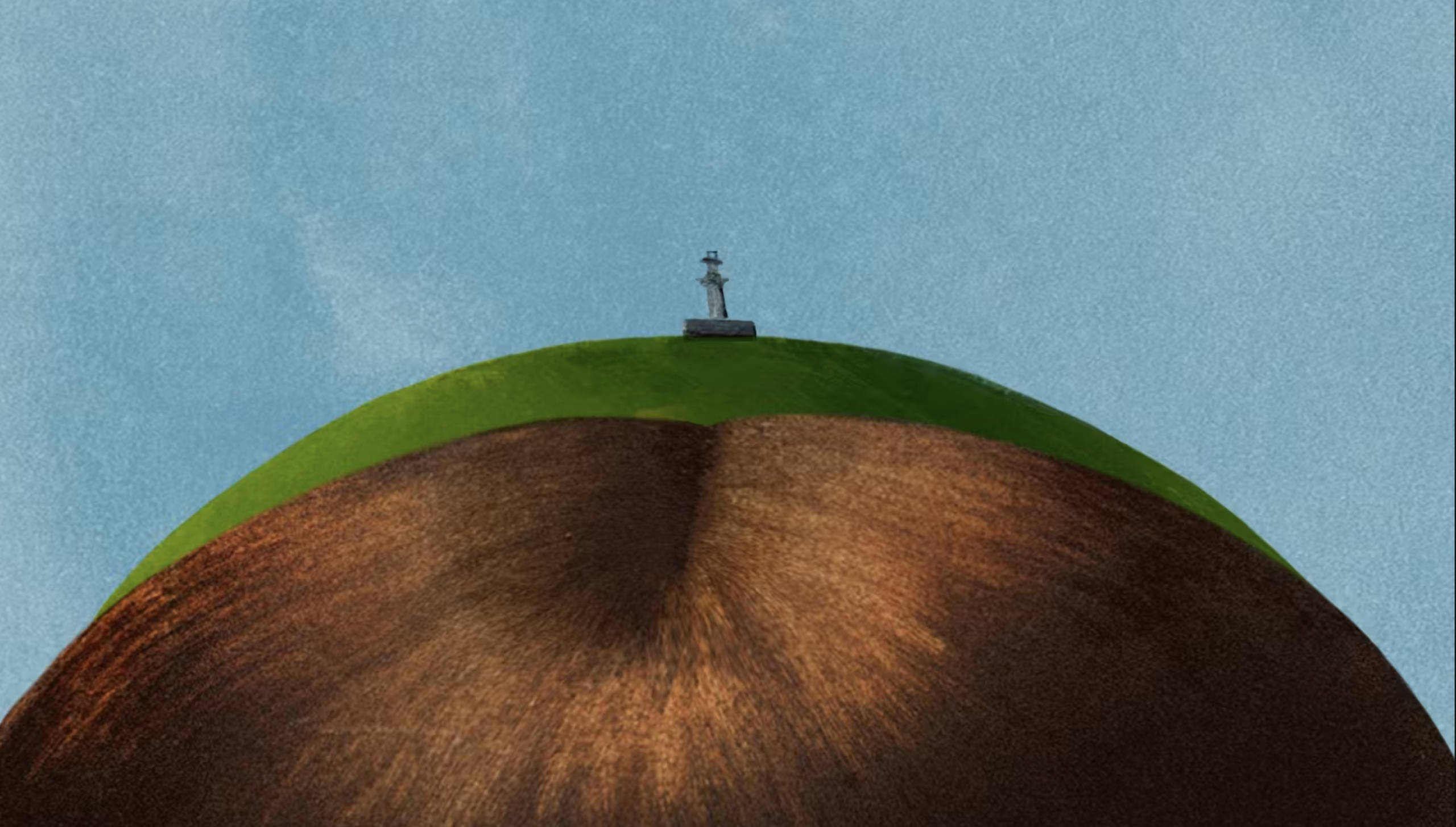
This is where The Hill distinguishes itself from so much contemporary literature—achieving a “new miracle,” both stylistically and thematically. Many novels promise transcendence only to retreat into irony, faux profundity, or narrative exhaustion. The Hill achieves something more difficult. Helen and Suzanna experience genuine moments of vision through the contemplation they learn from Sister and from Sylvie—and through fidelity to each other. Neither escapes into self-creation. Neither abandons obligations. Neither eschews the disruptions of the proverbial Child. Instead, both remain devoted to the seemingly mundane work of loving across distance, keeping promises, and returning to the same places again and again, even if only spiritually. Precisely because they refuse to transcend these ordinary commitments, those commitments become transfigured. The hill that Suzanna has climbed so many times becomes majestic, radiant with meaning; and Helen ascends, too, receiving lofty revelations of her own. A type of mystical union materializes, affirming the inviolable triumph of the mother-child bond.
Say that an otherwise wan protagonist in a postmodern bildungsroman intimately understands the sorrows and ecstasies of family life. Say that she invokes the crown of thorns, or Jonah in the whale, to describe suffering. In the end, The Hill sticks the landing, literarily speaking, because it understands that transcendence is not found by fleeing generational bonds, but by remaining faithful long enough to see them transfigured.