
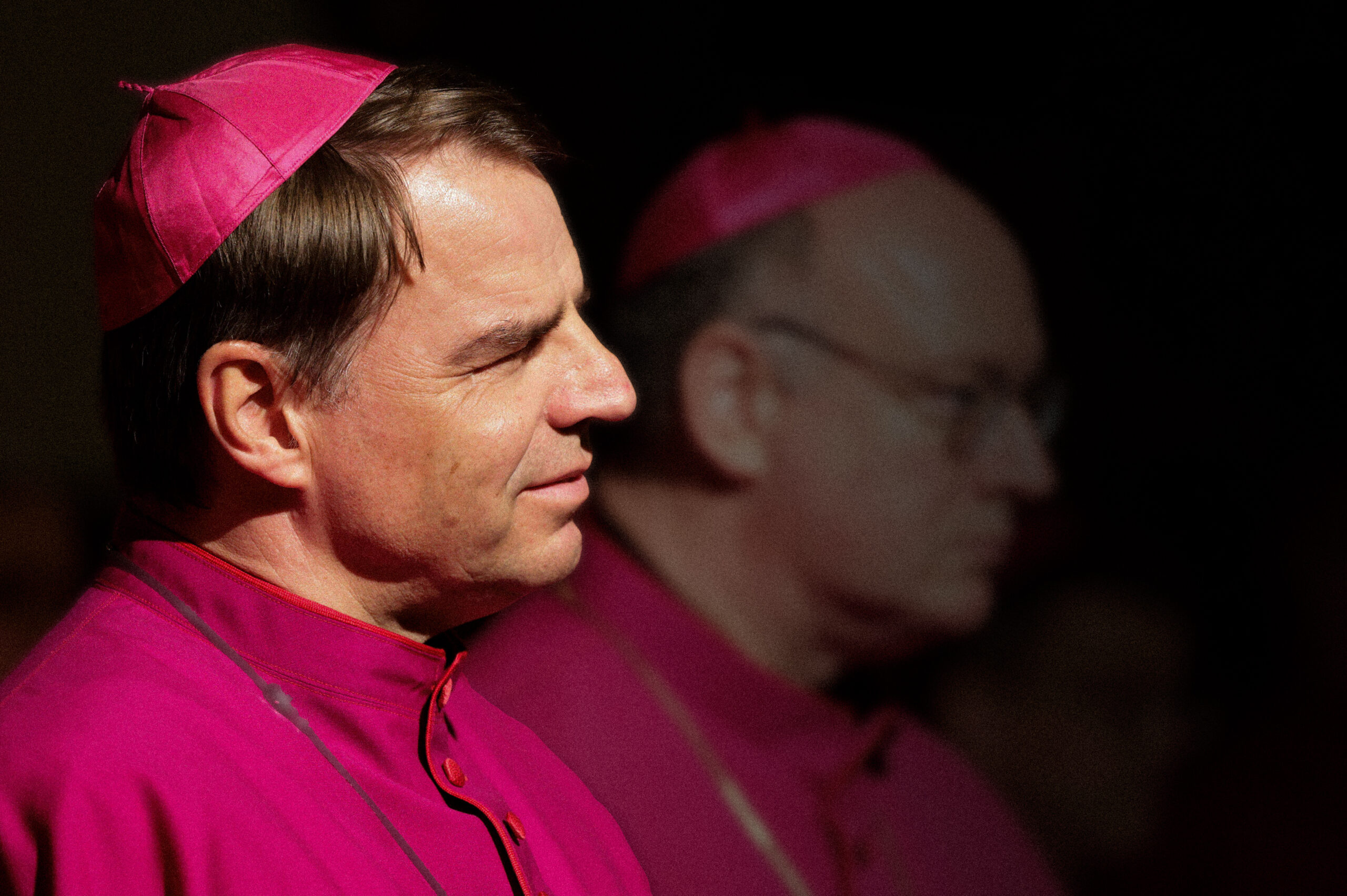
Bishop Stefan Oster of Passau, Germany, delivered a 40-minute address about the (German) Synodal Way on Wednesday, February 4, 2026, via YouTube. The written form was published on his website. Here, I would like to provide a summary of Bishop Oster’s main points for the sake of our anglophone audience. In preparation for this article, I listened to the German audio and read the German text. All translations and paraphrases thereof are my own.
To start, Bishop Oster used a provocative and revealing title for his address: “The Self-Secularization Continues: Reflections following the Last Assembly of the Synodal Way in Germany.” The referenced assembly was the sixth meeting of the Synodal Way [Der Synodale Weg], held in Stuttgart from January 29–31, 2026. Resulting from the gathering was an action report titled “Monitoring the Implementation of the Synodal Action Plans [Handlungstexte].”
This thirty-seven-page report includes summaries of surveys that were conducted before the latest meeting. It covers several themes, including very controversial ones advocating for drastic changes to Church doctrine and practice, such as the Church’s teaching on homosexual acts (5), the blessing of same-sex couples (21), and the ordination of women to the sacramental diaconate, as well as calls for worldwide theological discussion on admitting women to the priesthood and episcopate (35).
In the introductory portion of his address, Bishop Oster states he remains convinced “that the problematic ramifications of the Synodal Way for the Church in Germany and worldwide clearly outweigh its positive aspects.” The remainder of the text is divided into eleven numbered sections with headings that indicate the types of concerns he has.
“1. Polarizations are intensifying.” In Bishop Oster’s experience, the polarization between “liberal-progressive” and “tradition-oriented, conservative positions” has only gotten worse since the advent of the German Synodal Way. Increased tension has occurred globally, nationally, and locally. The relationships of the Church in Germany with the Vatican and with other national bishops’ conferences have suffered. Polarization has grown within the German bishops’ conference, between the clergy, and among the faithful alike. Ostensibly, one reason for this is the fact that “the Synodal Way explicitly promotes a liberal agenda.”
In his own reflection upon the Synodal Way’s treatment of Christian life, Bishop Oster “has the impression that an underlying motive of liberalizing endeavors” is behind their approach.
“2. What [are] the systemic causes?” Bishop Oster contends that the Synodal Way’s proposed solutions to the abuse crisis differ from those of Pope Francis, who named “clericalism” and “spiritual worldliness” as causes of the crisis. The Synodal Way fixates on other issues, such as the Church’s sexual ethics, priestly celibacy, clerical power, and women’s ordination. According to Oster, studies have already concluded that “neither celibacy nor the Catholic stance on homosexual activity would play a decisive roll with respect to abuse.” He concurs that the exercise of power and authority ought to be examined, but he fears the Synodal Way is intent on proposing changes that would “weaken or indeed eliminate the sacramental character of the Church,” which he cannot support. In short, he feels the abuse crisis is being used as an opportunity to push agendas that have long been near and dear to the heart of liberal progressives, even though those agendas have little or nothing to do with the actual crisis.
“3. Ultimately, it is about Catholic anthropology: man and sacrament.” Bishop Oster is concerned that the Synodal Way is calling into question the Catholic view of humanity, sacramentality, and—put together—the sacramentality of Christian people. He offers some biblical and patristic quotations that expound upon these themes, including comments about holy matrimony, the Eucharist, the priesthood, and the grace that makes new life possible, along with the obligation to die to sin (see Rom 6:2). He acknowledges that such conversion and change of life is ongoing, not instantaneous, but the unspoken inference is that the Synodal Way is undermining these sacraments and the moral demands of life in Christ.
“4. Emphasis on God’s assurance with simultaneous eradication of divine demands.” The Synodal Way’s stress on God’s grace and promises appears to forget the corresponding demands God places on us to live a holy life. In his own reflection upon the Synodal Way’s treatment of Christian life, Bishop Oster “has the impression that an underlying motive of liberalizing endeavors” is behind their approach. In the midst of this section, Bishop Oster recalls Pope Francis’s own warning to the protagonists of the Synodal Way not to create yet another Lutheran [evangelische] Church in Germany. Bishop Oster is concerned about the downplaying of the seriousness of sin. Ostensibly, this would be connected—but not limited—to calls for changes in the Church’s sexual ethics and definition of marriage.
“5. Mission to the poor.” Along with the Synodal Way, Bishop Oster affirms the need to stand with the poor, marginalized, and otherwise disadvantaged. However, the christological motivation for doing so has been insufficiently highlighted. He notes that “in the evaluation of service to people, there seems to no longer be any differentiation made whatsoever with respect to whether a person enacts this service with and for Christ or perhaps out of purely humanistic motives.” As Christians, we want “to give them more than just material bread.” We want them to come to faith in Christ. “And, indeed, our service to the poor consists precisely in this: through our service in the midst of their precarious lives to simultaneously communicate Christ to them. So that, out of the ‘ten lepers’ in the Gospel, at least one will hopefully return, who does not simply take Christ’s graciousness for granted, but rather returns in order to fall before the feet of Christ [vor Christus auf die Füße fallen] and praise God (see Luke 17:12ff).”
If Catholics no longer care about the Eucharist and the other sacraments, then that’s a bigger issue to address.
“6. What about faith in the real presence of the Lord?” In this relatively long section of his address, Bishop Oster gets at the heart of his concerns regarding the Synodal Way. He acknowledges that about 90 percent of polled Church members share the Synodal Way’s calls for far-reaching ecclesial reform on certain hot-button issues. “But,” he points out, “the tragedy is that well over 90% are also no longer interested in the sacraments, at least no longer in the sacrament that our tradition calls ‘the source and summit of all ecclesial life’!” Yet, Bishop Oster notes, “Nowhere in the Synodal Way have I encountered an earnest discussion [Debatte] about how we could more profoundly understand what ‘sacrament’ means and how we could thereby grasp anew what salvation means.”
Thus, while the Synodal Way feverishly pursues its secularizing and liberalizing agenda to conform the Church’s doctrine and practice to the current social mores of a de-Christianized society, Bishop Oster thinks the real, fundamental crisis in the Church is not being addressed. He contends that “the Church’s crisis is first of all a crisis of spiritual life and of the internalization of the contents of our faith.” If Catholics no longer care about the Eucharist and the other sacraments, then that’s a bigger issue to address. Placating people’s desire for the Church to reflect distorted, secular views on marriage and sexuality, as well as their calls for drastic changes to the sacrament of holy orders, will not resolve the core issue. The obsession with blessing same-sex relationships and admitting women to holy orders while ignoring the near total lack of belief in Christ’s real presence (both in the Eucharist and in the souls of the faithful) illustrates how far the Synodal Way is from the mind of Christ and his Church.
“7. The monitoring presumes changed doctrine.” The aforementioned report coming out of the latest Synodal Way meeting presents its points in terms of “monitoring,” suggesting ongoing vigilance to track how much its desires and directives are being implemented. Hence, it lists which provisions have been instituted by how many dioceses and reports on their experience with such implementation thus far. As Oster remarks: “Now, the monitoring presented during the Synodal Way already fundamentally presupposes a new sexual morality and along with it a new anthropology.” In each of the categories it treats, the Synodal Way’s practical steps assume that the doctrines must be changed. Thus, they proceed as if such doctrinal revision is a foregone conclusion, or, indeed, that the practice should be changed even ahead of—and perhaps to facilitate—such changes in teaching. As Bishop Oster characterizes it: “We have, of course, already seen this pattern in the Synodal Way from the beginning: the public pressure on the conservatives must remain high; then they will eventually acquiesce or even recognize their own bigotry and finally bow to the majority. And then hopefully the Romans will also.”
Bishop Oster affirms his belief in the validity and truthfulness of current doctrine, which he believes will not change under Pope Leo. Accordingly, he cannot submit to the calls for implementing the Synodal Way’s directives. Relatedly, he expresses concern for the faithful in Germany who simply want to live according to Scripture, tradition, and the magisterium, who are increasingly being treated as extremists simply on account of their orthodoxy.

“8. The rift from [Der Graben hin zu] many believers is deepening.” Bishop Oster reiterates his concern that the Synodal Way is facilitating further disintegration within the Church rather than promoting renewal. It is causing division between the Church in Germany and ordinary believers, other dioceses (especially in the global South and East), and Rome.
“9. Clericalism and spiritual worldliness.” Drawing from these twin concerns of Pope Francis, Bishop Oster contrasts the Synodal Way with Francis’s own vision of synodality. Unlike the former, the latter is not concerned with changing the truths of Christian doctrine. Rather, it is about how to apply and live out the truths of the faith in the present age. “The German Synodal Way, however, from the beginning, has been about, first, the alteration of doctrine regarding humanity and the priesthood, and, second, about politics, in order to prevail against the doctrinally conservative.”
“10. And the question about power?” Bishop Oster contends that the Synodal Way’s method for dealing with the issue of power is to call into question the sacramental character of the priesthood and promote a desacralized vision. In the end, this amounts to the clericalization of the laity and shifting power dynamics to gain control over the hierarchy. The means of achieving this was expressed by some at the assembly who insisted that the Synodal Conference is itself the governing authority that dioceses must obey: “Power is now to reside with the assembly in which non-bishops hold the majority.” This view directly contradicts the synodality advocated by Pope Francis.
“11. Signs of renewal beyond the Synodal Way?” In contrast with the destruction he sees resulting from the Synodal Way, Bishop Oster points to signs of authentic renewal in other parts of the Church (e.g., France, Belgium, western Switzerland, England, and the United States). There are “people who are searching for depth, for authentic, existential spirituality, for the beauty of the liturgy, for intellectual engagement with the great tradition. So—to use the incriminating term—rather conservative.” Such renewal also takes place in Germany, but normally no longer through the parish and other ecclesial institutions. Much of it is taking place online. No wonder, since, Oster remarks, “The Church establishment here is asking itself: Do we even want these people?” In other words, the orthodox faithful who love sacred liturgies are not welcome by many in the German hierarchy.
Bishop Oster concludes his remarks by acknowledging that we do, indeed, need to find ways of reaching those who feel “hurt and rejected by the Church,” such as those who do not understand teachings regarding sexuality and gender. The aim of such accompaniment, though, is their sanctification, which we can facilitate through our loving service to them. “We all need a deeper longing for the presence of God within us, a longing for holiness and truthfulness that helps us truly to touch people’s hearts with the Lord, and to seek the Kingdom of God with them.” In this regard, he calls us to imitate the saints, who are the ones that have successfully renewed the Church down through the ages.
As I mentioned in a previous article, Bishop Stefan Oster was one of four German bishops vocally opposing the German Synodal Way, which Pope Francis and other curial officials also criticized. The Synodal Way has remained undeterred. It will be interesting to see if Bishop Oster receives any support from his fellow bishops or even the Holy See. In the end, however, the important and commendable thing is that Bishop Oster remains faithful to Christ and to the Catholic faith he so passionately defends.