
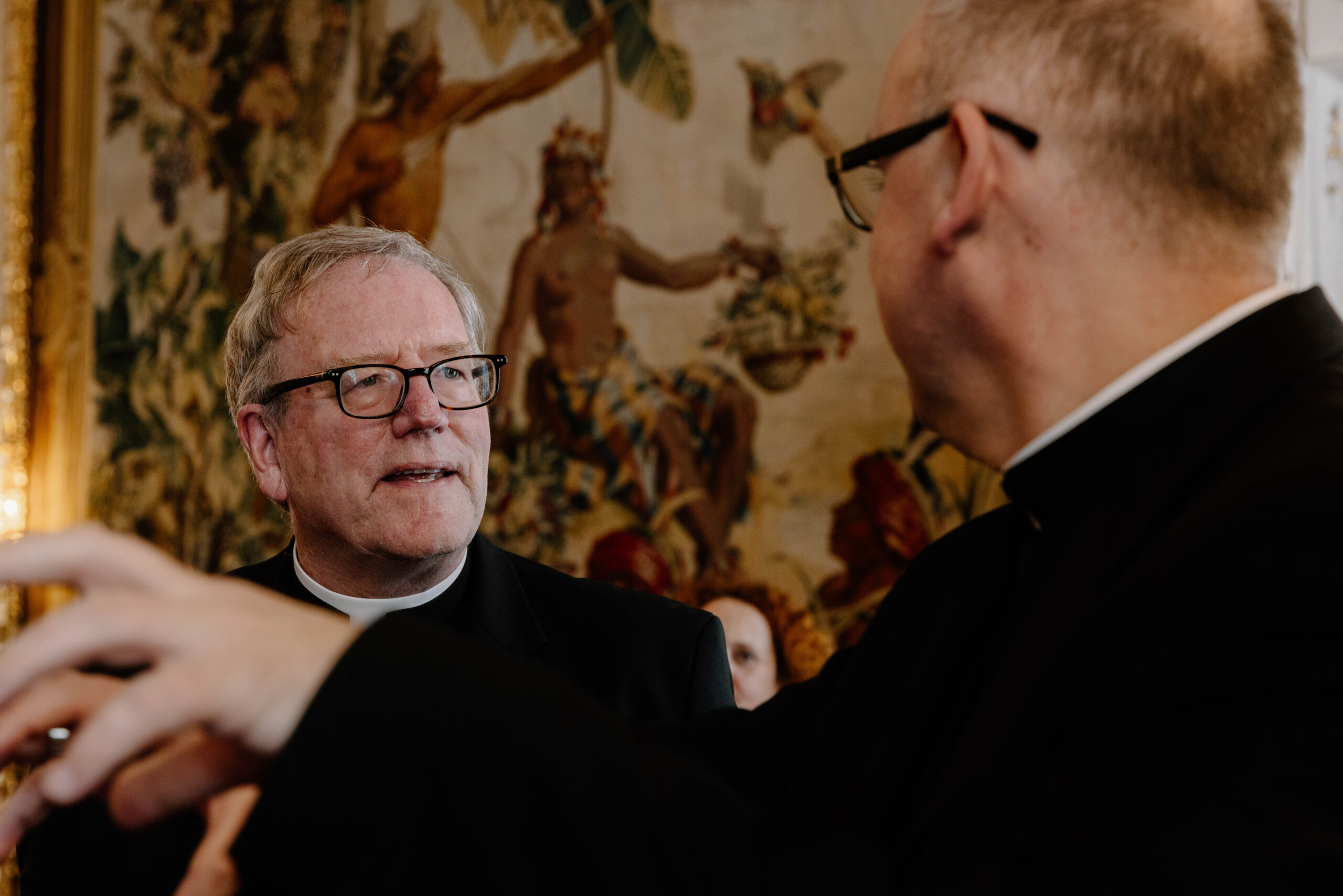
The following is a speech recently delivered by Bishop Stefan Oster SDB, introducing the 2025 winner of the Josef Pieper Prize, Bishop Robert Barron. The ceremony was held in Münster, Germany, on July 27, 2025. This is a translation from the original German.
. . .
Dear friends of Josef Pieper, dear Bishop Robert Barron,
You may be familiar with the following experience while visiting a church: You hear a preacher speaking, and what you hear goes in one ear and out the other. You are touched by . . . nothing! Of course, there may be several reasons for it: your own lack of attention and inner disposition. And of course, it can also be due to the speaker, who gives, for example, the impression that he has learned his material well, but it is not very relevant—neither for himself nor for you as a listener.
On the contrary, there are preachers who speak in such a way that they can stir something inside the listener. In the best case scenario, they even ignite something, perhaps even in such a way that they are able to take you on an inner journey of intense thought and compassion.
Think of the biblical example of the disciples of Emmaus, who leave Jerusalem disappointed after Good Friday. The risen Lord joins them, initially unrecognized, and lets them tell him what has happened, why they have lost their hope. And then he begins to open up the holy Scriptures to them in such a way that they ask themselves in retrospect, “Did not our hearts burn within us as he spoke with us on the way and opened up the meaning of the Scriptures to us?” (Luke 24:32).
I say intentionally that the two of them can express their perception this way only in retrospect. Because when you’re listening, when you’re going with the flow, when you’re fully present, you don’t usually think about the feelings you have. Instead, you are completely focused on what you are listening to, sometimes even enraptured by what someone is saying and also attracted by how he is saying it.
Or think of the apostle Peter’s Pentecost sermon, told to us in the Acts of the Apostles: Peter speaks of the risen one himself and of the prophecies of the Old Testament that announced the outpouring of the Spirit. And many listeners, we are told, were “struck to the heart” (Acts 2:37). And three thousand people were baptized. So what was so special about Peter’s sermon that it had this effect? You can read this sermon nowadays or have it read to you. And every one of us would know: If it were simply read out loud, it would never have the same effect as it did on the day of Pentecost in Jerusalem.
Some people have the ability to ignite people more than others.
But what is the difference between a preacher who speaks in such a way that what you hear goes in one ear and out the other, and a preacher who speaks in such a way that it goes “straight to the heart”? First of all, it is possible that both could even use the same words and say the same thing, and it could either bore me or inflame me.
We know it depends on the disposition of the listener as to whether or not something can reach the heart, but obviously some people have the ability to ignite people more than others. My personal experience—especially when I hear preaching—is that the preachers who really touch me are usually those who, to my impression, are also praying persons in an existential sense. They are the ones who let it shine through that they have prayed and are praying the Scriptures, who encounter the Lord in the Scriptures as the God who speaks to them and who is thus at the same time the demanding God. They are praying persons who are first receivers before they are givers. They are also persons who know about man, who above all know man before God—in man’s entire existence, with his joys and hardships. They also know man in his looseness and how much he actually needs love and the redeeming God.
But in order to understand people more deeply and to be able to put this into words, it is also extremely helpful to know philosophy, especially philosophical anthropology in connection with biblical anthropology and in contrast to circulating contemporary ideologies about human beings. Josef Pieper was a master in this. An older Salesian confrere of mine, a New Testament scholar from Argentina, once confessed to me, “We were able to learn from Josef Pieper what we can do today with Thomas Aquinas.” We can know man, in his concrete situation in the here and now, in his time and society, in the conditions that enable or prevent him from going deeper, in his longings and hopes, in his temptations and abysses—and above all, in what can open men today or broaden their inner view of the reality in or behind the objective-material world.
Who is the human person, and how do the human spirit and the recognizable, known reality relate to each other? How does the revealing and redeeming God come into play here? Does faith in Christ change our access to reality and to ourselves? Josef Pieper unfolds the fundamental connections of human existence with astonishing clarity, which open up to the Gospel as if by themselves.
Nevertheless, he remains a philosopher in the strict sense of the word; his philosophy is not simply crypto-theology. Rather, his thinking makes clear what Thomas Aquinas repeatedly developed as a Catholic axiom—namely, that grace presupposes nature and does not destroy it but completes it. So when natural reason, which is inherent in every human being, is touched by grace, it is not destroyed but is even more brought to itself as natural reason. This means that in his ability to recognize, man is directed toward the things of the world but in a way that places reason itself at the disposal of the recognizable world, without being influenced by primarily selfish interests. Natural reason, which is liberated to itself through the gift of grace, is able to recognize the things of the world in themselves—of course never in all their fullness and depth, but nevertheless with respect to their objective content.
Take as an example the encounter between two people: Imagine someone who meets you with genuine interest in you. And imagine this is someone who is not pursuing his own interest, not an ego interest, but really means you as a person. And imagine this person is also someone who fundamentally cares about the truth, someone who wants to live and stand in the truth. In a real encounter, a person like this may even recognize you more deeply and authentically than you do yourself.
Do you notice how recognition itself in this case becomes an ethical attitude? A recognition that is not simply possessive, that does not want to exercise power, that does not want to profit in a superficial way? As a philosopher, Josef Pieper opens up such relations to us in an inimitable way. He knows and recognizes man. And when you immerse yourself in his speech and writing, it reads pleasantly, agreeably, attractively. It is as if difficult issues are brought to light. His writing breathes freedom—and as a Christian, I would say: You can feel the grace in it.
An older, biblical word for this would be something like anointing. We find this word several times in Scripture, especially in the First Epistle of John: “You have an anointing from the Holy One” (1 John 2:20). The biblical word “anointed” or “anointing” connotes fragrance, a pleasant atmosphere, something that is healing, a certain lightness. At the same time, however, it conveys authenticity and something like authority; an authority that is, of course, not overbearing but that turns what is said into an attractive offer, a gift. A person who can be granted “anointing” in this sense is authentic, convincing, and free in what he says and how he says it but without being “persuasive” in a bad sense.
Think of St. Paul addressing the Corinthians in his first letter: He actually comes, as he says, in weakness and trembling, and he doesn’t want to persuade or use particularly clever words either. Nor is he concerned with himself, but only with Christ, the crucified one. But it is precisely in the midst of this, in this attitude of looking at the matter itself, or here at the Lord himself, that the Spirit and power are suddenly revealed, as Paul himself says (cf. 1 Cor. 2:1–4).
People probably sense when someone is saying something that is profoundly true. And even more, because it is true in a deeper sense, it is something that affects you deeply. The truth of things themselves and the truth from which I myself exist belong together; they have the same root.
I would even like to go one step further: Thomas Aquinas says, as Josef Pieper also reminded us, that whenever a person speaks the truth, it comes from the Holy Spirit. If someone is grounded in truth not only in his thinking but also in his entire existence, then this will also give him inner freedom. A person who is truthful in this sense has become inwardly free for an unintentional devotion to things for their own sake. Josef Pieper calls this attitude the capacity for “objectivity” (Sachlichkeit). And if this is true, then precisely in this Christ himself is mysteriously present. For, according to the evangelist John, Christ is the Logos—i.e., divine reason itself, the Word of God itself—in whom and through whom everything becomes recognizable and can shine forth in its own truth. Christ is the Father’s anointed one par excellence. And a deep, truthful, free devotion to the things of creation will then also be “anointed” in its recognition and speaking of them. And that is why such speech can also be powerful and profound in a good sense but without being possessive. And it may even be able to develop creative power in the heart of a person who is hearing it.
Unfortunately, ladies and gentlemen, in our language today we have rather mangled the word “anointing.” Because when someone speaks “anointing” in German, it is either banal or meaningless or in any case boring—in other words, exactly the opposite of what is meant biblically.
I have unfolded all of this from the perspective of Josef Pieper in order to finally come to Bishop Barron. He is a man who has in the last few years become one of the most influential Catholic evangelists in the world, especially the English-speaking world. And if I have just spoken of preaching that is igniting, and as well of knowledge of man and of anointing, I see all this—among many other qualities—in Bishop Barron too.
His most significant and extensive contribution to the Church’s ministry of faith is summarized in Word on Fire Catholic Ministries. It has become a very broad and deep work of the New Evangelization. As far as I know, it was called “Word on Fire” from the very beginning. This word is a perfect expression of Bishop Barron’s main concern: It is about proclaiming the Word of God itself in such a way that it can ignite—“Word on Fire”—so that people ask afterward, “Didn’t our hearts burn in our chests?” And that they might then stay on this track, continue to follow this Word, and bring it to life in their own lives. “Word on Fire.” There is probably no exact German translation of this. Wort auf Feuer certainly doesn’t sound like the English original. “Word that burns,” “that can ignite and carry away,” or even “Word that is anointed”—all of this is probably meant.
What is the difference between a preacher who speaks in such a way that what you hear goes in one ear and out the other, and a preacher who speaks in such a way that it goes “straight to the heart”?
But what makes the heart burn? One essential aspect is Bishop Barron’s comprehensive biblical education, his knowledge of Scripture. Like hardly anyone else, he opens up the coming of Christ from the whole of Scripture, including the great tradition of the Old Testament with its many fascinating announcements and promises that find their fulfillment or culmination in Christ. Of course, he does so with the greatest respect for the tradition of faithful Judaism—always with a well-informed connection to Jewish tradition. So it becomes clear why the attempt to understand Christ without the Old Testament would be an extremely amputated understanding.
From this understanding of Scripture, Bishop Barron proclaims the whole Christ, not just that one pleasant to us. It is about the pre-existent Son of God, about the Messiah promised in the Old Testament, about the child of Bethlehem, about the herald of the kingdom of God, about the healer of the sick, about the head of the new people of God, about the suffering and the dead, about the risen Christ as well as about the Christ who will return and judge. It is about the whole Christ, who invites us to repentance and new birth and who teaches us—as Paul says—to allow our whole thinking to be taken captive in him, in Christ (cf. 2 Cor. 10:5).
Bishop Barron also has extensive philosophical training, particularly in Thomas Aquinas, Paul Tillich, Josef Pieper, Dietrich von Hildebrand, John Henry Newman, but also in Nietzsche, Marx, Sartre, Foucault, and many others. From this perspective, he also knows the human being. He knows about standing before God, and he knows the ideologies about man, especially about man in our societies today. Moreover, he is also very well informed about the cultural, political, and social trends of the time and constantly seeks public discussions with key figures from politics, culture, and the media. And he does so with figures of all political and ecclesiastical persuasions.
But far more important is that he is a praying man—in my view, it is the decisive factor. He constantly calls us as Christians, especially those who are involved in preaching, to the “holy hour,” the daily hour with the Lord, by the Liturgy of the Hours, by reading the Scriptures, by adoration of the Blessed Sacrament. If you ask me where Bishop Barron receives the ability to ignite, or this “anointing” I have described, the all-important source is here! Appropriating Scripture on the one hand from comprehensive education and on the other hand from prayer, from dialogue with its author—this is the source of the anointing and the Word that can ignite and carry away.
Robert Barron is also—like Josef Pieper himself—a master of presenting complex content in understandable and beautiful language. And he is competent in the use of media. He used YouTube videos for the first time twenty-five years ago to enter into a conversation with contemporary culture like almost no other churchman. He made videos where he discussed movies from the perspective of faith. That’s how it started. He also preached by radio, and he produced a very successful series about the Catholic faith that aired on TV that he and his team filmed on several continents: CATHOLICISM, the story of the development of our faith and its beauty.
With this video series, now also available in German, he points to another concern of his preaching. As a theologian, he is deeply influenced by the so-called nouvelle théologie, which has its outstanding exponents in Henri de Lubac and Hans Urs von Balthasar. Joseph Ratzinger, a younger member of this important tradition, is also a frequent source of reference for the theologian Robert Barron. Balthasar has laid out his great, magnificent trilogy of theology in fifteen volumes according to the transcendentals: the true, the good, and the beautiful. According to classical metaphysics, the transcendentals are the basic determinations of everything that exists. However, Balthasar unfolds his great trilogy exactly in a reverse order. The first volumes of his great work are called Herrlichkeit: Eine Theologische Ästhetik. Balthasar does not begin with the true or good but with the beautiful.
This is also an extremely important and inviting approach to faith for Bishop Barron in his preaching. Much of what is done at Word on Fire, Barron emphasizes, is at last intended to be beautiful and aesthetically pleasing. After all, in a materialistic, liberal Western culture like ours, what the Church first proposes can in general no longer be what we have recognized as truth—i.e., the dogma. Nor can it be morality—i.e., the question of what is good or what should be done. In many respects, the Church today is too much in the moral dock for that. But what we can always do is show our culture what is beautiful and in what ways our faith is beautifully expressed in the many great works of our tradition: in painting, architecture, music, literature, and so on. The greatest artists of our faith tradition were also very often people of deep faith.
Therefore, the productions of Word on Fire are also truly beautiful, not to say exquisite. The video productions about faith, the saints, the sacraments—all are beautiful, very attractively produced. Finally, for several years now, an elaborate and beautifully produced magazine entitled Evangelization & Culture has also been published quarterly. And there is The Word on Fire Bible, a beautifully produced multi-volume Bible combining the biblical text with important commentaries from the great faith tradition and illustrations of outstanding works of art. It is a Bible edition that is “like a cathedral,” its creators say. And there are numerous books from Word on Fire’s own production or classics that are being reissued—all very attractively edited.
The aim of these efforts about aesthetically high-quality products is this: Anyone who is attracted by the beauty of these expressions of faith may—in a second step—be willing to ask what makes a life of faith also good and true, and so in the end find dogma and morality. In such a way, these two aspects can first be experienced as existentially relevant and liberating, not alienating or even accusing. After all, this is a common prejudice of our time: Catholicism demands a system of beliefs that begins with sentences like “You must,” “you should,” and “you should not.”
In our country, the question has been recently asked more emphatically than before, especially after various empirical surveys: Are people really religious by nature? Or even Christian by nature? Catholics have taken it for granted since the Church Father Tertullian. Surveys in our country have shown for a long time that more and more people are turning away from Church and faith. There are various reasons why they leave the Church, but it’s an interesting fact that the vast majority of them no longer turn to another denomination or another religion. Nor do they become esoterics, as I previously was inclined to believe. Rather, the increasing number of people are those who become either a-religious or anti-religious when they leave one of the two major churches in our country. And when I talk with my confreres in the eastern federal states of Germany, I have been hearing statements like this for a long time: Many people are no longer interested in the question of God at all. They are disinterested and therefore precisely a-religious or anti-religious. But, then, what is meant by the old sentence speaking of the anima humana naturaliter christiana—i.e., the insinuation that the human soul basically finds a kind of natural equivalent by faith in Christ?
If someone is grounded in truth not only in his thinking but also in his entire existence, then this will also give him inner freedom.
In his context and for his country, Bishop Barron also repeatedly addresses the growing number of so-called “nones”—people who answer “none” when asked what religion they are. And yet, he adheres to the basic anthropological definition that Augustine once formulated, “Our heart is restless until it rests in you, my God.” One of the main factors why people no longer find this peace of faith or even no longer seek it may be, among many others, the level of media distraction. If people today devote many hours of their daily time to media consumption, it is possible the soul loses its contemplative dimension or that it becomes deeply buried. In the classical tradition, this would mean the ability to see: to perceive the world with the entire faculty of the soul. And such contemplative regard goes deeper than seeing just something or many things, as Josef Pieper has repeatedly pointed out.
The media, especially digital media, constantly distracts us, serves our tendency toward addiction and constant curiosity, and at the same time promotes our tendency toward narcissism, thus spoiling the ability of our soul to look deeper, to allow ourselves to be touched by the truth. Bishop Barron is aware of all of this, including in connection with what the philosopher Charles Taylor called the “buffered self.” This means a common way of self-perception of the human being in our time, aiming to unfold and develop his potential solely within and from himself, and so he hardly enters an attitude of receiving and gratitude. This comes from a development that has been taking place for centuries and has continued through specific forms of rationalism, individualism, subjectivism, materialism, and other phenomena and was further intensified by the technological revolution. This modern form of self-awareness is, in Taylor’s term, “buffered”—i.e., buffered against everything that could determine or even define me from the outside. And it seeks to behave in a self-determining way, ultimately ascribing to itself what is accepted from the outside. The external world is therefore used and needed much more in function of the self and much less as something given to us for which we are thankful.
In the midst of this culture of the digitally distracted, buffered self, which tends toward constant narcissism, Bishop Barron himself nevertheless continues to enrich the culture. He and his now considerably large team constantly use both social and traditional media to reach people. The internet Areopagus, which is full of chatter and superficiality, has been enriched with quality, argument, and beauty for years. As far as I can see, the United States has suddenly become the pioneer of a perceptible conversion movement: Catholicism is remaining rather stable in number after years of recent decline. Incidentally, this also applies to vocations to the priesthood. And moreover, there is a considerable new turn to Catholicism among intellectuals, actors, media people, and educated young adults. And if this is a verifiable trend, Word on Fire and Robert Barron are indeed a major factor in it. People seek and find quality, intellectual, and existential engagement and guidance to the faith with him, which satisfies many of them far more than other approaches. Barron’s approaches also seem to reveal something of our basic anthropological axiom: The human heart can only find peace in an encounter with the infinite.
It may be that the constant, addictive distraction of digital media is a path to a bad infinity; Bishop Barron’s content offers instead a way beyond it toward an encounter with the real infinite, with the living God. Again and again, people in the “Areopagus of the internet” bear witness to how much Bishop Barron has helped them to encounter the real God beyond the internet: in prayer, in the Word, in the sacraments, and in the community of the Church. One of the messages Barron always repeats is especially important: “Don’t dumb down the faith.” In German, it means something like: Let’s stop trivializing the content of faith. No, our God is not a nice grandpa who sits on a cloud and is happy when his creatures do just a little bit of nonsense. And Jesus is not a nice, sandaled man who walks through Israel and strokes the children’s heads. Our God is the Creator of heaven and earth who let himself be tortured and killed in Christ in order to love his creatures home. In doing so, he defeated sin, death, and the devil. And this God longs for creatures who have been made new, who have a new heart, and who can be recognized as belonging to God’s family—those who allow God to determine the path of their lives, who, in Barron’s words, have entered the stage of theo-drama and left behind their personal self-reflection or ego-drama. Therefore, don’t dumb down the faith.
Incidentally, Bishop Barron also wants others to get to know what he is doing with Word on Fire: evangelizing in today’s world and its culture. Two initiatives in particular stand out for this purpose. One is the Word on Fire Institute, an interactive online community with numerous courses that convey the depth and beauty of the faith, offer help to live a spiritual life, and support participants from all over the world in sharing what they have received with others. After six years of existence, the Institute has over 25,000 members. In addition—and this is the latest initiative—Bishop Barron has begun to gather a group of priests around him to continue his work. As far as I can see, it is to be the beginning of a new congregation, consisting of men who, as priests, are just as good with new ways of evangelization in the digital world and other contemporary worlds as they are with good theology and philosophy.
* * *
Finally, a word about the political dimension of Bishop Barron’s work: First of all, Barron is a philosophically educated, systematic theologian who succeeds like few others in bringing the faith into conversation with the culture of the time. And for him, this conversation naturally includes Catholic social teaching, which he explains just as clearly as other topics.
Instead, there are some voices in our country that try reflexively to defame him as right wing or as a supporter of Donald Trump, and it usually happens very quickly. To my mind, such a categorization says much more about the person making this judgment and about the Church system and its media processes in our country than about the person being judged.
I’m going to sharpen things up a little in the following. By this, I don’t mean all manifestations of Catholicism in our country but something like the majority views among those who are still Church tax–paying members, as well as among those who earn their money from Church institutions. The majority, as I perceive it, has largely adjusted to the fact that positions of liberalism have been reached in our German Catholic world, from which many simply no longer want to or can go back. This is true in particular with respect to the major anthropological questions and, in connection with this, to the very fundamental question of the sacramental constitution of our Church. Many in our Church have largely left binding doctrinal positions behind. And because there are so many of these people, just as many probably think this is basically the new Catholicism shared by most Catholics; it is only in Rome or other parts of the world Church that this is not yet as well understood as it is here. And then it fits well that conservative or even right-wing political movements and parties propagate and instrumentalize family policy positions, for example, that actually have their origins in the faith and the human image of our Church—for which we are the original and not the worse, political copy, which is often enough nothing more than superficial populism. Nevertheless, such populistic instrumentalized positions can be easily used to defame a substantially and intellectually profound Catholicism as “right wing,” simply because it no longer fits in the shared view of faith by a Catholic majority.
As a consequence of such debates, a characteristic of the Church quickly becomes apparent in our country, in which something like a mostly well-financed Catholicism of appeasement often dominates but which has essentially lost its spiritual power and attraction. By this, I mean a kind of affiliation of many Catholics in our country who struggle with some essential aspects of our teaching or who have long left them behind but who are still with us for other reasons. For example, because the Church is ultimately a good employer where people are financially well secured, or because “they do a lot of good social work at the Church.”
In any case, we also have a lot of what Bishop Barron calls “beige Catholicism”; beige here meant as a color that is not too bright and therefore not too meaningful. As to the understanding of faith, beige Catholicism is a phenomenon where the prevailing culture dominates the faith and adapts it to itself, without the faith being effective in the opposite direction. In other words, without being a faith that is capable of changing the culture with truthfulness, conviction, and love. I am very sure Josef Pieper would never have wanted to defend such a beige Catholicism. In his willingness to engage in discussion, Pieper was open to any discourse, but in the principles of his faith, he was a faithful man of his Church. And it is precisely in this respect that, in my view, Pieper has much more in common with this year’s prizewinner than with all those who wanted to rescind the Pieper Prize from Bishop Barron because they no longer consider him compatible with a predominantly German form of Catholic belief.
And indeed it is true that something like the New Evangelization has no easy standing in our specifically German form of church for precisely this reason. Many find it annoying or suspicious. But because the New Evangelization is at the heart of Bishop Barron’s faithful commitment, it seems almost inevitable to his critics that he must somehow come from the right-wing corner. And, as I already said, such a categorization says more about the categorizer than the categorized.
But let me predict the following. In the foreseeable future, many more people will ask themselves: How can it be that Bishop Barron has such a reach in our country and has long been one of the beacons of hope for renewal among many young people in our country? How can that be, even though he is so loyal to the magisterium? Perhaps one or the other will end up reflecting and finding the following answer: Perhaps this is why Bishop Barron is so successful and has such a wide reach, not despite but precisely because he is able to speak the great, beautiful tradition of the Catholic faith so vividly, so deeply, and so relevantly in our time. And it may even be precisely because of this that sincere seekers of truth can really get to the depths in which their soul is nourished, instead of ending up frustrated in a right-wing or left-wing political extreme.
Bishop Barron has now received nine honorary doctorates and numerous media awards. He has been invited to the headquarters of Google, Amazon, and Facebook to speak about “Arguing Religion.” He has spoken in the British Parliament about the role of the Church in history, and he has over six million followers on the combined mainstream social media channels.
I therefore hope this award ceremony today will bring him to the attention of many more searching people and that in this way he can also contribute to a new awakening of the Catholic faith in our country, as he did in his own homeland.
Dear Bishop Robert, it is a great pleasure and honor for me to congratulate you on the Josef Pieper Prize for 2025. Thank you for your great service, which fits so well with the thinking and work of Josef Pieper, and which is so exemplary for the New Evangelization inward, into the Church, and at the same time into the broad conversation with the culture and the world of today.
Congratulations and God’s rich blessing!