
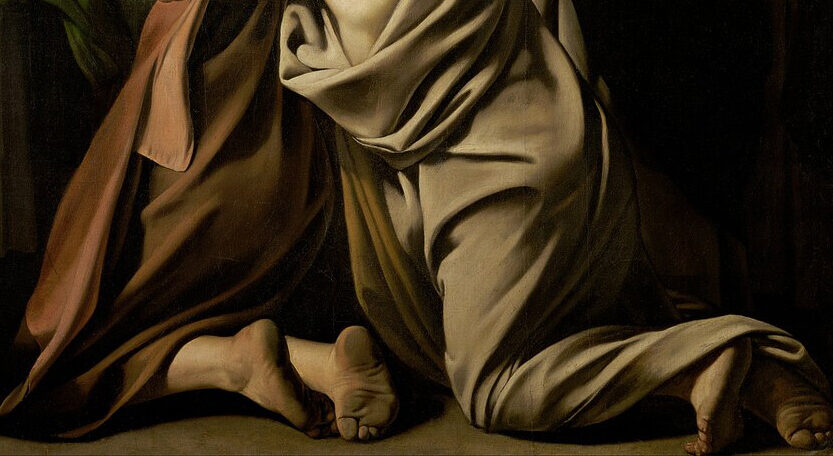
In what follows, I want to add a footnote to Pope St. John Paul II’s meditation on the spiritual significance of our bodies, which makes manifest our vocation to love. Though seemingly unimportant, the foot is indeed something to note.
This point was lost on me for most of my life, but two years ago, I found myself unable to think about anything other than feet and their theology. Collapsed on the grass at the end of an exhausting two-day, thirty-five-mile pilgrimage here in the US, my own feet aching and blistered, I beheld a scene that transported me to Sant’Agostino in Rome, which not only boasts the mortal remains of St. Monica but also a stunning image by Caravaggio.
There before me I saw in the flesh the very feet of Caravaggio’s pilgrim in his painting Madonna of the Pilgrims, also known as Madonna of Loretto. Not only were the feet in front of me bare and dirty, the bottoms faced me as the pilgrim in question knelt in reverence at Mass.
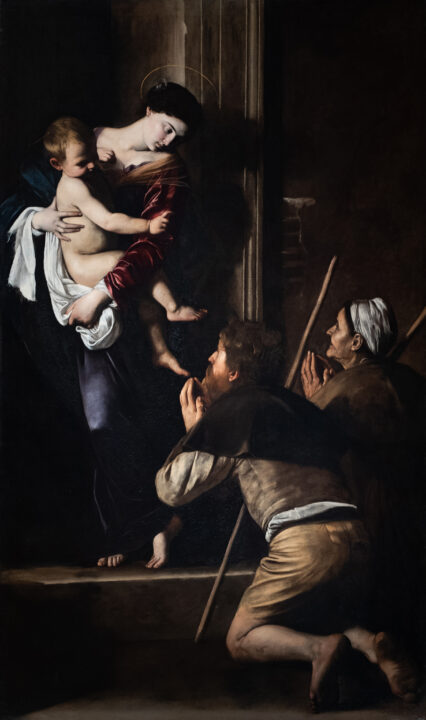

Behold feet! The baby, the toddler, and the young child have adorable feet. Yet when these same feet achieve adult form, they almost invariably lose their beauty and take on a purely functional character, just like elbows and ears.
Caravaggio’s masterful painting brilliantly highlights this very contrast between young and old, for he places in the Madonna’s hands the infant Christ, whose cherubic feet dangle effortlessly in the arms of his mother; her own pristine feet, in turn, are elevated above the earth, both by a step and by their position—as though she were calmly supported only by her toes. Yet the pilgrim’s feet are dirty, flexed, and strained, pressed down by the burden of being.
Though the feeling of feet would have been a daily occurrence for much of human history, we moderns have had to pay little attention to our feet. As the poet Gerard Manley Hopkins notes in “God’s Grandeur,” they are insulated from our notice: “Nor can foot feel, being shod.” Shoes anesthetize our feet, keeping them snug, safe, and squarely outside of our notice.
I Am My Feet
The great French Catholic philosopher Gabriel Marcel might have said, “I am my body,” but we pilgrims could put that same line more pointedly as “I am my feet.” When we do so, what might we note?
First, feet are for standing. One of the glories of parenting is having one’s child stand in that first wobbly, swaying posture, an act repeated every morning by each of us as long as we are able. To stand again each day is a natural rehearsal for the resurrection on the last day.
To walk here and there is the natural analogue to our daily spiritual journey to our heavenly homeland.
Second, feet are for walking. Another of the glories of parenting is having one’s child take his or her first steps, something each of us repeats again and again throughout our days. To walk here and there is the natural analogue to our daily spiritual journey to our heavenly homeland.
Third, feet are for feeling. Stand too much and the feet hurt. Walk too far and the feet hurt. Run too hard and the feet hurt. At such moments, we may even be tempted to wonder: Do we have hands just to massage our aching feet? To suffer through one’s feet is to be constantly reminded that we need to lift our hearts to the Lord.
Fourth, feet are for virtue. If humility is the key to all virtues, feet are supremely important. It’s true our physiological demands are humbling as well, but the plain fact that we have feet—feet that press down again and again into the humus of the earth—is a reminder that whatever our ultimate heavenly aspiration, we are also terrestrial creatures and not angels.
Fifth, feet are for reverence. Whether we sit or stand, our feet are on the ground, ready to take us off walking at a moment’s notice. But when we kneel, we introduce a further remove: Our feet are out of commission. To walk, we first have to stand up, one leg at a time. Kneeling, then, is from one point of view the feet offering themselves up by shifting weight from their soles to the knees. To kneel is to plant oneself in the earth and be still.
Sixth, feet are for the whole person. Each of us pilgrims are one body with many parts. There may be some parts more noble than others, but their very nobility depends for their exercise on the whole and its lowliest parts. “The eye cannot say to the hand, ‘I have no need of you,’ nor again the head to the feet, ‘I have no need of you.’” (1 Cor 12:21). That is, we can only hold our head high if our feet are keeping us humbly planted below.
And They Kissed His Feet and Worshipped Him
Jesus’s feet bore the weight of the cross, and thus for good reason did Mary anoint them with precious oil (John 11:2). And when he is restored to life, he shows not only his hands but also his feet to his disciples. “Look at my hands and my feet; see that it is I myself. Touch me and see; for a ghost does not have flesh and bones as you see that I have” (Luke 24:39).
On the Friday that we call Good, we each take turns kissing the feet of the corpus on the crucifix.
It is instructive that the very evening in which our Lord set apart his priests and their hands for the breaking of the bread, he also washes their feet. They were in Jerusalem on pilgrimage. Theirs were the feet of figures on the way, and those feet would soon take those hands to the four corners of the earth.
Perhaps we might recall, in this connection, the wisdom that St. Paul drew from Isaiah: “How beautiful are the feet of those who bring good news!” (Rom 10:15, quoting Isa 52:7).
A Note About Hobbits
Allow me to close this footnote about feet with an asterisk about hobbits, for J. R. R. Tolkien seems to have divined the spiritual significance of feet when he brought this species into being. Hobbits have as their most distinctive bodily feature, besides their diminutive size, large bare feet. And it was those very feet that, step by step, enacted the first adventure of Bilbo from the Shire to the Lonely Mountain and back again, and those very sort of feet that made the all-important pilgrimage that destroyed the ring. The hobbits, we can say, represent the human as pilgrim, setting out to destroy, through humility, the allure and weight of sin. Their pilgrimage, like every other, was a kind of via crucis.