
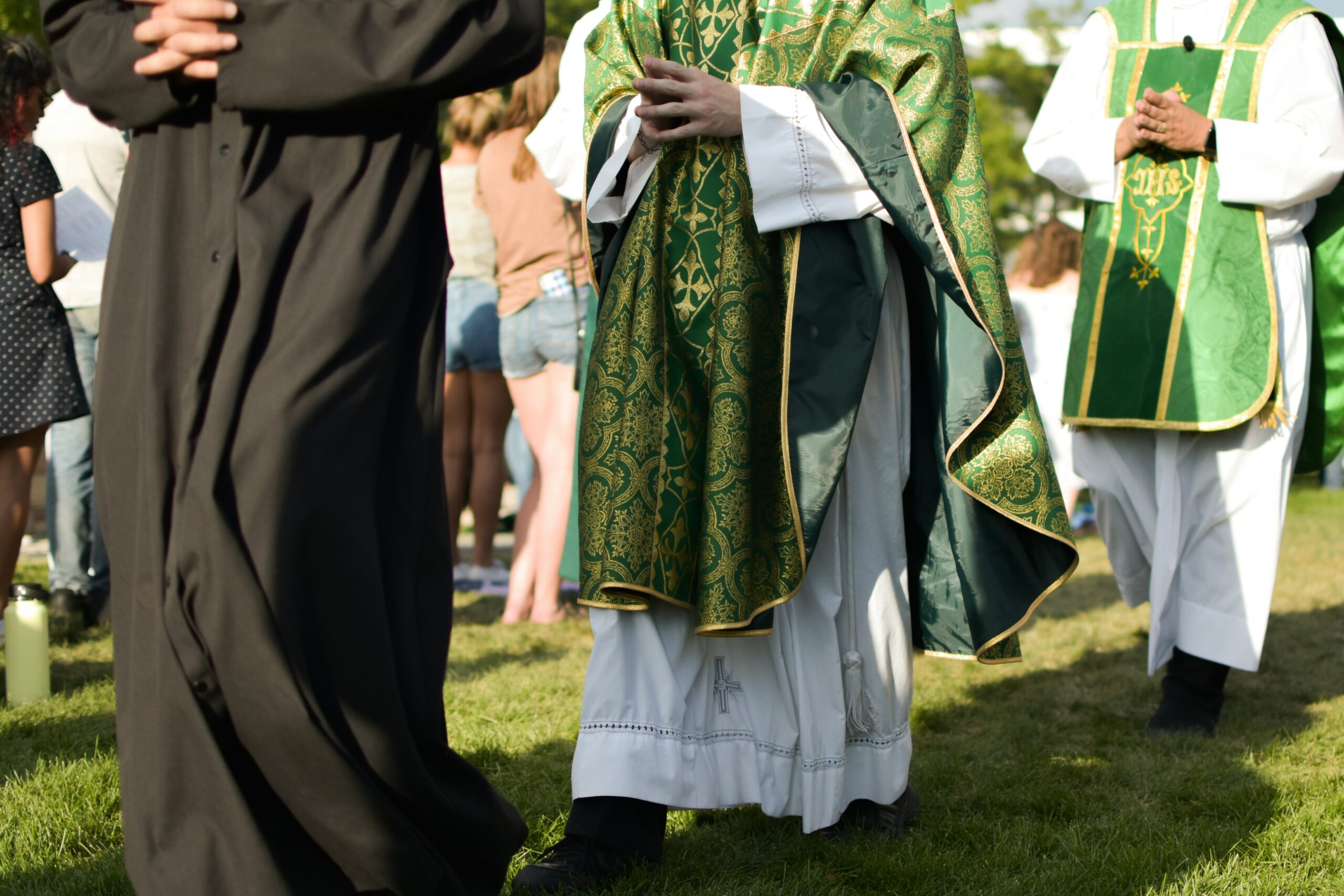
The Altar Reveals What the Age Forgets
During his catechesis on March 25, dedicated to the dogmatic constitution Lumen Gentium of the Second Vatican Council, Pope Leo XIV emphasized that the priesthood has always been, and remains, reserved to men. Referring to Lumen Gentium 8, the Holy Father stated that the close connection between the sacrament of holy orders and the male sex of its recipient is rooted in the hierarchical structure of the Church, which is not a human construct but a divine institution given by Christ to the apostles (cf. Ordinatio sacerdotalis 4). Christ chose twelve men, representing the twelve tribes of Israel, as the foundation of his Church, the new Israel, the people of God (cf. Heb 12:22–24). In other words, Pope Leo stressed that the Church is a divine institution “built upon the foundation of the apostles and prophets, Jesus Christ himself being the chief cornerstone” (Eph 2:20).
Consequently, any possibility of changing one of the constitutive elements of the sacrament of holy orders for human purposes is excluded a priori. Although all the baptized share in the priesthood of Christ, according to can. 204 §1 of the Code of Canon Law (cf. Catechism of the Catholic Church 871), this priesthood differs from the sacrament of holy orders both in degree and in essence (Lumen Gentium 10), since the latter confers “sacred power” (sacra potestas) upon its recipient.
However, it appears that the Anglican Church holds a very different opinion, since on the very same day of Pope Leo’s catechesis on the priesthood being reserved to men, Dame Sarah Mullally was installed as archbishop of Canterbury.
Whereas the Anglican Church proudly presented Dame Sarah Mullally as the first woman to lead the Church of England, Catholics maintain that the priesthood is inherently connected to being male. According to can. 1379 §3 of the Code of Canon Law, the attempted conferral of the sacrament of holy orders upon a woman results in latae sententiae excommunication for both the minister and the recipient.
Although not everyone possesses the same qualities, each member of the Church has his or her own vocation and function within the mystical body of Christ.
The Church declares that she has no authority whatsoever to confer priestly ordination on women, such that only a baptized male validly receives ordination (can. 1024 of the Code of Canon Law). This declaration is grounded in the words and actions of Jesus Christ himself. Christ generously included women among his disciples (Luke 8:2), and women were the first to encounter him after his resurrection, being charged with proclaiming the paschal message to the apostles (Matt 28:7; Luke 24:9; John 20:11)—actions that ran counter to the Jewish traditions of his time, which attributed little value to the testimony of women.
Nevertheless, Jesus did not appoint any of these women as apostles. Even his mother, Mary—the supreme example for every follower of Jesus Christ—was not granted a place among the twelve (Inter insigniores 2; Ordinatio sacerdotalis 3). Furthermore, when the apostles sought to replace Judas, it does not appear to have been considered an option to choose the Blessed Virgin or even Mary Magdalene. Although they were “filled with the Holy Spirit” (Acts 2:4) together with the apostles, it was Matthias—an otherwise unknown follower of Jesus—upon whom the lot fell after the invocation of the Lord’s name (Acts 1:23–26) (Inter insigniores 3).
One should also take into account that the Church is at once a heavenly and an earthly reality (CCC 954–962). The faithful on earth already share in the glory of the triumphant Church in heaven with the saints: The members of the Church militant and triumphant possess citizenship in the city of God, which will be fully manifested at the last judgment (Augustine of Hippo, City of God, I.35). Consequently, as Dr. Scott Hahn explains in his book The Lamb’s Supper, there exists a significant overlap between the liturgy celebrated on earth and that of heaven as described in the book of Revelation.
Revelation 19:7–9 explicitly presents the heavenly liturgy as Christ, the Lamb, and his Church sharing the marriage supper as bridegroom and bride. This idea of the Church being reunited with Christ in heaven as a nuptial feast recurs frequently throughout the New Testament (Matt 22:1–14; Luke 14:15–23; John 3:29). In the same vein, Scripture makes clear in several places that the union between God and his Church—the new Israel—is analogous to that between a bridegroom and his bride (Isa 54:5; 62:4–5; Jer 2; Hos 1–3; 2 Cor 11:2; Eph 5:21–33) (Inter insigniores 5). Furthermore, just as Eve was made from the rib of Adam (Gen 2:21–22), so the Church, founded upon the sacraments of baptism and the Eucharist as her pillars, is said to originate from Christ’s side at the cross (John 19:34).
Therefore, when one takes into account that the priest acts in persona christi when celebrating the sacraments (CCC 1548), it becomes clear that he represents the bridegroom during the earthly liturgy, while the Church on earth is the image of the triumphant Church united with the Lamb in heaven. Just as the sacrament of matrimony requires a man and a woman for validity (can. 1055 §1 of the Code of Canon Law; cf. CCC 1601), so the Church can be validly united only to the representative of her bridegroom—namely, the priest acting in persona christi.
The fact that there are things which a man is able to do but a woman is not, and vice versa, is rooted in the ontological difference between the two sexes as constituted by God. Although Galatians 3:27–28 states that “there is neither male nor female,” God created humanity as male and female, each with their own respective characteristics, features, and capacities (Gen 1:27–28; 5:2). Being “one in Christ” (Gal 3:28) signifies that all human beings have been equally redeemed through his sacrifice, just as there is no longer any distinction between Jews and non-Jewish people (cf. “there is neither Jew nor Greek” in the same verse). Moreover, the view that God wills the clear distinction between the two sexes to be maintained appears to be supported by the prohibition against men wearing women’s clothing, and vice versa (Deut 22:5).
Thus, it can be concluded that Scripture bears witness in several ways to the reservation of the sacrament of holy orders to men as being rooted in the divine will. While a variety of biblical illustrations have been discussed in this article, the fundamental point remains that the different roles of men and women in the Church—just as in broader society—are grounded in the ontological distinction between the two sexes as established by the Lord in creation. Difference, however, does not entail inequality: Both Scripture and Church teaching make clear that all human beings, male and female alike, are fundamentally equal, possess the same inviolable rights, and share in the redemption offered by Christ (1 Pet 3:7; CCC 1934–1935; 2334). St. Paul teaches that, although not everyone possesses the same qualities, each member of the Church has his or her own vocation and function within the mystical body of Christ. The fact that the hand and the eye do not have the same function does not mean that one has less value than the other; rather, they serve the body of Christ in different ways (Rom 12:3–8; 1 Cor 12).