
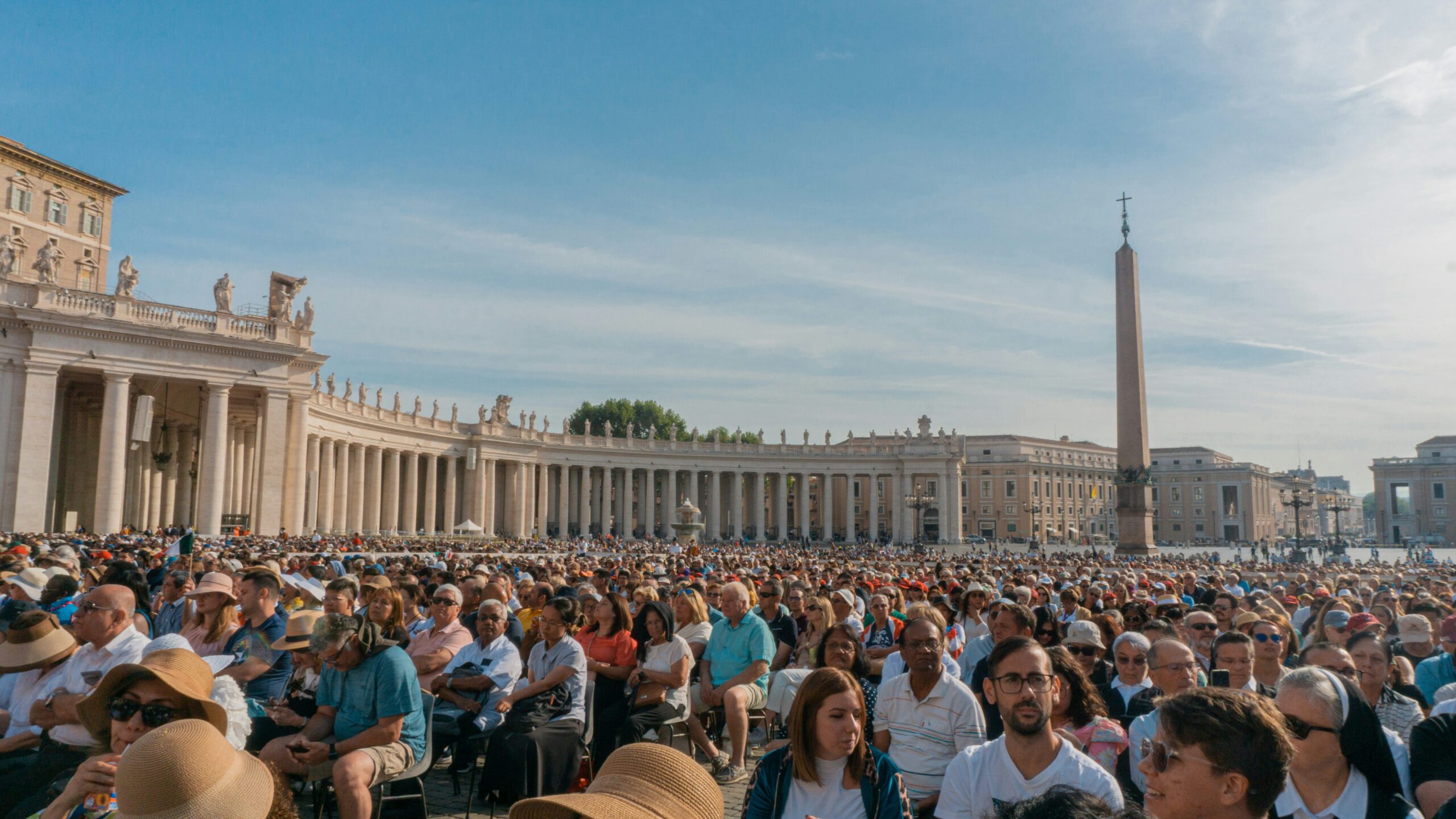
Over the last several months, the swell of political violence and broader cultural disruption—acutely the horrible assassination of Charlie Kirk—has galvanized many lay Catholics to ask, “What can I do about all this?” We must wrestle with the tensions inherent in that question for us as Catholics. Something of the Catholic worldview has always struggled in the context of the empire: We never fit neatly in the political categories of any time period and the same is undoubtedly true today.
At the same time, the first public apologetic of the Christian faith, the Epistle to Diognetus, leans heavily on the public witness of Christians as part of its most vital function. As they are accused of being “enemies of the human race,” the author of the letter instead suggests a different way of considering Christians: “soul of the world.”
To sum up all in one word—what the soul is in the body, Christians are in the world. The soul is dispersed through all the members of the body, and Christians are scattered through all the cities of the world. The soul dwells in the body, yet is not of the body; and Christians dwell in the world, yet are not of the world. The invisible soul is guarded by the visible body, and Christians are known indeed to be in the world, but their godliness remains invisible. The flesh hates the soul, and wars against it [see 1 Peter 2:11], though itself suffering no injury, because it is prevented from enjoying pleasures; the world also hates the Christians, though in nowise injured, because they abjure pleasures. The soul loves the flesh that hates it, and [loves also] the members; Christians likewise love those that hate them. The soul is imprisoned in the body, yet keeps together that very body; and Christians are confined in the world as in a prison, and yet they keep together the world.
With American civic life in crisis through polarization, declining trust, and the erosion of local communities, many Catholic citizens feel alienated and powerless. Faith too often is either weaponized in partisan battles or relegated to the private sphere, leaving little room for a vision of civic renewal rooted in the deepest wells of our cultural heritage.
Catholic social teaching and the Christian humanist tradition offer a third way.
Catholic social teaching and the Christian humanist tradition offer a third way: not withdrawal, not partisan combat, but the rebuilding of civic life through solidarity and subsidiarity.
It seems to me that the deepest wellsprings of the renewal of culture so desperately needed today are found in the uniquely Catholic imagination. We need Catholics capable of being “salt of the earth,” to use the Gospel phrase, or, as the Epistle to Diognetus says, the “soul of the world.”
Bishop Robert Barron’s largely underrated address at the National Eucharistic Congress perfectly underscored this call. He opened with a reminder that the ecclesiology of the Church, dramatically lived out in recent papacies, is that of a “Church that goes out from itself.” He spoke there of what he called the “obligation of the laity”:
Your Christianity is not for you. Christianity is not a self-help program. . . . Your Christianity is for the world. Jesus said, ‘You are the light of the world.’ The secular order, that’s your space! Move into it with panache and energy and intelligence and enthusiasm and become body given, blood poured out. We’d set the country on fire.
Speaking later of the universal invitation to all baptized Catholics to the evangelical counsels, Bishop Barron spoke of what it looks like for the laity to practice the evangelical counsel of obedience. Taken from the Latin word for “to listen,” Barron suggests obedience as the great antidote to what he calls the “culture of self-invention.” In listening to the voice of God, we find ourselves generously fulfilling God’s invitation to the laity to go outward.

He continued, “Your job is to bring the lumen to the gentes. Bring the light of Christ out into the secular world. This great revival will have been a failure if we do not change our society; if we do not stream forth from this place with the light of Christ.”
With all that in mind, I see two temptations today for faithful Catholics: for our focus to become either too small or too big—to be tempted to focus on the micro or the macro to the detriment of the other.
I might think all I can do is focus on myself, to become holy in my own circumstances, and leave the rest to others. This is necessary but incomplete. Conversely, I might think that impacting the culture might require a grand, nationally oriented gesture: launching an organization for a great cause, significant thought leadership and nationwide media efforts, engagement in national political campaigns, or large-scale intellectual or cultural contributions.
The micro focus is necessary as a starting point for all, but it’s not sufficient. Catholics who attempt to engage the world without first being given over entirely to a personal relationship to Jesus risk becoming a countersign. Have we not seen enough of the negative impact of Catholics trying to engage in public life without first being given over wholly to Jesus and obedient to the full demands of the Gospel? However, a personal call to holiness does not give us permission to withdraw from the call to impact the culture more broadly; discipleship is a prerequisite that does not excuse our call to engage the world.
Likewise, the macro focus is important, though few are called to it and it is not the purview of all. Not all of us can start a nationally influential podcast, run for public office, design a cathedral, or direct a culturally significant movie.
What exactly, then, does it look like for Catholics to be the “soul of the world”?