

Among the flawed philosophies that reign in today’s culture is the insistence that our actions can be deemed blameworthy only when they hurt someone on a more or less immediate timeline. This mindset is necessary to guarantee each of us can live by the truth we choose for ourselves, in that it eliminates an objective good and evil for all but the most severe circumstances.
In the short term, this ideology seems to bear out. But then the consequences of our actions are often broader and deeper than our limited human perspective can appreciate. If we could take in the whole picture—the repercussions today and tomorrow, here and elsewhere, for better or for worse—I think we’d have to confess it is not in anyone’s best interest to gauge our decisions based on the results we can see, rather than on an established sense of right and wrong. As Catholics with recourse to the sacrament of confession, we need to resist this outlook in favor of a point of view based on loving self-gift above all else.
George Eliot (pen name of Mary Ann Evans) wrote the classic novel Silas Marner: The Weaver of Raveloe (significantly smaller in scope and page count than her better-known masterpiece, Middlemarch), which eschews the spiritual element here while retaining the morality. The story’s observations on isolation and community, wealth and poverty pack a punch for readers even 165 years after its publication. Then, as now, we tend to look for the easy way out. We find we don’t need to reach very far to put our hands on a justification for the course of action that leads to our own best interests. But are we any better off for doing so?
Meeting Silas
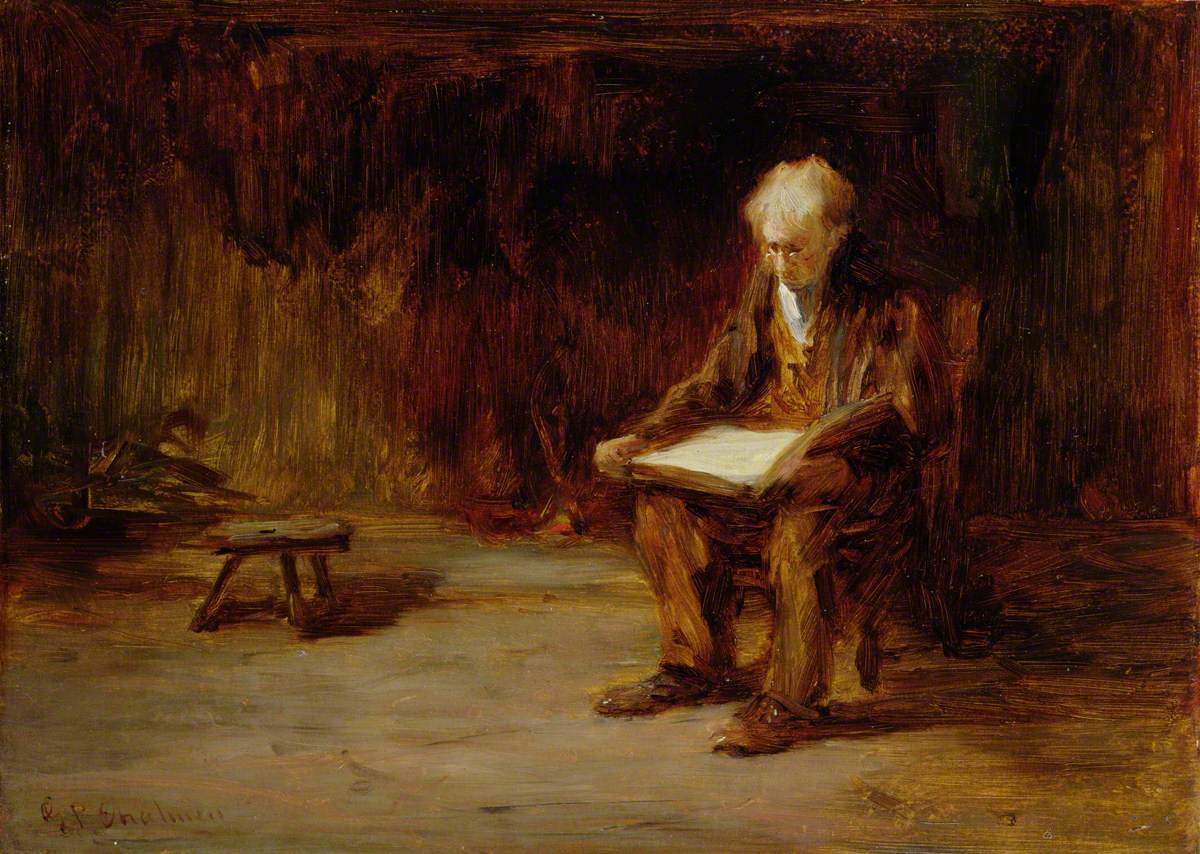
Silas is a strong young man whose good prospects are torn from him without real cause. His best friend’s selfish betrayal means that Silas is ousted from his community, loses the woman he was about to marry, and finds little use for the God he once served. He travels to the rural town of Raveloe, where he supports himself on his fine skill as a weaver, though he makes no effort to otherwise engage with the community. He contents himself by counting his earnings in the evenings. He harbors no hope of a larger home or finer goods. Gold is his only companion, and he looks forward to its growth as a means of satisfying that desire for communion that might have been fulfilled by a wife and children.
Sometimes it’s hard to accept that God uses all things for the good.
Readers may find that Job momentarily comes to mind when Silas’s money is stolen. How can a man who has lost so much and caused no one any harm have lost nearly everything again? Again, he is the victim of another man’s greed, and again the repercussions appear to fall on him alone. His despondency finally lifts on a snowy New Year’s Eve when a little girl wanders into his home, her mother recently dead of an opium overdose. To everyone’s surprise, Silas resolves to adopt the girl. He sees in her the gold come back, transformed, renewed:
The heap of gold seemed to glow and get larger beneath his agitated gaze. He leaned forward at last, and stretched forth his hand; but instead of the hard coin with the familiar resisting outline, his fingers encountered soft warm curls. In utter amazement, Silas fell on his knees and bent his head low to examine the marvel: it was a sleeping child—a round fair thing, with soft yellow rings all over its head.
The arrival of the child, a beautiful depiction of grace and redemption, is also the result of a more complicated history, for which she, like Silas, is not responsible. Her mother, Molly, was the first wife of Godfrey Cass, the older son of the town squire; the girl is his daughter. Godfrey has been estranged from his wife, and only his troubled brother knows of their relationship. Molly had intended to make herself known to all of Raveloe that evening. When instead she dies, she frees Godfrey to marry a woman he truly loves—and to dodge acknowledging that he’d ever been married, that the child is his.
Everything Is Fine
The story might end there. Godfrey marries Nancy. The girl, Eppie, is raised with love and without the suffering of addiction. It doesn’t look like he’d hoped, but Silas has the family he longed for. The narrator reflects in this manner:
And when events turn out so much better for a man than he has had reason to dread, is it not a proof that his conduct has been less foolish and blameworthy than it might otherwise have appeared? When we are treated well, we naturally begin to think that we are not altogether unmeritorious, and that it is only just we should treat ourselves well, and not mar our good fortune.
This is Godfrey’s point of view for the next sixteen years when all is, for the most part, well. He and Nancy are not able to have children, but they take care of each other. Eppie grows into a lovely young woman on the verge of engagement to a hardworking young man who cares for her—and Silas—deeply. Silas returns to church and finds a place in the community.
But as Scripture tells us, that which is in the dark will come to light. There is no earthly justice for Silas’s mistreatment in his first home (when he returns at the very end of the novel, the village is gone), but the truth about Eppie rapidly emerges. Linen takes much longer to weave than to unravel. The discovery of Godfrey’s younger brother’s bones at the bottom of a quarry is the pull on a loose thread that sets in motion a series of confessions that expose the long-hidden truth.
Godfrey confesses first to Nancy, who regrets that she never had the opportunity to decide for herself how to respond to his past. She cannot say whether she would have married him, but she suggests they might have raised Eppie as theirs. Their marriage would have taken a very different course had they both been more honest with each other about the lived circumstances of their home.
When the couple tells Silas and Eppie the story, it becomes clear that it is too late for them to take Eppie in now. Nearly grown, Eppie does not want their money or their life. Indeed, after all these years of Silas caring for her, she is ready to begin caring for him.
Just as his brother robbed Silas of his money, Godfrey has robbed Eppie, Nancy, and Silas of the chance to encounter the truth on their own terms. Much has been taken from Silas, but in his loss he has come to a greater capacity for love. In the end, Silas exhibits the height of paternal love in giving Eppie the freedom to choose which path to take, even if it means leaving him behind. But of course, she does not want the nicer clothes or the bigger home. She wants to be with the people she loves, the people who have taught her how to love. In a way, she loves Silas because he first loved her.
Nancy and Godfrey do what they can for Eppie, respecting her terms and the life she wants for herself. Godfrey sees that while he cannot go back and make a different choice then, he can choose a better path from this point forward. He receives his wife’s mercy with gratitude and humility.
There Are No Do-Overs
Sometimes it’s hard to accept that God uses all things for the good. We find ourselves getting stuck on certainties: That shouldn’t have happened or She didn’t deserve that. Maybe not, but our presumptions don’t change the way things are, and try as we might, we can’t foresee how things turn out five, ten, or sixteen years from now. Though Eliot discarded the Christianity of her youth for Romanticism in her adulthood, she retained a strong intellectual sense of morality, which commentator George Levine says Eliot believed “entails recognition of the realities of the world we live in.”
Pride and greed obscure our view of those realities. Even the smallest act of selfishness might have an impact down the line that we wouldn’t choose if we’d known. Likewise with selfless acts: We are obliged to make the right choice, the best choice, even when it doesn’t seem it will change much of anything today.
Let us take a hint from this short novel elapsing over the course of more than thirty years. Eliot needed a lifetime to tell this story, to show that ultimately community is preferable to isolation, that true wealth is counted not in coins but in relationships. May we hold this lesson close as we acknowledge the limited vision of which we are capable in this world.