
“Education is the process of reaching a higher—or more elevated—state of confusion.” The renowned medieval historian and Princeton professor Bill Jordan once offered this quip to me and my peers, and, though he meant it humorously, it prompted me to seriously reflect on the purpose of my education and the reason I was in his class to begin with. My experiences as a college student have shown me that entering into crises of meaning about our vocations as students on a secular campus—seeking to follow Jesus Christ—is certainly not unique to me. After the rose-colored glasses of the first semester came off, I often encountered my Catholic peers asking versions of the question, “What exactly are we doing here—and what is this secular university for, anyway?”
Two perspectives seem to predominate among my fellow students, Catholic and non-Catholic alike. And, although each one can at first appear reasonable and appealing, I believe both answers ultimately fall short of the true—and highest—end of education.
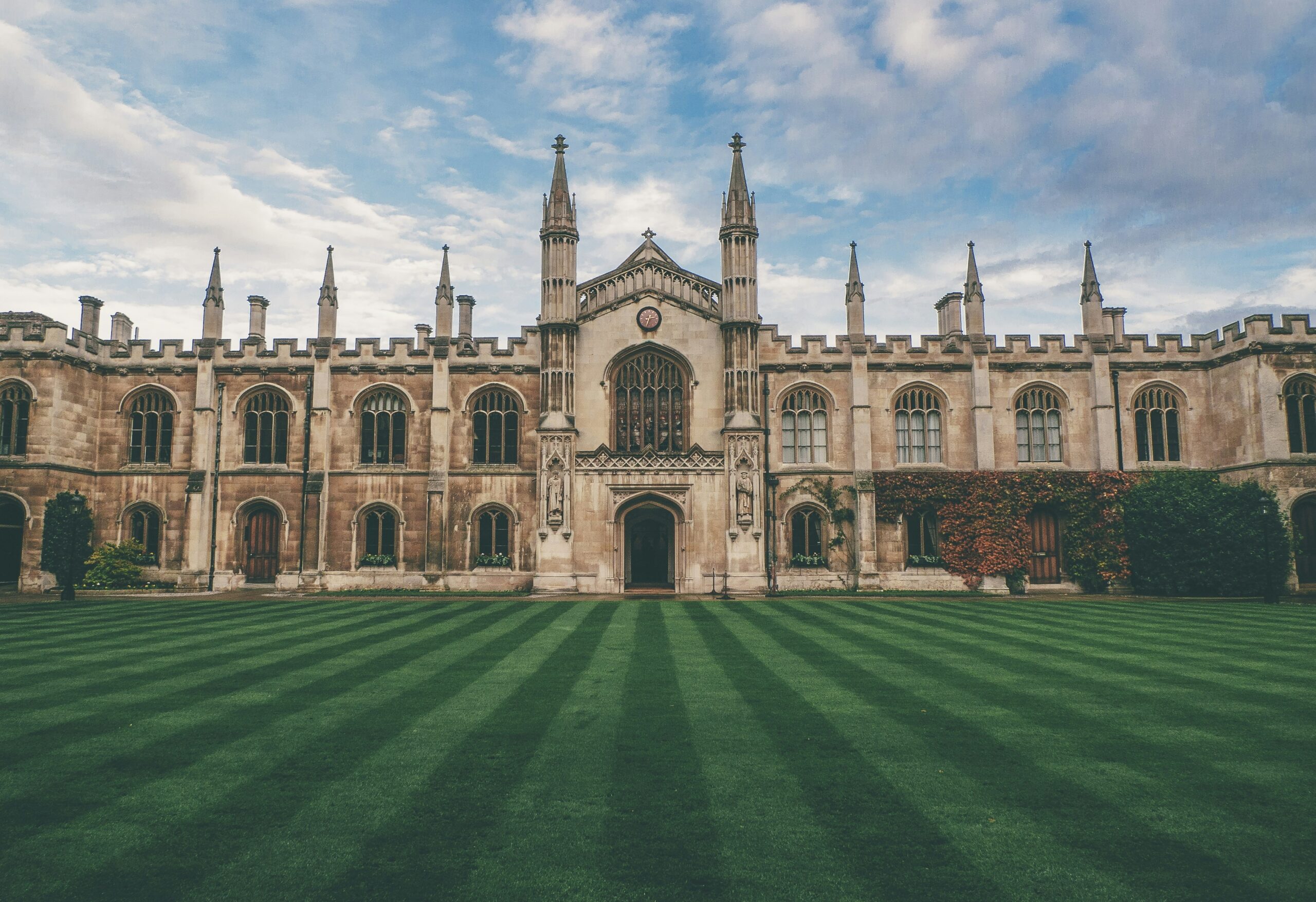
Before I arrived on the scene of Princeton’s Gothic towers and green quads, I saw college through a principally instrumental lens. To me, higher education was little more than a stepping stone—a professional certification or résumé enhancer. Universities like Princeton seemed to be, at their cores, credential providers and extended networking opportunities for allegedly “elite” white-collar jobs. It was cut-and-dry; one studies engineering to become an engineer, economics or finance to work on Wall Street, and so on. Classes and learning opportunities seemed valuable only insofar as they were useful for some other end. Knowledge, in this sense, was good because of what—or where—it got me. And so, the question that animated every class became a practical one: “When and how am I going to use this?”
It became clear to me that this understanding of education—found among Catholic and non-Catholic students—was substantively shallow and morally empty.
But I realized a careerist understanding of education quietly suffocates the soul. Students who think the way I did, whether through ignorance or faulty formation, see all knowledge as means to external ends. This is a worldview in which poetry is superfluous, history is obsolete, and art is aimless. It became clear to me that this understanding of education—found among Catholic and non-Catholic students—was substantively shallow and morally empty.
Another perspective is concentrated among my Catholic peers, whether at Princeton or other institutions. I like to call it “education as piety.” For these students, education is worthwhile solely because it can—if you stay within a narrowly crafted window of acceptable subjects, texts, and courses—make you a “better” Catholic. Latin pedagogy, philosophy, or Church history become avenues worthwhile principally for their ability to facilitate “greater” holiness or traditionalism. These sorts of students, in their error, encounter literature and art in a moralistic fashion. The humanities become hegemonic and the sciences irrelevant. Their scope decreases. They become less “liberal.” Under this view, one would read St. Augustine or St. Thomas not for their insight—valuable to all people—into human nature or deep philosophical questions but rather for the comforting assurance that they were on the “right team.” This temptation is particularly prevalent among those studying the humanities or attending certain Catholic universities.
But, as St. Josemaría Escrivá once wrote: “The first Apostles, for whom I have great affection and devotion, were nothing to boast about, humanly speaking. . . . They weren’t educated; they weren’t even very bright, if we judge from their reaction to supernatural things.”
The apostles, lauded for their faith and sanctity, were some of the greatest saints in Church history. Yet education clearly does not automatically confer sanctity. And the intellectual life, while good in itself, is not in itself a form of piety. The holiest among us are often not the ones with the greatest “knowledge,” and vice versa.
Both of the perspectives I have described are lacking for the same reason: They make education about something other than itself. But why is education worth pursuing for its own sake? And why should the Catholic student, confident in the wisdom of the Church and secure in the deposit of faith, seek out a liberal education?
In his seminal work The Idea of a University, St. John Henry Newman proposed something rather shocking—namely, that the university exists for the pursuit and cultivation of knowledge. Not for activism, not for job training, and not for spiritual formation but for the pursuit of truth as a good in se.
A university education, wrote Newman, “has a very tangible, real, and sufficient end, though the end cannot be divided from that knowledge itself. Knowledge is capable of being its own end.” At first glance, this may seem shallow, perhaps even disappointing or downright untrue. But properly understood, it is a profound affirmation of the human mind and genuine, intellectual wonder.
Education, if it is to be truly liberal—in the classical sense of liberalis, “free”—must be pursued for its own sake.
Newman was not naive. He understood that education will inevitably produce side effects: Students may become more virtuous, more employable, or more eloquent. But these, for Newman, are not the ultimate purpose of education. They are what Aristotle called “accidents”—things that may arise from the pursuit of a given thing but are not intrinsically attached to its object.
Education, if it is to be truly liberal—in the classical sense of liberalis, “free”—must be pursued for its own sake. To seek knowledge only for what it gives us or for what it can be used for is to demean it. To study is to acknowledge that the world is intelligible: that truth can be known, and that the mind was made to contemplate it.
The liberal arts, then, are not a random assortment of impractical disciplines, but a coordinated effort to free the mind from any dispositions toward intellectual arrogance or narrowness. “It is a great point,” Newman wrote, “to enlarge the range of studies.” Why? Because without this enlargement, the mind becomes fixated—dominated by its own assumptions, prejudices, habits, or attachments. The physicist sees the world in terms of force; the economist, in terms of incentive; the political scientist, in terms of power. But the human person cannot be reduced to one method.
This is why we should strive to avoid becoming an “ideologue”: someone, less a scholar than a partisan or activist for a contestable cause, who sees every problem through one lens. Take, for example, the Marxist, who reduces history to class struggle, or the Darwinist, who reduces behavior to evolution. These thinkers are not unintelligent, but their intellect has not been properly trained. It has not been set free.
A liberal education, by contrast, introduces the student to a broad horizon. It trains the mind to see not only within a framework or set of sectarian strictures but beyond it. And in doing so, it produces what Newman called “a philosophical habit” of the mind—a practice of balance, of proportion, of fairness.
To be liberally educated is to think well. And to think well is to order the soul.
At this point, some may object: “But what about faith? Doesn’t education need to be ordered to salvation?” Yes, and Newman would agree. But the ordering often does not come immediately. Liberal education, Newman argues, is neither catechism class nor religious formation. The university is neither the confessional nor the pulpit. It is, rather, the mode by which one may train their mind to comprehend the truth, wherever it is found.
A university, in Newman’s view, is not meant to make saints but thinkers.
Liberal education, then, ought not be indifferent to God.
Newman did not deny that education can aid sanctity. He merely denied that it guarantees it. A student may read St. Augustine’s Confessions and remain proud or memorize articles of the Summa theologiae and still lack charity. The intellect is not the will, and knowledge is not virtue. Yet both are good, and both are needed.
For Catholic students, this is freeing. It means that one can study biology or history or literature not simply as a tool for evangelization but as an act of reverence for the subject itself. Liberal education, then, ought not be indifferent to God. All knowledge, rightly pursued, is a participation in the Truth, through whom all things were made.
What, then, is required of students? What kind of attitude does this vision of education demand?
Firstly, liberal education demands intellectual humility. Newman reminds us that pursuing the path of learning how to think is a sort of extended apprenticeship. One must learn to wait, to wrestle with difficult texts, to admit confusion, and to listen to other perspectives; listening to someone, after all, does not necessarily mean agreeing with what they say or believe.
Since to be educated is a gift, students must be grateful. To study the great works—to encounter the genius of Plato, Homer, St. Augustine, or Dante, for example—is not a hurdle in the race to obtain a credential but a special kind of blessing. As Newman said, it is an act of entering into a long-lived tradition, which may develop in us a certain “freedom, equitableness, calmness, moderation, and wisdom.”
St. John Henry Newman did not see the university as a factory. It is not a platform for slogans but a temple for the mind. His vision is a balm for the anxious and disoriented student of today. And perhaps, more than anything else, it is a call to return: to recover a vision of education animated by love, rooted in truth, and crowned with wisdom.
The apostles did not need a degree, but the student would do well to remember their profound example. For they, too, were students, asking Christ, “Explain this parable to us” (Matt 15:15).