
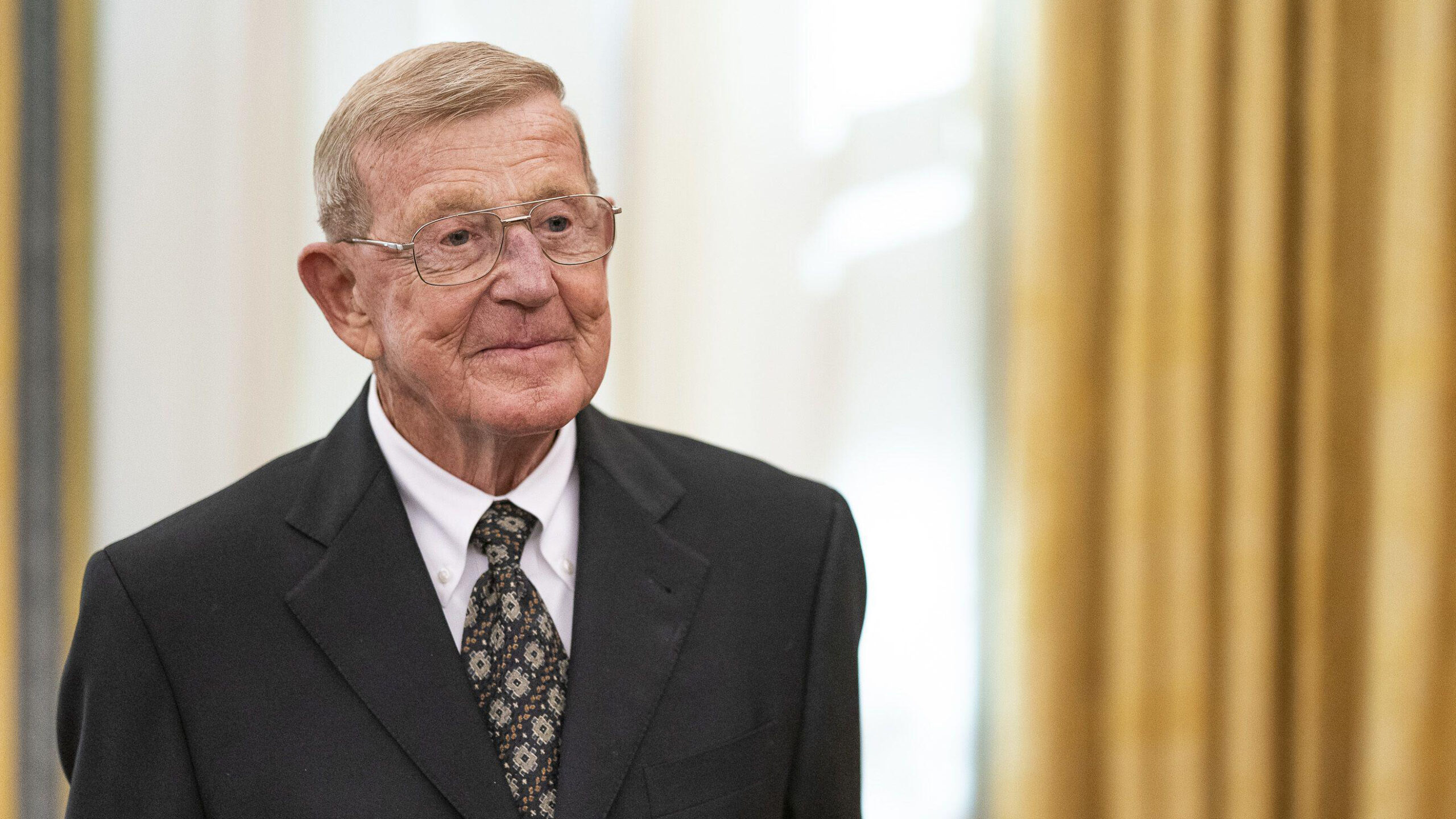
Before a Notre Dame-Miami football game, a chaplain of the Miami Hurricanes said, “God doesn’t care who wins football games.” When he heard this, Lou Holtz replied, “God may not care, but his mother sure does.”
If you were to go on a random Tuesday to Mass at the Basilica of the Sacred Heart at the University of Notre Dame in 2026, you’ll see long lines of people (mostly students) waiting to go to confession. But in the mid 1990s, when I was a student, you could generally walk right up with little or no line. One day, I stood as the only person waiting to enter the confessional box. A moment later, up walked Coach Lou Holtz. He took the next spot in line.
Lou was a legend. He led the Irish for eleven seasons as head coach, including an undefeated season in 1988. I had seen him from the third-to-last row at the Fiesta Bowl when they won the national championship, but now he was right next to me.
I wasn’t entirely surprised. I had heard that he was a practicing Catholic, attended daily Mass, and said the Rosary regularly. He was influenced from his earliest years by the Sisters of Notre Dame who taught him in grade school. “The sisters . . . influenced my life tremendously,” Holtz once said. “This was due to the fact that they encouraged you always to make sure that God is the focus of your life, and they didn’t allow you to do anything except to the very best of your ability.” Of course, it is almost impossible always to do everything to the very best of your ability and keep God as the center, so here Holtz was waiting to go to confession. It’s generally bad form to talk to people as you wait in line for confession, but I couldn’t resist.
“Coach,” I said to him, “I’m sure you are much more busy than I am. Please, go first ahead of me.” “Are you sure?” “Yes, I’m sure. Please, go in next.”
We switched spots in line. Holtz turned back to me, “Is there anything I can do for you?” Now, that’s a question anyone loves to hear. A myriad of possibilities popped to mind. But I thought immediately of my stepfather-in-law.
“God didn’t put us on this earth to be ordinary.”
So I replied, “My father-in-law is a huge fan of yours. Would you mind sending him an autographed picture?”
And he said, “Yes, I’d be happy to.”
Then the penitent left the confessional box, and the coach entered.
When Holtz was done with his confession and left the confessional, he thanked me again and went on his way.
Later that day, I dropped off my father-in-law’s address at the office of the head football coach.
Like a serve in tennis, Coach Holtz sent off a signed picture to my father-in-law. And so, in my father-in-law’s house, you can still see the national champion coach’s autographed photo and signature: “Dear Miles, best wishes, Lou Holtz.”
I am to this day edified that someone as important and busy as the head coach of a national champion football team made time to humble himself and go to confession. Coach Holtz once said, “If you’re not close to God as you once were, I wonder which one moved!” In confession, we move back toward God.

He also made time to do something very nice for me when I had done almost nothing for him. An ultra-busy person hardly needs one more thing to do, but he added a little extra to his plate to be nice to me.
Holtz gave great examples on and off the field. He practiced what he preached, but when he didn’t, he practiced confession. Bono said, “I’m a follower of Christ who can’t keep up.” Every good confession is a chance to begin the race again.
The good coach will now be buried in the cemetery on Notre Dame’s campus, Cedar Grove. As it happens, I know just where his remains will be. His final resting place with his wife, Beth, is right by David Solomon’s, and not far off from Alasdair MacIntyre’s and Ralph McInerny’s. Coach Holtz lived what he once said: “God didn’t put us on this earth to be ordinary.” And now I pray he has received an extraordinary reward and the ultimate championship victory.