
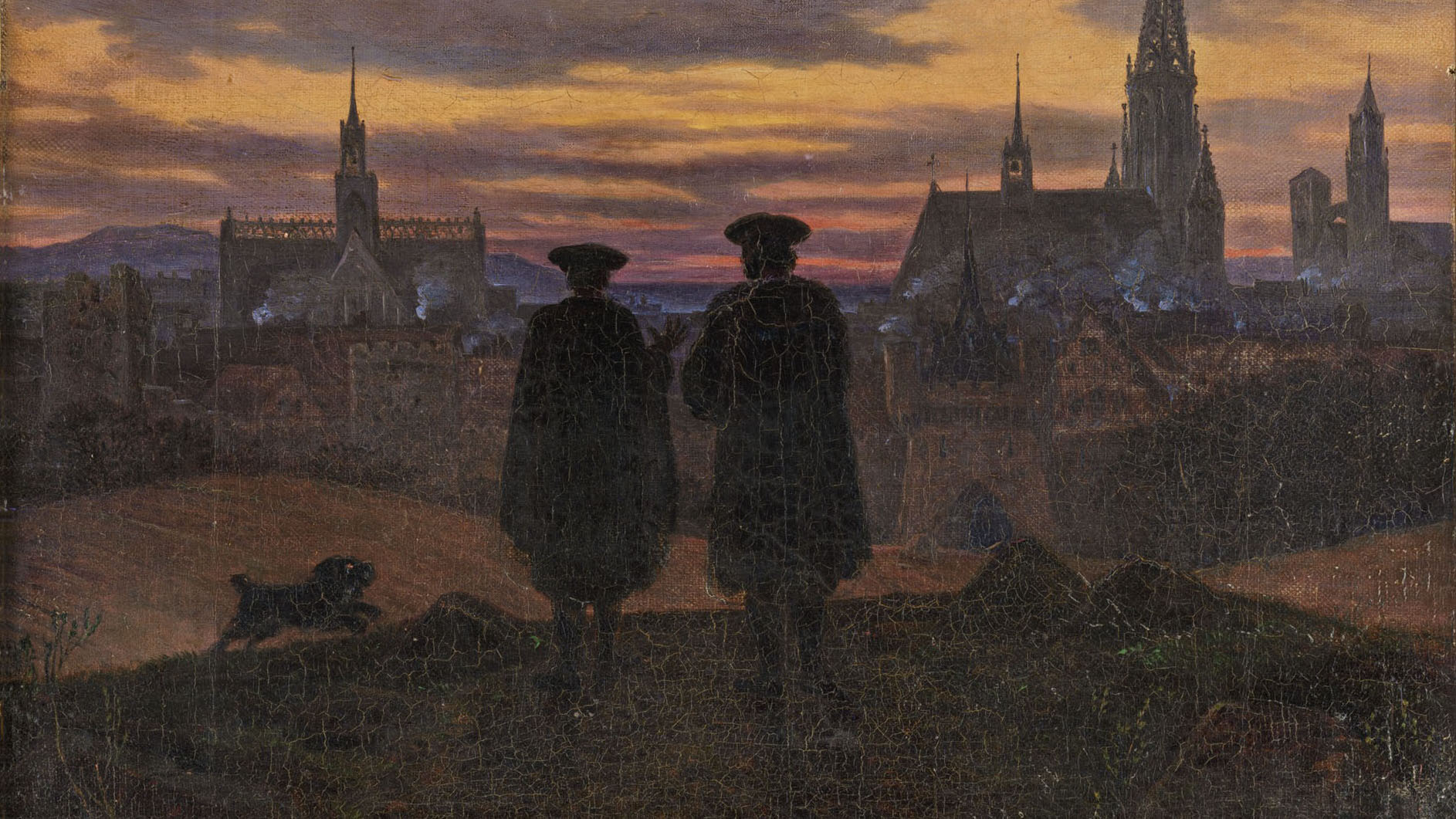
The proverbial “deal with the devil” is typically understood as trading one’s soul for some great gift or experience. The great bluesman Robert Johnson, so the story goes, learned his guitar skills “down at the crossroads,” from “Old Scratch,” and paid for it by dying on his hands and knees, barking like a dog. Oscar Wilde’s titular character Dorian Gray makes a bargain to remain young and beautiful for the sake of a life of libertinism but ends up committing suicide. And, made famous by English playwright Christopher Marlow and later by German polymath Johann Wolfgang von Goethe, Dr. Faust (or Faustus) bargains with the demonic Mephistopheles to procure a moment of this-worldly bodily and intellectual transcendence.
We are familiar with the cautionary lesson to be learned: Whatever great benefit may come from the immoral shortcut—of which the bargain with Satan is but the most extreme example—it will in the end bring us ruin. All the glory and pleasure will soon evaporate, and we’ll be left with the terrible, sometimes even deadly, consequences of our short-sighted avarice and lust. But in truth, the devil is rarely so dramatic. As the worldview underlying Goethe’s Faust shows, modern man has traded his soul for prizes far less fabulous than one might expect.
When we first meet Faust, he is a brilliant scholar who, though he has mastered much learning, remains deeply dissatisfied. Professional achievement, philosophy, and even conventional religion all fail to generate the fullness of life for which he yearns. He can “hear the message” of the Gospel at Easter, but he can “believe no longer.” What Faust desires is, “a vision of Nature’s forces; That bind the world, all its seeds and sources; And innermost life—all this I shall see.” He aspires to experience everything—to penetrate the secrets of existence, to overcome his limitations, and attain a deeper sense of knowledge and fulfillment.
Unbeknownst to him, Mephistopheles (in a literary allusion to the Book of Job) is discussing the discouraged Faust with God above. Yet, argues scholar and translator David Luke, Mephistopheles is “neither Milton’s nor Marlowe’s Devil,” but is rather “de-theologized.” There is (seemingly intentionally) no reference to sin, evil, hell, or damnation, and even death is dismissed by the devil, who declares that he is indifferent to what happens to men after they die.
As the worldview underlying Goethe’s Faust shows, modern man has traded his soul for prizes far less fabulous than one might expect.
The Lord, alternatively, is not so much the God of the Bible but a spokesman of Goethe’s “positive and life-affirming” Romanticism. He is proud of Faust, whom, he asserts, “serves me, but still serves me in confusion; I will soon lead him into clarity. A gardener knows, one day this young green tree; Will blossom and bear fruit in rich profusion.”
Goethe thus subverts the classic drama of the battle over men’s souls and in its place presents to us a more modern dichotomy: human striving versus hopelessness. Mephistopheles, who is given divine permission to tempt Faust, is intended to manifest genuine, objective despair and the idea that human imperfection invalidates human aspiration, while Faust represents the subjective despair even the idealist often feels. God, in turn, is the realization and embodiment of that hopeful idealism. “Man errs as long as he strives,” Goethe has the Lord declare, neatly summarizing Goethe’s positive view of humanity.
When Mephistopheles (first in the form of a dog and then as himself) arrives at Faust’s home, he tempts the scholar in words that will appeal to him: “My friend, you shall in this one night, In this one hour, know greater sensuous delight; Than in a whole monotonous year!” Though he first demurs, eventually Faust gives in:
Books sicken me, I’ll learn no more. Now let us slake hot passions in; The depths of sweet and sensual Sin! Make me your magics—I’ll not care to know; What lies behind their outward show.” He desires, “To give oneself entirely and to feel; Ecstasy that must last for ever! For ever!—For its end would be despair. No, never-ending! Never ending!
With Mephistopheles’s help, he seduces the poor maiden Gretchen (also referred to as Margarete). Yet in short order, their romantic fling becomes all consuming, and in order to preserve the lovers’ privacy, Gretchen murders her mother with a sleeping potion. After she becomes pregnant, her brother challenges Faust to a duel, and, again with Mephistopheles’s assistance, the brother is killed. Gretchen then murders her newborn child and is sent to prison. Faust attempts to free her from the dungeon, but she, having accepted her fate, refuses, while heavenly voices announce her salvation. Thus concludes Part One; in the (less widely-read) second part, Faust seeks to redeem himself by doing good for the world and future generations. “Whoever strives with all his might, we can redeem” sing the angelic hosts who guide him to his heavenly reward.
Despite the religious imagery, this is far from a traditional Christian story. Faust, writes Luke, is representative of a de-Christianized Romanticism, “something like a myth of European man.” The titular character does not appear to believe in God. When Gretchen speaks to him of God, Faust replies: “My dear, how can Anyone dare to say: I believe in Him? Ask a priest how, ask a learned man, And all their answers merely seem; To mock the questioner.” His quest for “God,” as such, is not spiritual or transcendent but earthly and to be realized through the natural order and earthly experience, striving, however imperfectly, to do good and be happy.
“Weimar Classicism was, in sophisticated and non-trivial senses, idealistic and optimistic, as well as humanistic in the sense that it saw the world anthropocentrically rather than theologically, and in the sense that it took a positive, indeed Pelagian view of human nature and human potential,” writes Luke. In Goethe, there is no original sin from which man must be redeemed by divine, salvific grace. Faust, in Luke’s words, is “saved by the organic development of his own righteousness.” (Helmuth Kiesel in a 2019 article in the German theological journal Communio makes much the same point.)
In this psychological humanism, Goethe quite effectively seemed to presage modern man. Today, the moral vision of the secular West excludes God (or, like Goethe, defines him as a benevolent, almost impersonal force who is simply happy to see us trying). Our conception of the good life, in turn, increasingly elides classical virtue in favor of therapeutic self-optimization and self-help, obsessed with health, longevity, and the latest “life hack.” We define goodness not by conformity to a received, objective moral order, obedience to divine law, or the achievement of a particular virtue, but by an ongoing process of effort and self-development—what F. J. Lamport describes in his essay on Goethe as a “perfectibilism” that identifies striving as the true telos of man.
Yet, pace Goethe, what if that perfectibilism is the actual deal with the devil—one in which men forget their divine origin and end in favor of trite celebrations of simply finding your “best self,” and “living your best life” through this-worldly pleasures and experiences? Created for virtue, holiness, and eternal life with God, we limit our horizons to the banal and mundane. Modern man, like Goethe’s Faust, is justified not through the grace of a God who descends from heaven and through his sacrificial death secures our salvation, but by self-satisfying canards about being a “good person” and having the right opinions, proudly displayed via bumper stickers, yard signs, and social media posts.
C. S. Lewis in The Weight of Glory cautions us regarding such a myopic worldview:
Our Lord finds our desires, not too strong, but too weak. We are half-hearted creatures, fooling about with drink and sex and ambition when infinite joy is offered us, like an ignorant child who wants to go on making mud pies in a slum because he cannot imagine what is meant by the offer of a holiday at the sea. We are far too easily pleased.
This is the Faustian bargain of prosperous modernity. We expect the devil to appear in smoke and fire, proffering his wears with a ghoulish smile. But perhaps, like Faust, the true devilry is in settling for an emotive “authenticity” and “living intentionally.” As he invitingly sings: “Oh, fill your heart right up with all of this, And when you’re brimming over with the bliss; Of such a feeling, call it what you like! Call it joy, or your heart, or love, or God! I have no name for it. The feeling’s all there is.” But, in truth, this will not bring us salvation. We were made for more than this.