
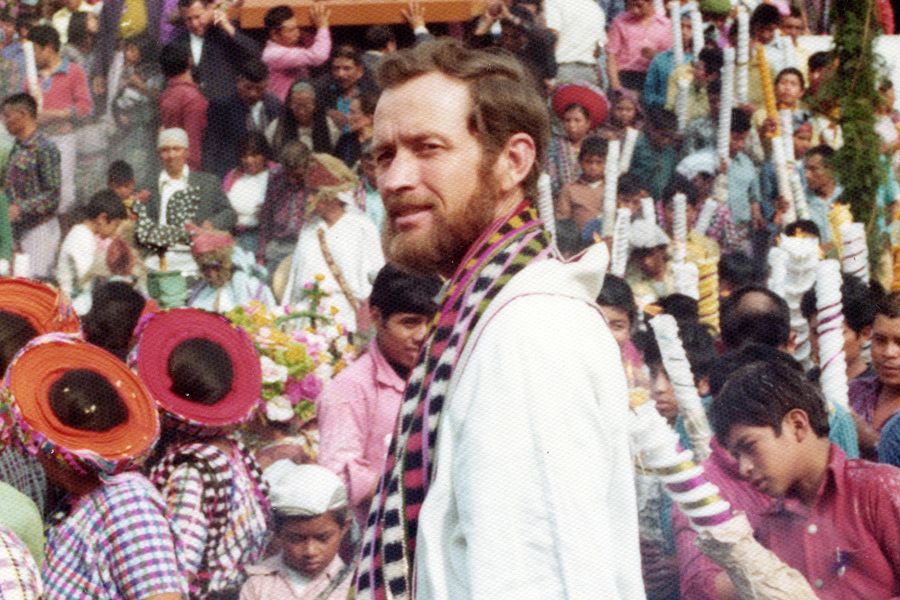
No saint was ever canonized by doing the bare minimum but by loving without measure. Fr. Stanley Rother gave without calculating, even to the point of death. A native of Oklahoma, hardworking farmer, and faithful shepherd, he is the first American-born martyr. His life exhibits a true, passionate love that gave everything without reservation.
Stanley Francis Rother was born on a farm in Okarche, Oklahoma, in 1935, to Franz and Gertrude Rother. He grew up to be a quiet, hardworking young man. He loved to farm and was very handy but was not particularly astute. Everyone was supportive but surprised when Stanley announced his desire to become a priest, and his father remarked, “You should’ve taken Latin!”
He was right. Stanley’s grades in seminary were so low that he was asked to leave. However, the rector saw so much good in the young seminarian that he wrote back to Stanley’s diocese. The bishop of Oklahoma City asked Msgr. George Mulcahy, rector of Mount St. Mary’s Seminary in Maryland, if he would give Stanley a second chance at his studies. A priest and family friend of the Rothers also wrote to Mulcahy, saying, “I realize it takes a certain intelligence to get along in the seminary, but I think he would make a fine parish priest. He is determined to become one. I hope and pray he makes it.”
The monsignor agreed to take him in, and Stanley entered Mount St. Mary’s in 1959, where his grades improved and he was, at last, ordained in May 1963. After multiple parish assignments, Fr. Stanley Rother volunteered for the missions, and by 1968, he was sent to Santiago Atitlán, Guatemala.
The first thing to confront Fr. Rother was the disheartening poverty. The malnutrition was acute, and around half of the Guatemalan children did not survive past age six. Rother used his agricultural knowledge to help them start new farms and establish farming co-ops. On at least one occasion, Fr. Stanley worked a bulldozer for more than nine hours to clear farming land. He only stopped once, and that was to say Mass. In addition, he helped build a hospital and aided in the opening of a school and even a radio station. He also began translating the New Testament into the local native language.
“If it is my destiny that I should give my life here, then so be it. I do not want to desert these people.”
When Fr. Rother first arrived, very few people were practicing their faith. But after seeing a pastor, a shepherd, who cared so much for them, the church pews began to fill at last. Fr. Rother’s door was always open to anyone, and all of the townspeople went to him for his guidance.
Guatemala soon became very violent. The country was rebelling against the elitist monopoly on wealth, and the government turned its eyes on the Church, the only voice for the people. In a letter, Fr. Stanley wrote, “Since the first of May, 1980, there have been four priests killed here in the country. At one place, there were about sixty men in the church, lined up by the wall, and they killed every fourth person.”
The government began kidnapping anyone suspected to be a ringleader and tortured them to death. This brutality against his flock greatly angered Fr. Rother. The military moved into the village and conducted a meeting, telling the people they were there to protect them. Fr. Rother, who had been quiet, shot up his hand and demanded, “If you’re here to protect, why are my people disappearing?”
Threats against Fr. Rother began, and the kidnappings continued. There was nothing anyone could do but watch each other disappear, one by one. The bodies of the victims were never returned, and Fr. Stanley would spend hours looking for them. Sometimes they were dumped in a field, on the side of a road, or even in a nearby well. The good shepherd never stopped searching for the lost bodies of his sheep.
Fr. Stanley fed the families of the men who’d been kidnapped and allowed any fugitives to sleep in his rectory. There was, in particular, one catechist who often slept there. In a letter to a friend, Fr. Rother wrote, “This person was probably the most sought after catechist. He’s been staying here off and on, almost constantly of late. He has been eating and sleeping here, usually visiting with his wife and two children in the afternoon. As he was approaching on Saturday evening, he was intercepted by a group of four kidnappers. I realized then, I had just witnessed a kidnapping of someone that we have gotten to know and love. I got back into the rectory after he had been kidnapped and I got a cramp in my back from the anger I felt that this friend was being taken off to be tortured for a day or two and then brutally murdered for wanting nothing more than better conditions for his people.”
His name was Diego. Fr. Stanley looked everywhere for his body but never found the catechist whom he had grown so close to and came to care for so deeply. With tears in his eyes, he asked, “Do you think Diego knew that I couldn’t help him?”
The clergy were especially in danger. In 1978, Fr. Rother wrote to Msgr. Flynn, the rector at Mount St. Mary’s, Msgr. Flynn, “June 30th, there was an activist Priest (Guatemalan) cut down by submachine gun fire just outside Guatemala City. . . . It is almost certain that the Maryknoll priest who died in the Fall of ’76 had his plane sabotaged.” Priest after priest was being targeted by the Guatemalan government. Many priests fled the country, and many who stayed were killed. The more that Fr. Stanley spoke out, the more his life was threatened.
“The reality is,” he writes. “We are in danger here in Santiago Atitlán. There is a chance that the government will back off. If I get a direct threat or I’m asked to leave, then I will go. But, if it is my destiny that I should give my life here, then so be it. I do not want to desert these people.”
At length, there was indeed a serious threat made on his life, and he discovered that he and his associate pastor were both on a death list. He decided to go home for a time to visit his family in Oklahoma in the winter of 1981. He spent most of his time there standing at the back door of his family’s house, gazing sadly into the distance. He said that after living twelve years of his life with those poor people, he almost felt like one of them. “The question is,” he said. “Should I take the chance and go back?” He was fully aware that he could return to being a comfortable parish priest in his home diocese, but he had given his heart to his flock in Guatemala, and he felt that he had abandoned them. “Nobody has yet convinced me to stay here,” he said.
Fr. Stanley spoke with Bishop Eusebius Beltran of Tulsa, and insisted, “A shepherd should not run.” Beltran agreed, and told him that he was right to return, not realizing that he was sending him to his death. “I didn’t probably realize,” he said. “How fearful he was because he was so intent on going back. But he had to be fearful, because he knew what was happening.”
He made a phone call to Msgr. Flynn and asked if he could come to the seminary at Mount St. Mary’s to think and pray. “If I stay there and speak,” he said to Flynn, “I will be deported or killed.” How difficult and anxious that week of discernment must have been. He knew he would not come back alive, but he could not bear to leave his flock. After a week of intense prayer, he finally said to the monsignor, “The shepherd cannot run at the first sign of danger. Pray for me, that I might be a sign of the coming of Christ for these good people.”
Fr. Stanley was fully willing to lay down his life, but he wanted to survive and keep fighting as long as he could. His flock had been whisked away by the government so silently and without resistance that one can almost hear the defiance in his voice when he said to Flynn, “They will never take me out and shoot me in the country and leave my body, or throw my body in a well. I will put up a fight.” When he went home for what must have been a very heart-wrenching goodbye to his family, he told his father, “If they ever come and get me, they’re not going to get me out of the house.”
“The shepherd cannot run at the first sign of danger. Pray for me, that I might be a sign of the coming of Christ for these good people.”
Fr. Stanley went back to Guatemala into the greatest intensity of guerilla warfare that had thus far occurred. He arrived just in time for Holy Week, as he had promised them. He began securing the parish property, changed the locks, and told one of the sisters, “If they come for me, light the Easter candle and sing Easter songs.”
After doing all he could to protect himself and the parish, Fr. Rother celebrated Mass and had a dinner with music and laughter in an attempt to comfort everyone and relax the tension that must have been overwhelming. He left the party and went to his room to sleep. In the middle of the night, three men entered the rectory. They found a young man who was staying there, and they demanded to be taken to Fr. Rother. The young man could only exclaim, “Father, they’ve come for you!”
Some parishioners heard the gunshots and came running into his room. The men had already left and Fr. Rother was already dead. He had always insisted, “If I ever get kidnapped, they’ll never take me out of the rectory alive.” The state of his hands suggested he had kept his word and definitely put up a fight. As the entire village filled the church to mourn their beloved shepherd, Sr. Ana Maria Gonzales kept them singing Easter songs as Fr. Stanley had instructed her, and her obedience is likely the only reason why the people did not rise up and become violent.
News of his death had to reach other ears as well. Another priest, Fr. Beckman, was sent to tell Fr. Rother’s family. He drove to the family farm, got out of the car, and before he reached the porch, Stanley’s father came outside and called out, “Father, they didn’t get him out of the house, did they?” One can imagine the pause Fr. Beckman must have made before looking the martyr’s father in the eyes and answering, “No.”
Fr. Rother’s body was laid to rest in Oklahoma, in the family plot, except one part of him—his heart. His heart was removed and remains in Guatemala, where it was personally enshrined by Msgr. Flynn at the front of the village church. When met with the question of what Fr. Stanley would tell seminarians today, Flynn paused a moment and replied, “Well, I hope he would say, ‘Be calm. The whole thing is in God’s hands. Be kind. Be kind. Be kind.’”
This good shepherd from Oklahoma has officially earned the title of blessed, and his feast day is July 28. It’s difficult to imagine anyone would disagree that he certainly deserves to be canonized as a saint. To quote that letter of recommendation written so many years ago to Msgr. Mulcahy, “He is determined to become one. I hope and pray he makes it.”
. . .
Special thanks to EWTN’s documentaries “An Ordinary Martyr: The Life and Death of Blessed Stanley Rother” and “Fr. Stanley Rother: American Martyr.”