

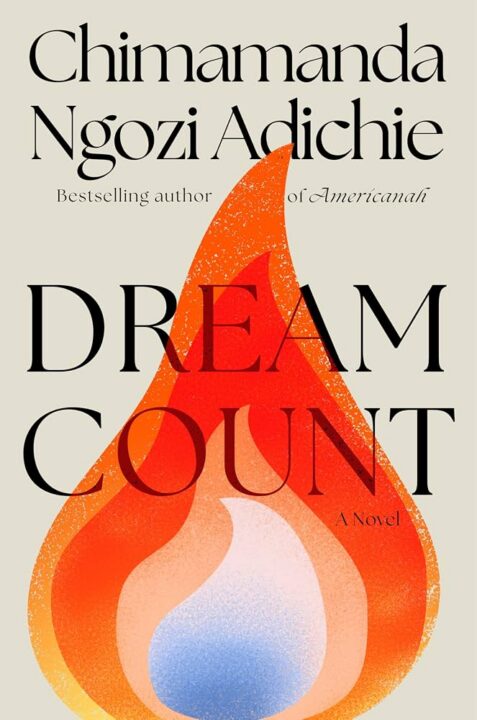
Chimamanda Ngozi Adichie, Dream Count (Knopf, 2025), 416 pages, $32
. . .
If the long-beleaguered world of literary fiction still has any superstars, Chimamanda Ngozi Adichie must certainly be counted as one of them. Well known for her TED talk warning against “the danger of a single story”—the destructive, reductive effect of viewing any person through the lens of shallow beliefs about their sociological, geographic, or religious affiliations—the Nigerian novelist has also been outspoken on humane issues ranging from war and peace to the importance of education to the treatment of women in the developing world.
She has also, though more quietly, spoken of her recent rapprochement toward the Catholic faith of her youth, in part a response to her grief over the loss of her own parents. In her essay “Dreaming as a Single Family,” Adichie responds to Pope Francis’s exhortation Fratelli Tutti by grieving, too, the loss of the joyful Catholic community she knew as a girl and imagining a time when the human tendencies toward factionalism and materialism and bitterness exhibited by some Catholics will be defeated by a greater unity in Christ and a spirit of “social friendship” flowing from that unity.
As Bishop Barron has recently noted, the Catholic Church in Africa holds profound lessons for its coreligionists in the West, and therefore it is also striking to note the resonance of Adichie’s themes in these texts, as well as in her most recent novel, Dream Count, with those recently laid out by Pope Leo XIV for the whole Church in Magnifica Humanitas.
Dream Count reveals territories of the heart where secular moral intuition continues to chime surprisingly loudly with the Church’s perennial teaching on men, women, love, marriage, children, and family, as well as shines a light into dark areas where the perennial teaching may encounter human pain and confusion and therefore needs to be offered all the more patiently and lovingly. Especially, it reveals those areas where the Church should be able to practice “affirmative orthodoxy,” amplifying what is right in the contemporary mind before turning to address any blight inflicted by the fallout of false ideas upon the flourishing of the human person.
Let me be clear: I do not claim that this novel sets out or attempts deliberately to do any of these things, simply that it does do them by virtue of its quiet but powerful witness to the actual conditions of daily American life among “third culture” families and communities, foregrounding the lives of girls and women. Not only this novel, but any good novel, is worth our attention not primarily as grounds for further cultural analysis but primarily as a frame for individual character and story. Precisely by treating characters not as faceless or bloodless case studies in sociology, not as sponsors of a “single story,” but as real people embedded in familial, economic, and religious contexts, it honors not only “their” reality but reality, full stop.
Zikora’s absolution and return to grace is simply felt and powerfully shown to be necessary for her soul, for her peace.
One of these “real,” though fictional, people is Zikora, who chooses her child in what we might call a crisis pregnancy. Zikora has been left, and left cold, by the father of her baby, who had previously dangled promises of fidelity only to bolt when the reality of new life impinged on his old life. This kind of abandonment, we soon learn, has happened to Zikora once before, in a much less mature relationship in college. In that case, the character chose abortion before returning to the Church through confession; the scene in which Zikora is reconciled is handled with great humanity, with a delicacy and beauty that would be impossible if it were depicted as part of an axiomatic or syllogistic effort to prove the necessity of that return. Zikora’s absolution and return to grace is simply felt and powerfully shown to be necessary for her soul, for her peace. The physical reality of motherhood, its brute pain and steep cost, are not at all softened or waved away by the narrative either. This too only increases the impact of the story and our estimate of the respect Zikora is due.
Other truths that the Church sponsors show up more unexpectedly through Omelogor, a financier-turned-graduate-student who takes up as the theme of her advanced studies an analysis of pornography’s negative effects on contemporary society. Omelogor concludes, from a secular perspective yet still quite rightly to Catholic eyes, that pornography malforms young people; its poisoned, decaying fruit feeds the root of the bad tree of relational dysfunction between men and women. Once these distorted social expectations are created—sick neural and physiological pathways established and false body-images ingrained—it is very difficult to reject these lies and return to life-giving scripts. Though some can achieve that path through a divinely inspired and grace-fueled craving for the clean and the true and the pure, others, probably most others, never find their way out of the labyrinth. In light of the crying need all around her, Omelogor establishes what amounts to, though it is not called, a ministry, where she supports the socialization needs of confused young men by proffering advice on what healthy relationship dynamics ought to look like. Yet Omelogor’s own relationships continue to be marked by a certain transience, a struggle to attach, and a transactional logic that, to her friend Chiamaka, appears to “starve” the deeper needs of the heart.
Each of the novel’s young women, in her own way, justly seeks to address the lack in what the men around her can offer her. For each, the same effort brings her up against a corresponding lack in herself and in her society. The most profound of these stories and the closest to real life, that of the Muslim woman Kadiatou, deserves its own essay—I cannot do it full justice here—as it opens up the widespread societal problems that arise when women are wrongly imagined to be less human than men, as well as the abyss of compounding pain caused for those who have endured sexual assault by the very processes that exist to prove the truth of their reports.

The novel also names more garden-variety and less grievous dysfunctions of contemporary life, such as Adichie’s Austenian satire, through Chiamaka’s university days, of the “woke scold” phenomenon. For Chiamaka, connections that could have become nurturing friendships and hopeful love prospects end up, instead, shattered by the wrong choice of word in front of the wrong person or even the wrong choice of drink at a Parisian brunch. By means of concrete detail, the motive of at least some wokeism is revealed to be a form of particularly elaborate snobbism in disguise. The irony compounds: A movement initially intended to call attention to real forms of injustice can become, in practice, a weapon against those who are not thought to fit into a bien-pensant social scene; a movement initially intended to create solidarity can instead feed rage, resentment, and social discohesion.
Note, though, that even though the characters in this particular episode are leftists, the “woke scold” cannot be justly thought of as an exclusively left-coded phenomenon. In real life, the rise of the “woke right” already features lockstep conformity of speech and behavior, fueled more by external sociological markers than by any actual drift of thought. This conformity posts itself as the entry fee for claiming a supposedly favored identity. Shunning and scapegoating come as the social cost of refusing those conformisms, just as aggressively on either side as on its supposed opposition. The axiom proposed by Ursula K. Le Guin rises to mind: “To oppose something is to maintain it. . . . To oppose vulgarity is inevitably to be vulgar. You must go somewhere else; you must have another goal. Then you walk on a different road.”
For no mere position of denial can ever turn itself inside out to become one of affirmation. All hatred tends to become what it hates. All violent opposition eventually starts to mirror what it opposes. While Adichie’s keen eye for social reality reveals this dynamic as it exists on the political and ideological left, the underlying principle she articulates in her afterword—“Ideology blocks different ways of seeing, and art requires many eyes”—should serve as caution for all who seek to see clearly, whatever their priors.
In keeping with its concern for justice, the novel’s themes at times are serious and heavy, but the tone remains one of hope. Kadiatou, after her long suffering, is given a conclusion of renewed dignity and community, an act of aesthetic justice to balance against the lack of restorative justice in her case. Meanwhile, an implicit positive model for engaging with those who see differently is present throughout Dream Count in Adichie’s affectionate, if sometimes bemused, account of the firm fabric of third-culture family life. Here the feedback and grounded knowledge of parents and grandparents, aunts, uncles, and family friends remains woven into processes of personal discernment and moments of major career decision. Sometimes, the social pressure to marry and have children becomes an irritant or even an impetus to grief because of unfavorable circumstance; still, it tracks closely to several protagonists’ own innate desires. Connection and continuity are valued over individualism, even as the individual is also nurtured, loved, praised, supported, and deeply seen, if at times still imperfectly known.
We will have to enter into the understanding of those we disagree with, to some degree, if we ever want to persuade society that it would be in its own best interest to take the Church’s proposals for the moral life more seriously.
The third-culture extended community has its problems and imperfections, which Adichie treats with gentle irony and wry humor, but even so, it still does a far better job than the typical late-stage American family of honoring the truth and implications of essential human dignity. Adichie’s fictional picture of community chimes cleanly with the note struck by Pope Leo XIV in Magnifica Humanitas:
It is individuals that matter, each and every person, together with their families. Social movements, communal ideologies and grand political proclamations in favor of a population are worthless unless they lead to the flourishing of persons—men and women—with their inalienable rights.
Faith and devotion, too, are tied tightly into other virtuous practices of family life in the novel. Trips to the sacrament of reconciliation are taught as a regular, conscientious habit when things have gone sour and wrong paths have been chosen. Rosaries are prayed together in times of stress or gratitude (or both). A Catholic wedding in particular is considered to be the sine qua non of a couple’s formally commencing a committed life together, even as informal commitments (or attempts at commitment) spin into view and then slide away.
Even so, the Catholicity that appears among Dream Count’s cohort of younger characters tends to reflect an attenuated practice of faith—not for lack of emotional connection to holy realities but perhaps for lack of fuller understanding and practical formation. Many younger Catholic characters do not seem to register, as previous generations did, the dissonance between a typical American private life and the public profession of a faith that is known to hold its adherents to a high standard. That challenge, global and irreducible, can be fully addressed by nothing less than a wholesale, worldwide upgrade in how the positive Catholic moral vision is taught, proposed, and lived: a new middle way between the disastrous rigorism and puritanism of repressive cultures and the developed world’s present insistence on celebrating shameless behavior.

Though we may imagine all the utopias we like, this middle way is beyond the power of a realist novelist to speak into being. What realist fiction can do—and Adichie does here—is to demonstrate how people do live, even when it falls short of how they ought to live, so that the psychology of choice and the pressures of conflicting ideas about the human person can be more clearly seen and more precisely addressed.
As Gaudium et Spes lays down, and Pope Leo recently highlights again in Magnifica Humanitas,
It is the task of the whole People of God, particularly of its pastors and theologians, to listen to and distinguish the many voices of our times and to interpret them in the light of God’s word, in order that the revealed Truth may be more deeply penetrated, better understood and more suitably presented.
This is also the task of the Church’s artists, writers, and creators. Fiction writers in particular walk the same pastoral tightrope that those with the care of souls must consider, while we also carry the added dimension of the difficulty of craft: Characters’ viewpoints must be presented as they really are, without distortion or diminution, with the greatest precision. Those who create narratives around characters in error (and who among us is without any error whatsoever?) must proceed with a total willingness to comprehend their characters with clarity, candor, and patience rather than with harshness or blame; with total docility, therefore, to the Spirit of all truth, yet without any fearfulness that, as David Foster Wallace puts it, “words meant to express may really invoke.” Writers, and readers, must not confuse mere articulation of a viewpoint with agreement with that viewpoint. For we will have to enter into the understanding of those we disagree with, to some degree, if we ever want to persuade society that it would be in its own best interest to take the Church’s proposals for the moral life more seriously.
To evoke Leo once again, “The Church regards all who sincerely seek ‘truth, goodness and beauty’ as companions on the journey, and considers them as ‘precious allies’ in defending the dignity of every person and in caring for creation.” This includes all the artists among us who work not in a spirit of ideology but toward a revelation of clarity.