
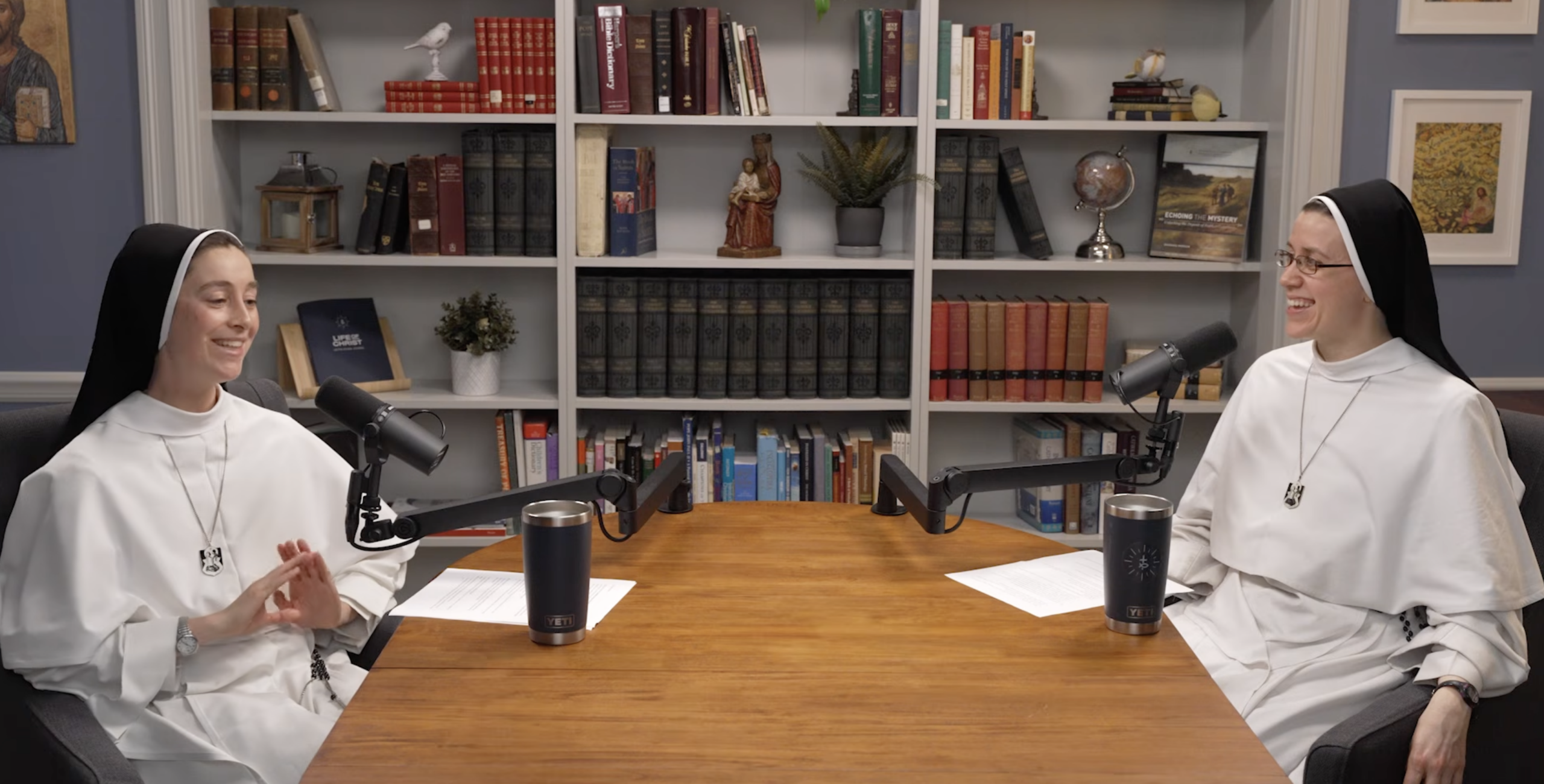
I wasn’t far into doomscrolling on TikTok when I came across a clip of two Dominican sisters discussing their Ultimate Frisbee game. As an Ultimate Frisbee player myself, I had to pause. But the second and deeper pause came when I realized that the video had over seven million views, and since I had stopped on this particular video, the algorithm fed me more videos of regular influencers saying things like “One more breakup, and I am joining them” and continuously praising the sisters for their demeanor, gentleness, and overall sweetness—something rare in our social feeds. I don’t think America had cared so much about a habit since Whoopi Goldberg hid in that fateful New York convent.
This happened in the early spring, but the sisters’ videos continue to appear on millions of feeds, as well as the videos of content creators who seem in disbelief. Among them is Vivian Wilson, Elon Musk’s estranged and conspicuously secular transgender child, who left the comment lowkey obsessed. It’s almost as if we’ve rediscovered a creature we thought extinct and now we gather around it in awe. Like most extinct creatures, the numbers of nuns went down largely due to the environment, but the environment has changed. This post-pandemic world is seeking more of what religion and these sisters can provide, so now suddenly and seemingly from nowhere, we are once again united around them.
To my own surprise, when I showed my little sister one of the sisters’ clips, she exclaimed, “She was my teacher!” and proceeded to sweetly add, “I don’t know if she remembers me, but she definitely still prays for me.” She shared that Sr. Miriam—the podcast host—used to encourage them to finish their work quickly so she could tell them stories about her life and convent life overall, similarly as they do on the podcast. She also shared that Sr. Miriam had a thick notebook filled with the names of all the students she ever taught and for whom she prayed for daily. My sister was confident that her name was in that notebook and described what a treat that felt like. I may be stretching it, but I think Sr. Miriam has been gathering more notebooks since her TikTok success has brought a multitude of new students eager to learn from her.
This is the real question here: Why are these sisters going viral? The sisters are simply being themselves, and that alone has made millions pause. I believe the real reason for the virality is the fact that America and the world in general has been in a spiritual drought. For the most part, this has been a completely unknown choice and in another part it has been a clear cultural choice, but perhaps this choice was made somewhat blindly. Many turned away from the Church because of the rules, the sex scandals, and the hopelessness around all these matters; but I think many were unaware of all the good things they gave up in this choice. And now these Ultimate Frisbee–loving sisters remind us of it.
Millions of people who were not looking for God were stopped mid-scroll by women who have him, and who seem, against everything the age promised them, to be unhurried, unanxious, and free.
Their podcast is not on apologetics. They don’t come across as intellectuals, although most of these sisters have advanced degrees. They are genuine women living out their vocations. The bewilderment is due to the fact that their way of life was supposed to be the clearest casualty of modernity. Instead, these women are the most sophisticated, attention-grabbing TikTok stars, and their success does not seem to be slowing down.
What Was Supposed to Be
The decline in vocations, and consequently the sisters’ participation in public life, whether it’s in schools, soup kitchens, and hospitals, has been steep. American women religious peaked in 1965 at 179,954, according to the Center for Applied Research in the Apostolate. Today there are 42,441, and the median age of those who remain is well past eighty. For sixty years, this curve has been read as a straightforward illustration of the secularization thesis: As a society modernizes, the supernatural and spiritual recedes, and the most complete forms of religious commitment are the first to become unlivable.
But the decline was never evenly distributed, and that is where the thesis strains. The orders that contracted most catastrophically were, overwhelmingly, the ones that liberalized hardest after the Second Vatican Council, those who set aside the habit, loosened the common life, and remade themselves to meet the modern world on its terms. The communities that kept the habit, the eucharistic devotions, and the demanding vows are, against every projection, the ones now drawing the young.
The TikTok sensation is not the only reintroduction of the sisters to society. There’s also a worldwide phenomenon of young single girls moving into convents due to the high cost of living. Media outlets have covered this with a sense of awe and confusion, as Gen Z women tell the reporters that they don’t feel judged by the sisters and they don’t mind the curfew—something older generations seem bewildered by. And then, there’s the Salesian Sisters cheering and blessing the Spurs from courtside—something fans from all over have noticed, and those clips are also gathering millions of views in social media.
The communities that kept the habit, the eucharistic devotions, and the demanding vows are, against every projection, the ones now drawing the young.
The Dominican Sisters of Mary, Mother of the Eucharist, are the case in point. Founded only in 1997 and canonically established by Cardinal John O’Connor in answer to John Paul II’s call, in Vita Consecrata, for a renewal of consecrated life, they currently number more than 150, with an average age around thirty-two and an average entering age of twenty-one. They are everything the post-conciliar consensus said would repel a modern woman, and yet modern women keep arriving at their doorsteps and social media accounts.
The Self They Don’t Have
Social media has exponentially grown a concept that already reigned for most of the twentieth century. It’s the modern understanding of selfhood in which, through your expression as an individual, you create yourself. You become who you want to become. It’s the belief that to be a self is to author one’s identity from within and perform it outward, that authenticity is the highest good and any external claim on the self is a kind of violence. Now in the age of social media, this has turned into the concept of a personal brand, and it almost seems like everyone is obligated to build one. The native habitat of this self is now the feed, where identity is a brand under permanent construction and the self is curated, optimized, and monetized in a labor that never finishes. This has also led to the burnout of a culture that has confused freedom with the obligation to keep producing oneself, and anyone who has ever attempted to become an influencer needs no footnote for what this experience can be like.
But now, among all those influencers who have successfully built a following through personal brand and content pillars, drops a whole religious order who has done the opposite of all of it. Their identity is not constructed but received, and in a TikTok clip the sisters explain what a vow of obedience really means, what life is like when you freely give up your self-determination and fully vow yourself to a life of complete service to God and his creatures. Dominican Sisters Open Mic runs on a structural fact the platform cannot fake: Sr. Miriam is interviewing not strangers but women she has lived beside for around two decades. Against a culture of performative connection among the lonely, the sisters offer the one thing it cannot manufacture and most wants: people who plainly love each other and want nothing from you.
Why Renunciation Looks Like Freedom
What secular media and generations above Gen Z, those who have lived in a world filled with resentment toward organized religion, seem to not connect with is Gen Z’s willingness to engage with the theology, even taking it seriously. The sisters are compelling not despite their vows and renunciation but because of it, and the Christian tradition has always insisted that this is not repression or a trick of branding but the actual shape of freedom.
What is often presented to the modern ear as a catalogue of deprivations—no money, no sex, no self-determination—the tradition reads as the reverse: liberations from the very goods that, pursued without limit, have a way of taking their pursuers captive. “Whoever would save his life will lose it, and whoever loses his life for my sake will find it” (Matt 16:25 RSVCE). To a generation that was told from birth that freedom means the endless multiplication of options, and that has tried that freedom to the bottom of the glass and found it strangely depleting, the woman who closed off nearly every option and looks unmistakably happy is not a relic of the past or a museum artifact. Instead, she is a provocation, and her virality suggests the opposite: that the freest and happiest person on the feed may be the one who renounced the feed.
The Charism Doing Its Work
It would be easy to call all this a happy accident, and at the human level it was: No one engineered the frisbee clip. But that would disregard the sisters’ own tradition. They are Dominicans—the Order of Preachers—whose founding charism is summarized in three words, contemplata aliis tradere, meaning “to hand on to others the fruits of contemplation.” Sr. John Dominic Rasmussen renders it almost verbatim when she describes the work: “We contemplate and give to others the fruits of our contemplation.” Their media apostolate calls the internet “the largest classroom in the world” and “the new public square,” and notes that St. Dominic “was not afraid to go out there into the streets.”
Seen this way, the virality is not a swerve from the cloister but the charism operating in a new context: preaching, which is what these women exist to do, finding the crowd where the crowd now actually gathers. The accident and the fittingness are both true at once, which generally is what we could call providence. The sisters answering their call and doing their work and God engaging—this is what miracles are made of.
When She Was Everywhere, and Then Suddenly Nowhere
This is why the moment reads as a return and not a novelty. For most of the twentieth century, the nun was among the most legible figures in American culture, even for non-Catholics, and in the world’s picture of America. Hollywood ran on her: The Nun’s Story, Lilies of the Field, The Sound of Music, The Trouble with Angels, Sally Field aloft each week in The Flying Nun. The success of The Sound of Music set off what critics came to call “nun culture.” As many as nine nun-themed pictures were greenlit in 1965 alone, and a generation later Sister Act did it again. These films traveled; a teenager in Madrid or Manila who had never crossed the Atlantic nor met an American had a certain idea of America, and of Catholicism, through its movies, and the nuns in them were unavoidable.
(That most of these orders, and the Ann Arbor Dominicans, are properly sisters rather than cloistered nuns is a distinction the culture has always ignored. The reach for “nun” names an icon, not a canonical category, which is itself part of the point.)

Then the icon vanished on two fronts at once: the real demographic collapse, and a cultural souring in which the figure migrated from heroine to horror-movie villain, from Maria to the sadistic abbess and the secret world filled with darkness. By the 2010s, even that ambivalence and duality had thinned, and the nun became just a Hollywood costume.
The Question That Comes Back with Her
The strongest skeptics have a point that deserves stating, because it is not weak. Perhaps this is simply aestheticized traditionalism; just another profile of the unmarried, ultra-trad woman, surfaced by the same algorithm that manufactures every other fascination. Are we captivated because we are still captivated by the habit as a costume, or because the world is beginning to see it for what it actually is? Perhaps virality, which cheapens everything it touches, is busy cheapening a vocation. A clip, after all, is not a conversion, and the same algorithm that found the sisters this spring will find something else by autumn. And yet even the objection concedes something: America lost touch with its beloved nuns, and whatever this particular cultural moment is, it is certainly a new point of contact.
What the skepticism cannot explain is the part that came first. These women were arriving in numbers, and willing to wear the full habit, for a quarter century before TikTok found them; the demographic fact precedes the virality and will outlast it. And the aesthetic the skeptic distrusts is doing honest work precisely because it points past the visuals and into a form of life the optimizers and social media strategists cannot counterfeit. Why? Because it is constituted by the one thing a personal brand can never include, which is the renunciation of having one.
Sr. Miriam, wary of the platform carrying her and preaching less screen time, calls the sisters’ TikTok a “stepping stone,” a place she hopes people pass through on the way to prayer. That is not the posture of someone building an audience. It is the posture of someone handing on a gift and trusting it to go where she cannot follow. That’s the evangelizing charism that guides the sisters’ online ministry.
So the culture did not rediscover the nun out of nostalgia. Personally, I don’t think they consciously missed her enough, even though they should, for the nuns always brought a place of joy and respite to our world. Instead, unintended audiences collided, by way of an algorithm, with the one form of life it had pronounced obsolete and found it more alive than the world that had written its obituary. NBC framed the story as “viral nuns inspiring a new generation,” which is true but tame. The sharper truth is that millions of people who were not looking for God were stopped mid-scroll by women who have him, and who seem, against everything the age promised them, to be unhurried, unanxious, and free.
In time, the fruits of the seeds sowed will come to show, and we’ll have to wait and see what will happen with the American nuns. We live in different times, and I actually think we crave rebellion less because we have tried, at scale, nearly everything these women gave up, the self-determination, the self-authorship, the endless keeping of our options open. Now the better question is Why are we the ones who look depleted and often unsatisfied, and they the ones the whole feed cannot stop watching? There’s something about their wholesomeness that we crave and desire, and perhaps that’s what we are so nostalgic about. They say that when there’s a breakup where there was once true love, inevitably time will heal. Inevitably, time will allow for the perspective and wisdom to mend a genuinely good and loving relationship, and I think that may be what’s happening with American culture and its beloved nuns.