

What does it mean to be “rational”? One of the most interesting social experiments exploring this question is Beast Games, which recently debuted its second season. The show falls broadly into the genre of unscripted reality TV game shows. Clearly it takes inspiration from shows that pioneered this genre like Survivor and Big Brother, but Beast Games has carved out a distinctive place. At fifty million views in its first season, it was Amazon’s most successful show, dwarfing the ratings of the former shows. Its exploration of the human psyche is deserving of comment.
MrBeast is by far the biggest YouTube channel in the world. The channel name is also the moniker of Jimmy Donaldson, who rose to fame through giving away huge cash prizes to contestants who complete difficult tasks to varying levels of strangeness and extremity. Survive one hundred days in an underground nuclear bunker with a stranger—win $500,000! Live on an airplane for ninety days with only airplane food for sustenance—and keep it! Win $10,000 per day you survive alone in a grocery store! And so on. Usually there are twists that involve Jimmy “bribing” contestants—tempting players to spend their potential winnings on comforts that would make the challenge easier and even to betray their partner to steal all the winnings.
So with Beast Games, which stands out for the records it has broken for number of contestants on a game show (1,000), the grand cash prize ($10 million), and the viral moments of temptation to take bribes. In the most discussed moment from season 1, four teams of fifty or so people each elect a leader to represent them. Conversations take place in which candidates promise to stay true to the team and resist any bribe; at least one contestant invokes his faith in Jesus Christ as the reason to trust him.
The team leaders ascend a tower with their teams watching. And then a giant screen with a money counter starts ticking upward, faster and faster. At any moment, one of the leaders can press a red button and win the amount of the money on the screen. But the catch is that the leader’s entire team will be eliminated while the leader still gets to continue playing for the grand prize. Jimmy is increasingly flabbergasted as the counter reaches $1 million. No one presses the button. The contestants make comments like “My integrity is not for sale,” “My team means more to me than this money,” etc. All four stayed true—and in the end none of the four went on to win the $10 million grand prize.
Contrary to what the Nash equilibrium would suggest, promises matter to real persons.
This episode drove some social scientists and economists crazy: Is this not a game show in which the whole point is to win money? And how can it be that players would stay true to others whom they had only met in recent days or even minutes? Isn’t it rational to maximize expected value in one’s decision and take the $1 million, when the alternative leaves one with roughly 1/200 chance to win $10 million (for what, the economists would tell us, is an expected value of $50,000, which obviously is way lower than $1 million)?
The classic exploration of individual rationality as homo economicus, the idea that rational persons make decisions based on utility maximization, is the so-called prisoners’ dilemma, in which two partners in crime are interrogated separately. If they both stay “true” to one another and deny the crime, they get one year in jail. But if one confesses and the other denies, the confessor gets off free, while the denier goes to jail for five years. If both confess, they both get three years.
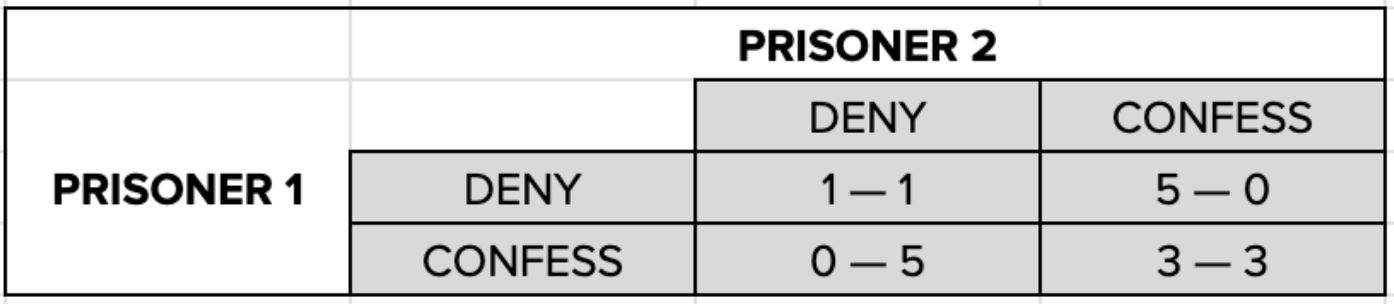
Assuming rational actors who seek to maximize expected value and minimize expected disvalue, both prisoners ought to defect and confess. For neither wants to get betrayed and on the hook for five years—and best case they get off free. This is the so-called Nash equilibrium: The optimal move is always to defect, regardless of any previous promises to cooperate. All that talk was just chatter.
The application to Beast Games is apparent. If human beings acting “rationally” were strict utility maximizers, they ought to defect when the payoff exceeds expected value of cooperating. But in reality, social scientists have found experimentally that in iterated games that reward defection, people are much more likely to cooperate when they have a chance to have conversations, build trust, and make promises. Contrary to what the Nash equilibrium would suggest, promises matter to real persons.
And so the expected value of a decision in Beast Games for many contestants isn’t just dollars and cents. They don’t take themselves to be mere homines economici. What they value apparently includes the goods of honesty, integrity, and friendship, including their friendship with God. It appears that for at least some contestants, what begins as friendships of utility with one another grows into something more. The catch of course is just this: It is very difficult to make it to the end without ever defecting, without ever breaking a promise.
In season 2, the “Mr. Bribe” game for $1 million was played again. And this time a contestant defected, taking the money and eliminating his team. The reactions of the contestants were telling: “You slimy!” “You look real bad in front of God, in front of your comrades on this team.” “You gave your word, and it was for sale. That really hurts—more than the money, it hurts that you broke your word.” “It hurts that you lied to us.”
Another viral moment from season 1 was when one of ten finalists defected and took $650,000 from a $1 million pot of money that, if he had played fairly, could have been split evenly. He breaks down into tears and apologizes afterward. He frames his surprise return to season 2 as an attempt to redeem himself. He finds alliances hard to come by due to his treacherous reputation. He (at least apparently) confesses that he was morally wrong to put himself and his family first above the other contestants, giving witness to the moral law that his fellow contestants took him and themselves to be bound by.
All of this indicates that the Beast Games contestants themselves considered it a game different in kind than, say, lighthearted bluffing card games played with friends or family, in which deceptions would be considered at worst jocose lies. In a high-stakes reality TV game like this, in which people have made significant life sacrifices to be away from careers and families, one’s advancement depends upon cooperation and trustworthiness. In this context, promises made—and even sacred realities invoked to solemnize promises—render deception and betrayal morally grave.
In the end, Beast Games does reveal that some human decisions can be analyzed according to the homo economicus model of the human psyche, but it remains inadequate to explain human behavior. It does not account for the revenge of conscience.