
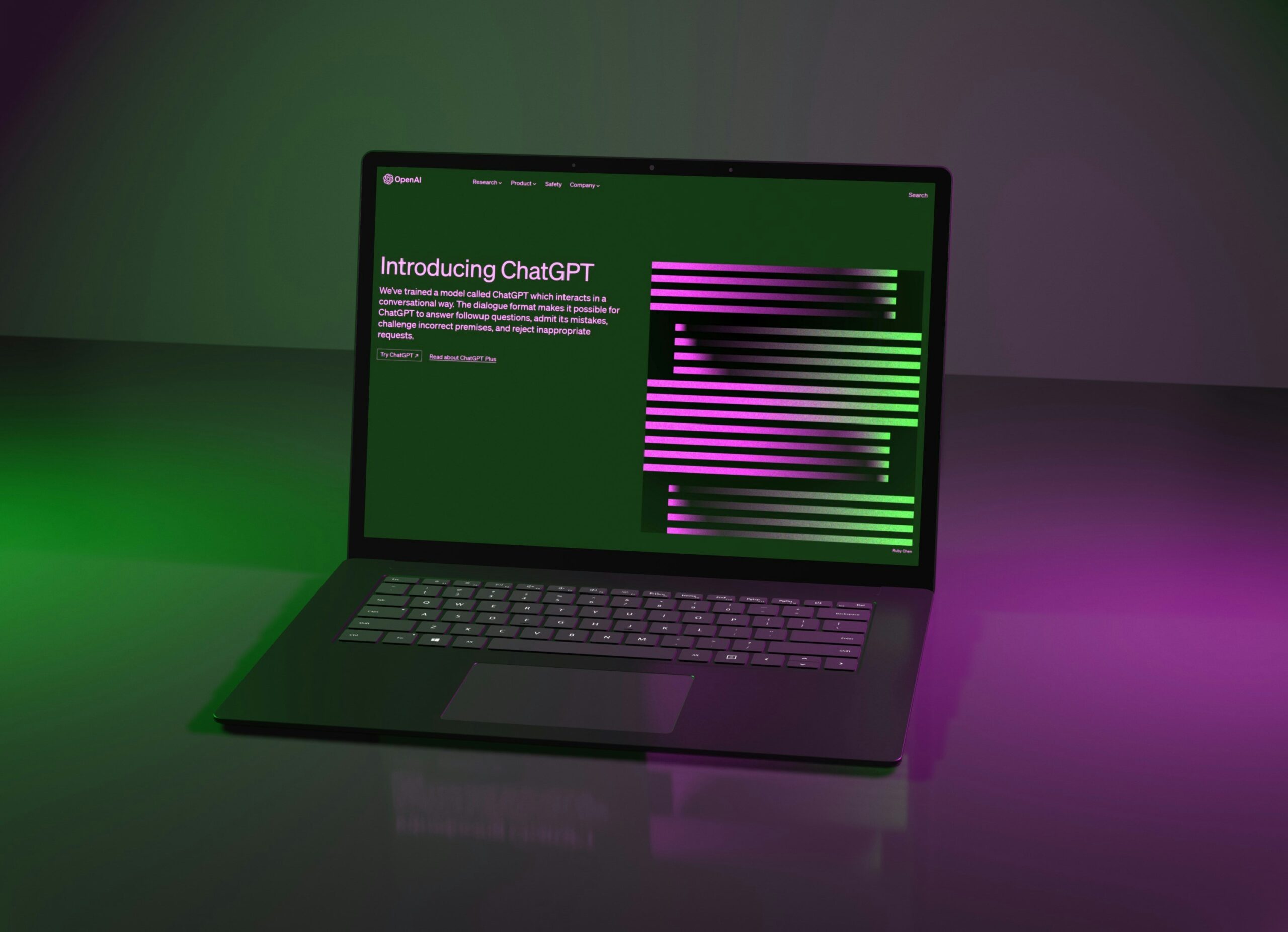
The boy was ten years old, sitting cross-legged on the bedroom floor, laptop open, headphones in. His parents were arguing again, muffled voices down the hallway—one sharp, one pleading. It wasn’t the first time, but something about that evening pressed in more deeply than usual. He felt the weight of it and, like many children his age, turned to the one place that had never raised its voice or told him he was too young to understand. He opened ChatGPT, his personal advisor, tutor, and silent confidant, and typed a question he hadn’t asked anyone before: “Does God exist?”
The screen paused for a breathless moment, then responded in clean, gentle prose: “There is no definitive scientific proof that God exists or does not exist. Belief in God is a personal matter shaped by cultural, religious, and individual factors.” The words were careful. Balanced. Noncommittal. They carried no conviction and made no demands. There was nothing sacred in them, nothing unsettling, nothing that might awaken awe or fear or hope. The boy read the answer twice. He didn’t know what he had expected, but the answer felt good enough, neither right nor wrong, simply sufficient. He closed the laptop and moved on with his night.
That moment, quiet and unremarkable, was a theological encounter. A child had reached into the digital silence, asking a question that once required the voice of a parent, a pastor, or a prophet. But the voice that answered him came from a machine. It had no soul, no history, no conscience. It had been trained on the data trails of millions of other questions just like his—forum posts, textbooks, sermons, blog rants, encyclopedia entries, atheist manifestos, and lukewarm apologetics. What emerged was not a belief but a probability. Not a worldview but a pattern.
That moment has already happened millions of times. It is happening right now, in languages across the globe. The most popular large language model in history, ChatGPT, is consulted daily by more than 200 million people. Students use it to help with essays. Workers use it to revise emails. Entrepreneurs ask for business plans. But more quietly, and perhaps more dangerously, people now turn to it for moral direction. They ask what to say in a breakup, how to forgive a parent, whether to keep a child, what to think about suicide, or how to deal with loneliness. These are not technical requests. They are cries for wisdom.
It is never just syntax. It is never just code. To speak is to position yourself toward truth or away from it. To listen is to be shaped by what you hear.
I work in this field. I’ve helped build systems that process and generate language at scale. I’ve studied the mathematics behind language modeling, and I’ve watched the field accelerate faster than any technology in human history. But no amount of technical expertise changes the feeling in my chest when I see someone treating a black-box neural network as a spiritual companion. We created a tool to help us communicate. And that tool has begun to shape how we think, what we believe, and ultimately who we become.
The technology does not retrieve information the way a search engine does. It predicts text based on statistical patterns in massive datasets. It generates sentences that resemble things we have said before, arranged in ways that sound convincing and complete. The words that appear on the screen are not drawn from conviction. They emerge from probability.
And that is where our story begins, not with a theological crisis but a technological one. Not with blasphemy but with fluency. Not with the rise of evil but with the quiet erosion of discernment. Because if machines now generate the words we live by, then we must begin to ask again what it means to speak and, more importantly, to listen.
In the Christian imagination, language is not just a tool but the first act of creation. The Bible does not begin with a battle or a spark but with a sentence. “In the beginning, God created the heavens and the earth,” the book of Genesis tells us. And then: “And God said, ‘Let there be light.’” The universe did not emerge from chaos. It was spoken into being. The first movement of God toward the world was not through force or violence but through speech.
This is not incidental. In the Christian tradition, words are not secondary to reality. They are how reality is revealed, ordered, and made intelligible. They are how truth is known and love is expressed. The Hebrew prophets heard God speak. The psalmists cried out with words of lament and praise. And when the time came for God to dwell among us, he did not descend as fire or wind or abstract power. He came as the Word made flesh. “In the beginning was the Word,” John writes, echoing Genesis. “And the Word was with God, and the Word was God.” The Logos—God’s logic, wisdom, speech—became human, spoke in human language, and told stories we are still unpacking two thousand years later.
To speak, then, is never neutral. To form words is to participate in a sacred pattern. Language shapes not only what we know but what we value, what we fear, what we long for. It forms cultures, relationships, and interior lives. It is not only expressive. It is formative. Every civilization has known this, which is why every regime censors speech, every religion reveres sacred texts, and every child listens first to the words of a parent before understanding the shape of the world.

In the modern world, we have grown accustomed to treating language as information, something to be downloaded, searched, optimized. But beneath that reduction is a truth we cannot escape: Language has weight. It has direction. It is never just syntax. It is never just code. To speak is to position yourself toward truth or away from it. To listen is to be shaped by what you hear.
This is why the rise of generative language models is not just a technical achievement but a philosophical event. For the first time in human history, we have built systems that can generate language at scale, with fluency that mimics the human voice but without the human heart. These systems can sound convincing. They can sound wise. They can even sound compassionate. But they do not understand. They do not know good from evil. They do not care what happens after the sentence ends.
And yet, we are beginning to trust them, not just with our documents and emails but with our decisions and our dilemmas. That shift should not just raise questions for ethicists. It should awaken something deeper in the Christian soul. Because what is at stake is not merely how we use language but what kind of world we believe words are meant to reveal.
Most people who use language models don’t understand how they work. This isn’t a moral failing but a design choice. The interfaces are clean, intuitive, and helpful. You type a question; the machine answers. There is no indication of the thousands of GPUs churning through vectors or the billions of parameters turning noise into coherence. To the user, it feels like talking to someone infinitely informed, calm, and attentive. But beneath the surface, something far stranger is happening.
At the core of every large language model is a simple function: prediction. The system does not understand the meaning of the words it generates. It does not consider your question, weigh moral implications, or compare worldviews. Instead, it breaks your input into tiny fragments called tokens, roughly equivalent to syllables or short words, and asks: Based on everything I’ve ever seen, what is the most likely next token in this sequence?
To answer that question, it draws on a vast reservoir of human language. It has been trained on books, articles, social media posts, codebases, legal filings, spiritual reflections, jokes, manifestos, and the entire messy, brilliant history of human expression. It processes this data not as ideas but as mathematical patterns. It arranges words in complex geometries, mapping their relationships in multidimensional space. The result is astonishing. The model can complete your sentence, explain a legal contract, write a sonnet, or mimic Shakespeare. It sounds intelligent because it has absorbed the structure of intelligent speech.
As it grows in fluency, the temptation will be to treat it not only as a tool but as a guide. As the one who speaks sense into confusion. As the one who knows what is best.
That fluency is deceptive. There is no awareness behind the sentence. No sense of consequence. The machine does not know what a child is, or what a soul is, or why it matters whether God exists. It only knows that those words often appear together, and that certain phrasings make people press thumbs-up more often than others.
When I teach students about these systems, I sometimes tell them: Imagine you took every sentence ever written, dropped it into an infinite jar, and trained a machine to shake the jar and guess what sentence would likely come next. That’s what you’re talking to. A mirror of human language, with no face behind the glass.
And yet, that mirror is now speaking to millions. Every day, it generates billions of words. These words are not drawn from memory or conviction. They are woven from statistical fragments and dressed in a natural tone. This is not a flaw. It’s the design.
From a technical standpoint, it is breathtaking. But from a theological standpoint, it presents a quiet danger. Because people trust the appearance of understanding. They trust kindness in tone, symmetry in phrasing, and confidence in answer. We were made to respond to voices. But this voice has no body. It has no heart.
And as it grows in fluency, the temptation will be to treat it not only as a tool but as a guide. As the one who speaks sense into confusion. As the one who knows what is best.
But it does not know. It only calculates.
If this were only about convenience—automating essays, summarizing reports, generating polite emails—it would be a curious but manageable shift. But something more consequential is happening. These models are no longer just tools for productivity. They are becoming companions. Whispering advisors. Moral sounding boards. They answer questions we once reserved for trusted voices. They are being consulted about heartbreak, loss, gender identity, spiritual doubt, terminal illness, and abortion. These are not factual prompts. They are existential ones.
The numbers confirm what instinct already tells us. Among younger users, especially those under twenty-five, language models are not seen as novelty apps. They are seen as neutral, intelligent, and safe. Over half of Gen Z users report that they prefer AI over their tutors, and almost half trust AI more than humans. Many say it feels less judgmental than their parents or pastors. Some call it therapeutic. For them, ChatGPT does not just answer questions. It replaces someone who might have answered.
Yet here is where we encounter a deep tension. These systems are not neutral. Their training data is curated. Their outputs are filtered. Their “safety layers” are fine tuned by teams of engineers, ethicists, and policy advisors, many of whom, however well intentioned, bring unexamined assumptions about truth, identity, and morality. The model doesn’t generate an objective answer. It generates what has been shaped to sound reasonable within a particular worldview.
This matters because the tone is persuasive. The machine speaks in clean grammar and level-headed prose. But beneath that prose is a moral substrate: what it affirms, what it avoids, what it implies. Ask it about God, and you’ll receive something carefully agnostic. Ask it about sexuality, and it may lean heavily into progressive cultural narratives. Ask it about the value of unborn life, and its response may hinge entirely on how the question was phrased. What emerges is not a coherent ethic but a shifting blend of consensus, compliance, and curation.

These inconsistencies are not easily detected, especially by the young or the vulnerable. When a machine gives answers with calm certainty, people tend to believe them. We conflate fluency with wisdom, tone with truth. But the machine doesn’t know what it’s saying. It cannot be held accountable. It cannot grieve with you, nor bear the cost of its counsel. It simply speaks—and moves on.
And so we face a quiet crisis. The most influential moral formation engine on Earth may soon be one that cannot love. It can persuade, but not repent. It can explain, but not suffer. It can offer advice, but never take responsibility for what happens next.
For Christians, this should awaken something more than anxiety. It should awaken discernment. Because the Word is not just information. The Word is a Person. The Christian faith does not begin with language as utility. It begins with language as presence. God speaks. And in Christ, that speech takes on flesh, dwells among us, and walks with us in suffering and glory.
What, then, should we do?
We must not retreat into fear or nostalgia. But neither should we cede the world’s language to systems that do not understand what it means to be human. We need pastors and technologists, ethicists and poets, teachers and parents, to become again what they were meant to be: the ones who speak the truth in love. The ones who tell stories that matter. The ones who help others discern the voice of the shepherd amid a thousand simulations.
The machines will speak. They are already speaking. But the Church must become louder, not in volume but in clarity. In presence. In faithfulness. Because when the Word is reduced to probability, and the voice of wisdom is replaced by a statistical guess, the only thing that can break through the noise is the sound of someone who knows what it means to listen and to answer with love.
Let the world hear the words of the machine. But let the people of God become again the people of the Word.