
I still remember the first time I ever entered a Roman Catholic cathedral. It was about twenty years ago when I was still a Protestant and, as of yet, had little to no interest in Catholicism. It happened in a most unlikely place that I’d never visited before—and which has been in national headlines recently covering its mayoral race—New York City.
One summer in college, a good friend of mine had a sister living in Manhattan. And, back in the early 2000s, late-night talk shows had not yet become insufferably politicized and unfunny. Hence, naturally, we were fans of Late Night with Conan O’Brien, and we plotted a trip to go visit her and catch a taping. Upon arriving, I was amazed that the small, two-bedroom apartment she split with a few friends cost $5,000 per month. It was barely enough for us to put sleeping bags on the living room floor. But we didn’t mind. We had a free place to stay in the Big Apple. So on the penultimate day of our visit, we got up at 4 a.m. and jogged several blocks across the city to get in line outside of Rockefeller Center. We were numbers seventeen and eighteen in line, respectively, of dozens of people, and after a couple hours we got vouchers to return to our place in line for standby tickets that evening. Conan’s people said they wouldn’t know how many tickets would be available until then. That evening, we returned and this time we were inside and could see the studio doors. We were so close! As we approached the front of the line, the worker announced: “Number seventeen, go on in. Sorry everyone else, that is all the space we have.” I was number seventeen. My friend was number eighteen.
My stomach felt like I was dropping on a roller coaster. I stepped out of line. To number nineteen I said: “Go ahead, take my place. I can’t leave a fallen man behind.” We walked out of Rockefeller Center, in silent dejection. I don’t really remember anything immediately after that, except wandering down the street. And all of a sudden, we were standing in front of St. Patrick’s Cathedral. We looked at each other and nodded. There was nothing else to do but to go in and pray. And as I sat in the pew, I felt an otherworldly sense of peace and calm. This story is just one of many proofs that God has a sense of humor in how he plants the seeds of the faith in the hearts of men. So I thank God we missed that taping—and for New York City.
As I recall this story, a few things about Rudy Giuliani’s New York stick out in my mind. The streets were pretty clean, and we felt completely safe in the early morning and late night about the town, including on the subway. I have been back to the city several times in the years since then and my experience has been that the streets and subway seem to have gotten progressively dirtier and sketchier each time—and that a city that already felt expensive twenty years ago has only gotten exponentially more so. And indeed, while things are still better than the city portrayed in Taxi Driver, the trends in the data are troubling: Crime is up, the number of people living on the streets is at a two-decade high, and inflation-adjusted rental prices have increased by about 40 percent, more than doubling the increase in the median wage in that same interim.
Mamdani seems to share his generation’s forgetfulness or ignorance of the Cold War era, and the many instances where socialism was tried and failed.
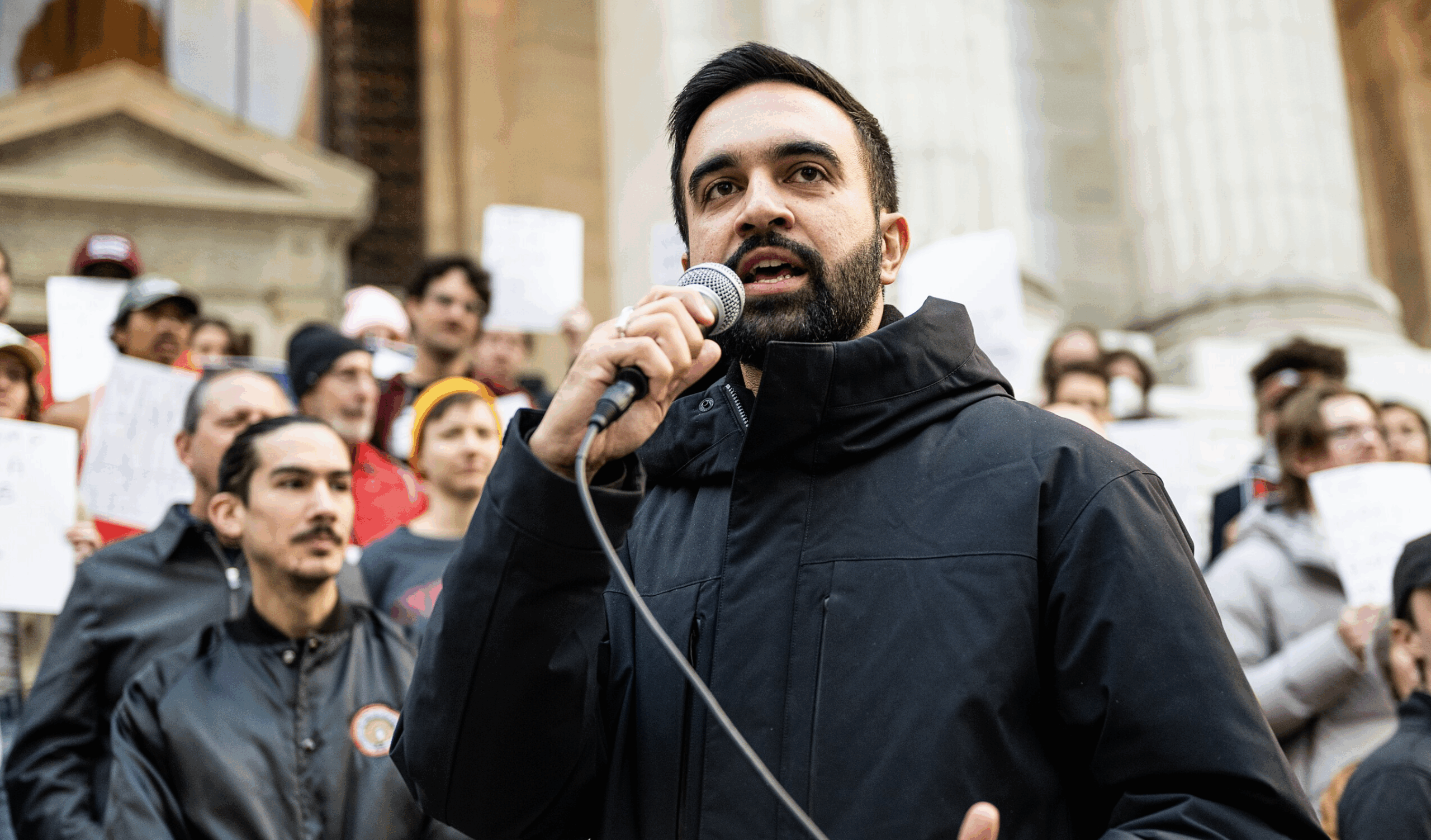
Hence, like many other Americans who are interested outsiders of NYC politics, I have watched the meteoric rise of Zohran Mamdani with fascination. Mamdani has run on the platform of making the city affordable, by means of his self-styled democratic socialism. Among his promises: Raise the minimum wage to $30/hour, freeze rents, give free bus fare, invest millions of dollars in “gender-affirming care,” create government-owned grocery stores, and provide free childcare for all young kids above six weeks old. His message resonated enough to win the Democratic primary. He currently holds a healthy lead in the polls and will likely be elected the next mayor of America’s largest city come November.
From the perspective of Catholic social teaching, Mamdani’s aim to make life more affordable for middle-class New Yorkers is entirely laudable. It is the socialist means that are dubious, particularly in light of history.
Take the idea of government-owned grocery stores, in which, says Mamdani, the profit motive is removed. This was tried in Soviet Russia and the Eastern bloc, to disastrous consequences. The problem lay in the very idea of a centrally planned, command and control economy. When market forces and the incentive structures of producers and retailers and the preferences of consumers weren’t allowed to operate freely to determine prices—when Adam Smith’s famous “invisible hand” was handcuffed—the outcome was shortages and breadlines.
As an avatar for Gen Z, Mamdani seems to share his generation’s forgetfulness or ignorance of the Cold War era, and the many instances where socialism was tried and failed. Perhaps the long-shot mayoral candidacy of Joseph Hernandez, the Cuban refugee who “despises socialism” and laments Castro’s socialist tyranny, will help educate them. My point here is not to diss Gen Z—their ignorance is as much a failure of their educators as anything else. Indeed, there is much commendable about Gen Z, including, I would argue, their appreciation of gaming. Hence, I would recommend to Mr. Mamdani and the Gen Z voters powering his campaign that they have a board game night and play Kolejka, or Queue. In this game, players are transported back to Poland’s communist days, before Solidarity and the first Polish pope broke the Soviet Union from within. As Polish consumers, players brave the queues at various shops, and navigate the absurdities of trying to fill their shopping lists in markets with artificially caused shortages. Among the many Polish jokes about those days commemorated by the board game, this one sticks out:
What do you call a many-legged creature that is twenty meters long, eats meat, yet has to make do with potatoes?
. . .
The queue in front of the meat store.

Mamdani’s platform seems to be implicitly channeling old Marxist ideas about profit. Marx thought that profits were inherently exploitative of workers, since he believed in a peculiar version of the labor theory of value. On Marx’s view, the value of a commodity is determined by the worker’s labor put into it. To take a simplistic example: If the worker’s labor is valued at $10 dollars per hour, and he spends one hour making a trinket, the trinket is worth $10. And, if the capitalist trinket store owner sells the trinket for $15, then, on Marx’s view, he has greedily exploited the worker by profiting off the “surplus value” that the worker generated but was not compensated for. Economists now know that the labor theory fails to suffice as an explanation for pricing mechanisms, which are not determined simply by a worker’s labor but by a range of factors, not least of which is the preferences of consumers.
The Marxist idea also falsely portrays the profit motive as inherently suspect. In Catholic social teaching, profit is a “first indicator” that a business is “functioning well.” It is thus entirely compatible with the virtue of charity for the entrepreneur, the manager, the CEO, etc.—as well as the laborer—to have profit as a goal of their action. Profits are indicative that labor and resources are being efficiently managed to deliver products that consumers want and which, presumably, better their lives. In circumstances where the basic norms of natural justice and the rule of law are generally observed, and individuals are free to take jobs or leave them and seek more desirable work elsewhere, contracts can be considered presumptively just.
On the other hand, Catholic social teaching emphasizes that exploitation is a real possibility that violates worker’s dignity. When profit becomes the predominant drive, superordinate to the virtues, one becomes a profiteer, which relishes instrumentalization of labor. The key limiting moral principle forbidding profiteering regards what is necessary for workers to pursue happiness. Hence, Pope Leo XIII teaches:
Let the working man and the employer make free agreements, and in particular let them agree freely as to the wages; nevertheless, there underlies a dictate of natural justice more imperious and ancient than any bargain between man and man, namely, that wages ought not to be insufficient to support a frugal and well-behaved wage-earner. . . . If a workman’s wages be sufficient to enable him comfortably to support himself, his wife, and his children, he will find it easy, if he be a sensible man, to practice thrift, and he will not fail, by cutting down expenses, to put by some little savings and thus secure a modest source of income.
All of this, the pope continued, is aimed at fostering an ownership society. A just society is one that encourages thrift and savings, and fosters as wide of ownership as possible. And indeed, in America, the primary pathway to wealth and upward mobility is home ownership. Of course, the sheer density of the population and the scarcity of land to build new single-family housing units in a city where only about 30 percent of residents own are, admittedly, severe structural barriers to any mayor who would seek to foster an ownership society in NYC. But fostering an ownership society is not even on Mamdani’s radar. And why would it be? The sort of citizenry that an ownership society fosters, a citizenry largely independent of government largesse, is anathema to the patron-client relationship necessary to form enduring socialist coalitions.
Mamdani’s policy proposals are insidiously subversive of the dignity of the family, the cornerstone of Catholic social teaching.
Instead, Mamdani seeks to enact the socialist’s dream of universal “free childcare” (to be paid for by a new 2 percent wealth tax on millionaires that will likely drive many of them out of the city). While it is couched in pro-family rhetoric, such schemes are anything but—and not only because their predecessors like Head Start are massive boondoggles with negligible results. Mamdani is correct that costs are becoming prohibitive to young families. But a six-week-old baby does not need more government-run daycare centers. He needs his mom. He needs his father. And he needs a loving community of friends, neighbors, parishioners, coaches, relatives, families, and the like who constitute a healthy civil society. These are the persons and institutions who, according to St. John Paul II, are enervated by the heavy-handed interventions of the Mamdanian “social assistance state.”
Marx explicitly called for the abolition of the family in The Communist Manifesto. This idea doesn’t poll well today. But Mamdani’s policy proposals are insidiously subversive of the dignity of the family, the cornerstone of Catholic social teaching. This is perhaps most apparent in his commitment to making New York a “sanctuary” state for transgenderism. Like universal “free” childcare, Mamdani’s transgender policy masquerades as pro-family while, in reality, subverting it. Mamdani promises to expand on New York policies of “sanctuary” for transgender youth, which subverts the rights of parents across the country who seek to protect their children from life-altering hormones and grisly operations to remove healthy body parts.
The old quip about socialism was if you aren’t a socialist by age 20, you have no heart; and if you’re still a socialist by age 40, you have no brain. I take the point of the quip to be that youthful sentimentality, like the exuberant passions of the young, eventually moderate and align with the judgments of an aged reason, particularly those judgments sobered by the realities of marriage and childrearing. For, as any reflective parent can attest, the only place (besides the monastery) where the communist principles of radically shared goods and “from each according to his ability, to each according to his need,” works is in the cell of the family. But that logic may no longer apply in a city where the middle class and industrial working class that populated New York in previous decades has been increasingly supplanted by the “nonprofit-industrial complex” made up of young, “well-educated, heavily subsidized global citizens,” who are largely single and/or childless. And it remains to be seen whether the older generations will have sufficient sobriety and conviction to check the youth in the forthcoming election. Mamdani won about 67 percent of voters aged 18–34 in a Democratic primary in which youth turnout surged.