
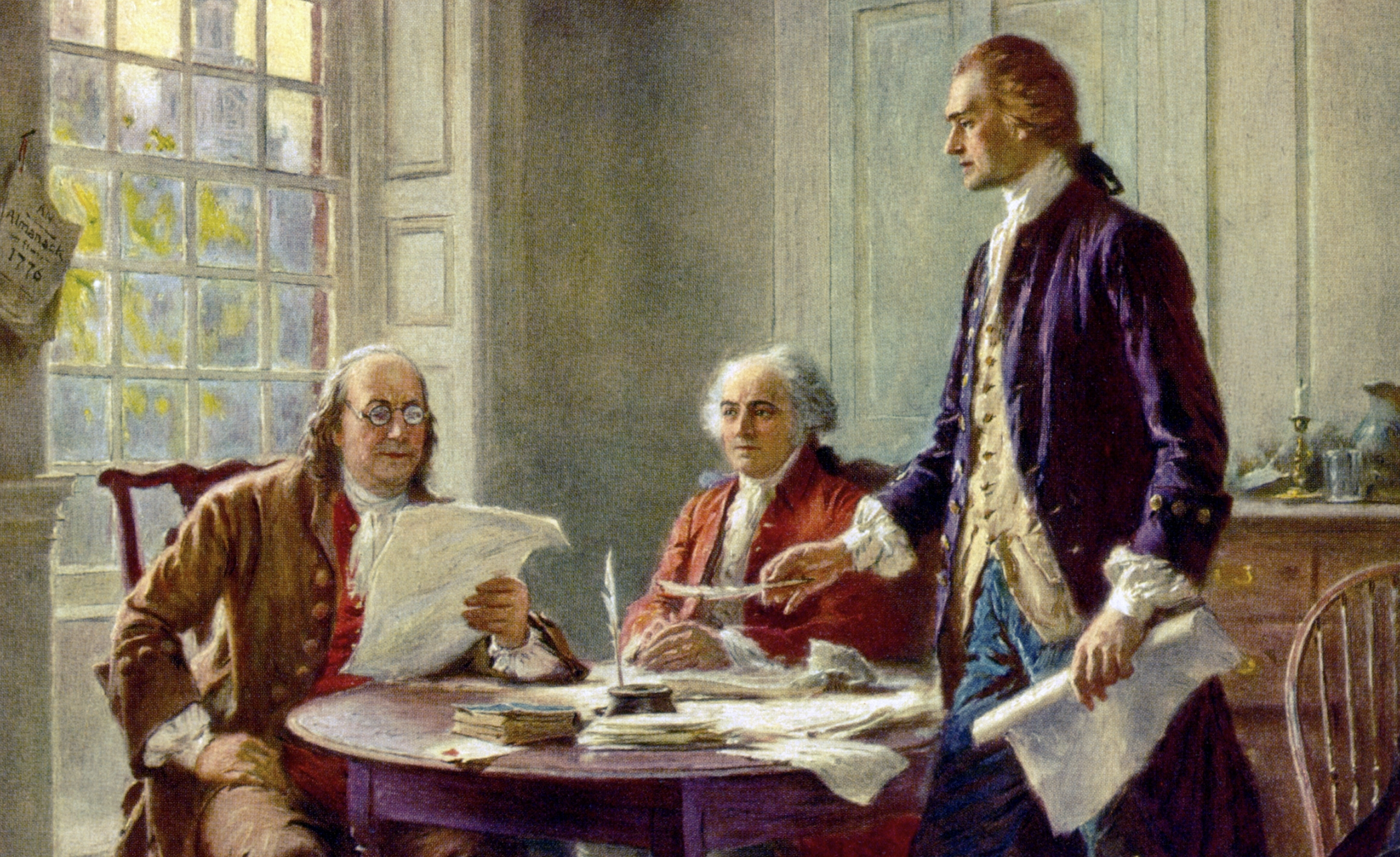
In May of 1825—fourteen months before he passed away and at a very advanced age—Thomas Jefferson explained to Henry Lee of Virginia, Robert E. Lee’s father, what inspired him to write the Declaration of Independence.
With respect to our rights and the acts of the British government contravening those rights, there was but one opinion on this side of the water. All American whigs [Patriots] thought alike on these subjects. When forced therefore to resort to arms for redress, an appeal to the tribunal of the world was deemed proper for our justification. This was the object of the Declaration of Independence. Not to find out new principles, or new arguments, never before thought of, not merely to say things which had never been said before; but to place before mankind the common sense of the subject; [. . .] terms so plain and firm, as to command their assent, and to justify ourselves in the independent stand we [. . .] compelled to take. Neither aiming at originality of principle or sentiment, nor yet copied from any particular and previous writing, it was intended to be an expression of the American mind, and to give to that expression the proper tone and spirit called for by the occasion. All its authority rests then on the harmonising sentiments of the day, whether expressed, in conversation, in letters, printed essays, or in the elementary books of public right, as Aristotle, Cicero, Locke, Sidney, etc.
Of course, we should remember, these recollections took place forty-nine years after the event, and Jefferson was quite elderly, so his memory might not be perfect. But it remains our best evidence as the sources behind the Declaration. Much closer to the event, John Adams had made a similar claim regarding the sources of inspiration for the Founding period. Adams explained: “These are what are called revolution principles. They are the principles of Aristotle and Plato, of Livy and Cicero, of Sidney, Harrington, and Locke; the principles of nature and eternal reason [the LOGOS].”
While it’s certainly possible to take each of these sources individually, it should also be noted that the idea of a lineage matters as well. So yes, Aristotle, Cicero, Sidney, and Locke matter, but they matter as a group which one can readily understand as a shorthand for “the Western tradition.”
Still, it is worth thinking about each person separately. To do so, though, we must also remember that the Founding was a deeply classical period. Any school child—even, say, a kid on the Massachusetts frontier—who had even a year or two or three of schooling, learned nothing but the Greek and Latin language in that schooling. Critically, then, the American population—fundamentally Protestant—also knew its ancient history and its ancient thinkers. Even at the seminal Battle of Yorktown, American and French troops communicated with one another through Latin as it was the one language they both had in common.
Aristotle (384-322 BC), of course, was one of the greatest of Greek philosophers, a student of Plato, who was a student of Socrates. Americans, to be sure, identified far more with the Romans than the Greeks, but the Greeks still mattered. In book 10 of the Ethics, Aristotle tells us that when we are excellent at something, we are honoring the God who gave us the gift in the first place. This became for Jefferson the right to pursue our happiness. Happiness had nothing to do with hedonism, but rather with attaining excellence in all things in life. It is a high calling.
Cicero (106-43BC) was the greatest of Roman republicans, a martyr, nonetheless. In his many writings—all devoured and beloved by Jefferson and the colonists—Cicero promoted reason as the language of both men and women and God, claiming that all good men and women share with God common citizenship in the Cosmopolis. Equally important, Cicero promoted the Natural Law as timeless and eternal.
True law is right reason in agreement with Nature. . . . it is of universal application, unchanging and everlasting; it summons to duty by its commands, and averts from wrong-doing by its prohibitions. And it does not lay its commands or prohibitions upon good men in vain, although neither have any effect upon the wicked. It is a sin to try and alter this law, nor is it allowable to attempt to repeal a part of it, and it is impossible to abolish it entirely. We cannot be freed from its obligations by Senate or People, and we need not look outside ourselves for an expounder or interpreter of it. And there will not be different laws at Rome and at Athens, or different laws now and in the future, but one eternal and unchangeable law will be valid for all nations and for all times, and there will be one master and one rule, that is, God, over us all, for He is the author of this law, its promulgator, and its enforcing judge.
Clearly, this is the inspiration for the first paragraph of the Declaration which references Nature and Nature’s God as well as the natural law.
Aristotle, Cicero, Sidney, and Locke matter, but they matter as a group which one can readily understand as a shorthand for “the Western tradition.”
Algernon Sidney (1623-1683), like Cicero, was a martyr. A radical Protestant and the least remembered of the lineage, Sidney wrote the profoundly influential Discourses. In this excellent book, Sidney Protestantized the neo-Thomist theories of Robert Bellarmine, making them palatable for a Protestant audience. As such, many Catholic scholars have—not incorrectly—claimed that the principles of the Declaration are Catholic principles.
John Locke (1632-1704), an English political philosopher and apologist of the Glorious Revolution of 1688, authored the Second Treatise on Government. In it, Locke argued that societies exist because men come together to secure their natural rights. The entire second paragraph of the Declaration found inspiration in Locke, with some of the language being taken directly from the Second Treatise.
There is one more figure who must be mentioned hovering around the edges of the Declaration: Tacitus, the brilliant Roman historian. In his Germania, a history of the Germanic tribes, Tacitus claimed that his subjects were primitive republicans with an elective monarch, just laws against criminals, and exceedingly moral in protecting the sanctity of marriage as well as of the unborn. Jefferson loved Tacitus, as did most American colonists. Indeed, they loved Tacitus so much that they believed that the great Roman was really writing about the Anglo-Saxons and that the American colonists were the latest incarnation of the Anglo-Saxons. In terms of language, culture, and law, this is absolutely true. When the Declaration was first published in book form in early July 1776, it came with a lengthy introduction by a radical Whig named “Demophilus.” In that introduction, Demophilus explained that the Declaration was merely the latest manifestation of Anglo-Saxon history that began with the mythic Hengist and Horsa first invaded the British isles around 450 AD.
Thus, we can praise the mind and soul of Jefferson for his brilliant document, but we must remember that that document, in its origins and inspirations, reached back to the ancient world, ultimately manifesting the experiences of Athens, Rome, Jerusalem, and London, all coalescing in Philadelphia.