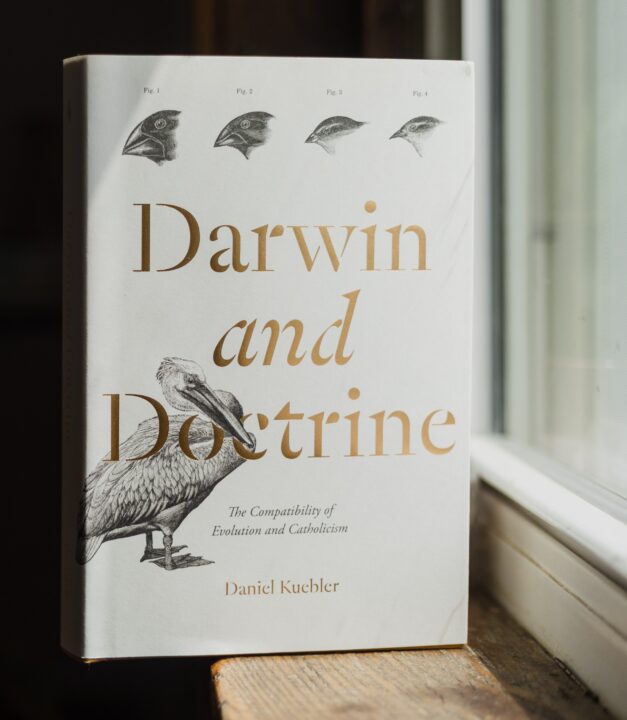
Dr. Daniel Kuebler’s new book Darwin and Doctrine: The Compatibility of Evolution and Catholicism is available now.
. . .
This year marks anniversaries of two significant events in the long-standing debate regarding evolution and the Christian faith. This past July marked the hundredth anniversary of the infamous Scopes Trial in Dayton, Tennessee, in which John Scopes was recruited to stand trial for violating the state’s ban on the teaching of evolution in public schools. The events of the Scopes Trial and its subsequent enshrinement in movies and popular culture has contributed much to the perception that Christianity and evolutionary theory are at loggerheads. Yet for Catholics, this August marks a more important event in the evolution/creation debate: the seventy-fifth anniversary of the publication of Humani Generis, the first papal encyclical to mention biological evolution. Unlike the Scopes Trial, which clearly pitted evolution against Christian beliefs, Pope Pius XII was open to the possibility of integrating the two. While not advocating for evolutionary theory, the encyclical stated that the Church did not forbid that “research and discussions, on the part of men experienced in both fields, take place with regard to the doctrine of evolution, in as far as it inquires into the origin of the human body as coming from pre-existent and living matter.”
Pope Pius XII’s openness to evolution has been reiterated and expanded upon in various documents and addresses by subsequent popes, including John Paul II, Benedict XVI, and Francis. Yet, many orthodox Catholics still seem caught in an either/or mentality when it comes to the creation/evolution issue, particularly as it evolves around the origin of man: Either man evolved from other primates or man was specially created by God. This either/or mentality sets up an inherent conflict between Catholicism and science, one that often leads young people to jettison the faith in favor of the data of modern science.
But the Catholic faith is expansive and seldom can be reduced to either/or scenarios. Rather, orthodox Catholicism lives in the dynamic tension of both/and. For example, Christ is both true man and true God. Likewise, salvation is dependent upon both faith and works. As Bishop Robert Barron has explained, “Catholicism consistently celebrates the coming together of contraries, not in the manner of a bland compromise, but rather in such a way that the full energy of the opposing elements remains in place.” This celebration of “the coming together of contraries” is true of the evolution versus creation question, in which Catholicism can embrace both creation and evolution in a manner where each helps illuminate the other.
In fact, the science of evolution, if understood properly, affirms rather than denies the Creator God. While many are quick to claim that evolution is random, autonomous, and blind, they miss the bigger evolutionary picture. The reality is that the evolutionary process only works because it plays out in a highly ordered universe, one finely tuned to not only allow for life but to allow for specific forms of life to emerge. In his groundbreaking work Life’s Solution, the Cambridge paleontologist Simon Conway Morris argues that the order in chemistry and physics leads to the emergence of specific forms or “life solutions” over and over again in a phenomenon known as convergence. The evolutionary process is both constrained and directed by this order such that on large scales, evolutionary trajectories can be somewhat predictable. In fact, Conway Morris claims that “the constraints of evolution and the ubiquity of convergence make the emergence of something like ourselves a near-inevitability.”
One cannot say “evolution or creation” as if one or the other could explain the totality of man.
This view of humans emerging from an ordered creation is quite resonant with a biblical understanding of man. In the second biblical narrative describing the creation of man, the text states that the first man was taken from the dust of the earth—aphar in Hebrew. The biological reality of evolution affirms this materiality of man, as mankind has indeed come from the earth in much the same way that the first biblical creation account describes how the earth will “produce living creatures” and “produce vegetation.” Through the evolutionary process, the same molecules found in the dirt of the earth have been transformed through orderly processes to produce the myriad life forms we see around us. Our physical bodies are no different. They have emerged via evolutionary processes from the material created world. While they have been formed via secondary causes that science can describe, these causes (mutation, selection, cooperation, directed mutation, epigenetic modifications, drift, etc.) only have efficacy because God, as the primary cause of all that exists, sustains them and allows them to operate.
In this manner, evolution is absolutely dependent upon God. But that fact is not sufficient to explain the emergence of man because man is more than a material being. As such, any scientific theory, since such theories are restricted to describing material phenomena, cannot explain the totality of man. Each and every person is a unity of aphar—the material body, and the breath of God—and the human spiritual soul. In fact, one cannot separate the two, as there is no true human physical body without a spiritual soul. To be a human body is to be informed by a spiritual soul. Likewise, as Pope Benedict pointed out in one of his early writings, “Only when the soul becomes the soul of this body does it truly become a ‘human’ soul. . . . The soul does not come from the body, but with the body.”1
In this sense, one cannot say “evolution or creation” as if one or the other could explain the totality of man. The evolution of the human body only makes sense in relation to the creation of the immaterial human soul. Likewise, the creation of the human soul rings hollow if there is no properly disposed matter for it to inform, and it is precisely this properly disposed matter that the evolutionary process has provided.
Psalm 19 states, “The heavens declare the glory of God; the skies proclaim the work of his hands.” The psalmist is correct to see God’s power and glory in the movement and luminosity of the heavens. In fact, this sense of God’s glory is not diminished by the fact that science can explain the movements of the heavens and the formation of the stars. Even with this knowledge, staring at the night sky still brings a sense of awe and wonder at our nothingness, God’s immensity, and the utter dependence of everything upon him. In a similar fashion, each creature that exists on our planet declares the glory of God and proclaims the work of his hands, and this sense is not diminished if science can explain the material processes that led to the emergence of these creatures. The fact that we inhabit a highly ordered and structured universe that can produce stars and elephants is even more astonishing and glorious than the stars and elephants themselves. The entire universe and all that is in it “declare[s] the glory of God,” as not a single creature on our planet or a single molecule in the universe has been produced apart from God. They have all been brought forth from his creation, a creation he destined from all eternity to eventually bring forth the type of creature that could know and love him for all eternity.
1 Joseph Ratzinger, Schöpfungslehre (1958), 76.
Dr. Daniel Kuebler’s new book Darwin and Doctrine: The Compatibility of Evolution and Catholicism is available now.