
A few weeks ago, a friend of mine was hanging around the Ohio SEEK conference, minding his own business, when a stray six-year-old marched up and challenged him to a wager.
“Five bucks,” the kid said, “If you can’t tell me about the saint I’m about to name.”
My friend took him up on the bet. The kid said, “Justo Takayama Ukon!”
The kid went home five bucks lighter. My friend blamed it on me.
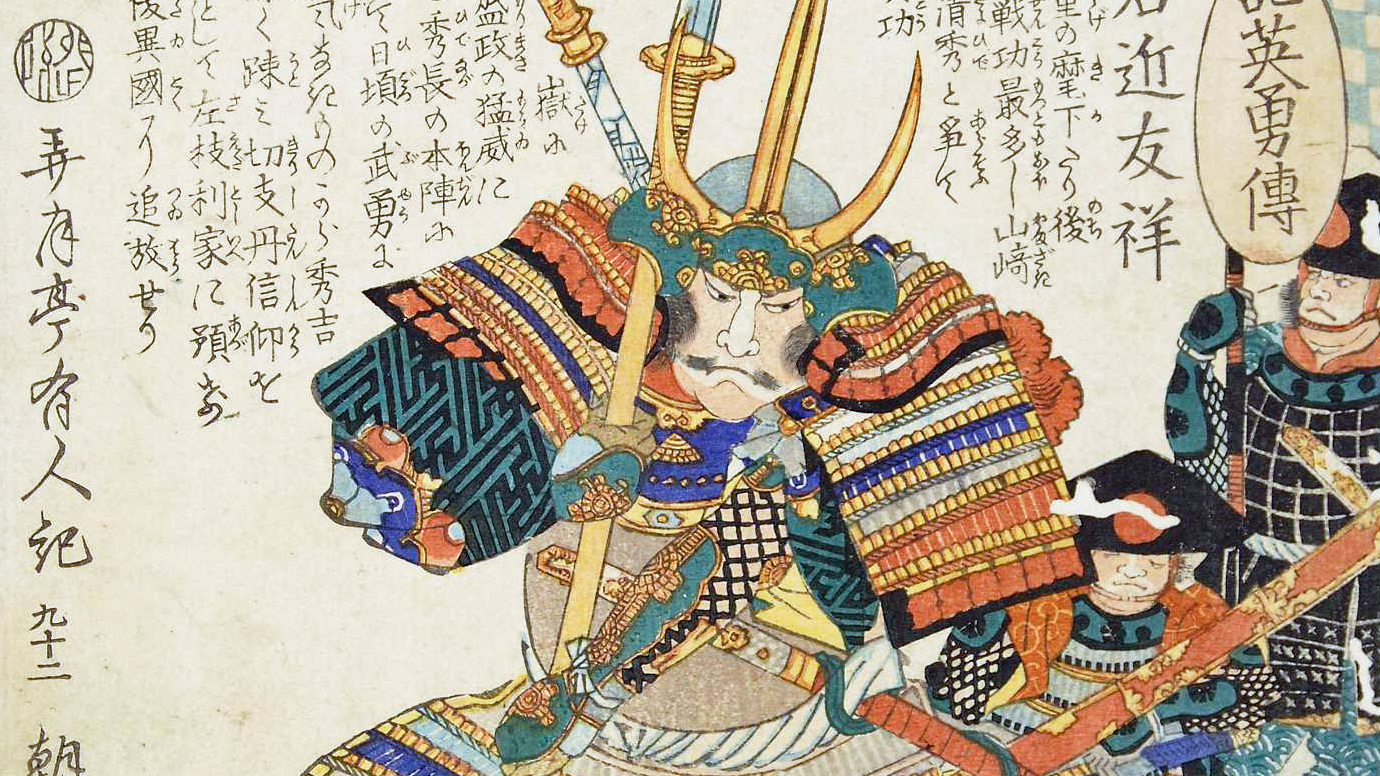
He had a point. For the last two years, I’ve been working as co-writer, associate producer, and assistant director on a documentary series about Bl. Justo Takayama Ukon (1551–1615), the sixteenth-century samurai warlord and Catholic convert. I had been raving about Justo to my SEEK friend for months in the lead-up to our four-week production in Japan last Eastertide. Outside Japan and the Philippines, I thought I was the only superfan of Justo. I was dead wrong. Never to be bested by bold six-year-olds, Young Catholic Professionals just named Justo the patron saint of its 2026 conference. I’ve lost count of the friends who have sent me pictures of their toddlers swinging plastic katanas at All Saints Day parties. When the documentary series comes out later this year on EWTN+, I have no doubt more secret samurai lovers are going to come out of the woodwork.
It’s easy to understand the appeal. There’s the obvious X factor—samurai will always be cool. But there’s also, at a deeper level, the paradox. How can a samurai be a saint? How can a man who lives by the sword die by the cross? Those were the questions that drew me into the story when director Sean Schiavolin first invited me to join the project. They’ve since become the heart of the cinematic enterprise. And the further we’ve taken them, the deeper the mystery has become.
Beatified in 2017, Justo was a prominent samurai warlord during Japan’s Sengoku or Warring States Period (1467–1615), the age that ended about thirty years before Shūsako Endō’s novel Silence is set. The country was consumed by civil war and social upheaval. The 250-year-old Ashikaga shogunate had collapsed, ridden by infighting and incompetence. The emperor had lost all authority, and rival feudal states struggled for power, led by daimyos, or samurai warlords, hardened by generations of castle warfare. Loyalty was as cheap as life. Samurai routinely betrayed their overlords, sometimes mid-battle. Husbands and wives showed scarcely more fidelity. Fathers bargained away sons as political pawns. Overtaxed peasants revolted against their feudal masters. In the middle of the chaos, Westerners touched Japanese shores for the first time, bringing the spark that would send the Sengoku era into its last, self-consuming blaze. In 1543, shipwrecked Portuguese traders brought the matchlock gun. Six years later, the Jesuits brought the Word of life.
How can a samurai be a saint? How can a man who lives by the sword die by the cross?
Justo’s story is like Shōgun meets A Man for All Seasons. His father, “Dario” Takayama, was a minor daimyo in the central region around Kyoto who converted to the faith a few years after St. Francis Xavier first arrived in Japan. Young Hikogoro Takayama was baptized alongside his mother and five younger siblings. He took the new name “Justus”—“Justo” in Portuguese—or “just man,” after the second-century martyr St. Justin, who converted to the faith from Stoicism and was later beheaded for refusing to make sacrifices to the Roman gods. Over the next five decades, Justo would live up to his namesake’s legacy.
Justo was hardened by battle from a young age. He fought alongside his father in the service of daimyos around the tumultuous capital region between present-day Osaka and Kyoto, known then as the Gokinai. Skilled in castle warfare, he took over the Takayama clan from his father in his early twenties and rose quickly through the samurai ranks to become a trusted military leader under Toyotomi Hideyoshi, the fierce peasant-turned-warlord who first unified the feudal kingdoms in 1591. Justo became widely known for serving his lord with loyalty and leading his people with justice. He used his wealth and status to support the Jesuit mission, building seminaries and churches in the lands he won by conquest. He married a Christian noblewoman, Lady Justa, shortly after he took over leadership of the clan. Together, they went on to have at least four children and five grandchildren.
Tales of Justo’s piety spread, quickened to legend by Jesuits who wrote back to Rome with news of the Christian mission. Justo was devoted to St. Ignatius’s exercises, and from what we can tell, his spirituality combined a martial Jesuit sensibility with the Christian Stoicism inherited from his father’s old Zen Buddhism. One Lent, Justo was reported to have used the discipline against his back in public. Another time, he carried the casket of a dead commoner to the gravesite with his own hands. The sights would have been shocking, even scandalous, for peasants who were used to revering their daimyos as de facto gods.
Justo perfected this Christian piety with refinement in his own culture. He was an accomplished student of chanoyu, the tea ceremony, and studied under the greatest tea master in Japanese history, Sen no Rikyu. Justo would regularly invite other high-ranking daimyos to join him in the chashitsu, or tea house, where he would speak to them about his faith, sipping matcha on the bare tatami mats, surrounded by shoji paper walls. His cultivated virtue was as uncommon as it was attractive in an age of bloodred realpolitik. Hideyoshi admired Justo’s faithfulness to his wife almost as much as his skills in battle. Justo’s noble reputation was an invaluable asset to the Christian mission, and he and his father were responsible for many of the estimated 300,000 Christian converts in Japan by the century’s close. Some estimates put the number as high as 600,000—more than three times the number of Roman converts in the first two centuries of the Church.
But the success was short-lived. After rising political tensions, Hideyoshi grew suspicious of the Christian missionaries. The Jesuits wielded considerable influence among daimyos in the southernmost island of Kyushu, thanks in a large part to the role they played as brokers and translators in the valuable silk and silver trade between Nagasaki, Macao, and Malaysia. Whatever good purpose the profits served, such worldly affairs set the mostly Portuguese Jesuits on a crash course with the Dominican, Franciscan, and Augustinian mendicants who arrived in the 1580s, mostly from Spain. Political and ecclesiastical rivalries among missionaries, and rash displays of Portuguese naval power by some Jesuit priests, pushed Hideyoshi’s nascent paranoia to a breaking point. In 1587, just after Justo had led a successful military campaign to defend Japanese Christians in Kyushu, Hideyoshi ordered all priests exiled from Japan. He gave Justo an ultimatum: recant his faith or follow the fathers into exile, forfeiting all his wealth and status. Justo chose exile.
It’s tempting to say that this was the moment that Justo became a saint. It’s certainly the dramatic high point of his story, the crossroads where he chose to stake his soul on the invisible world instead of the visible one. But that way of reading the story only gets at half the truth. By the time Hideyoshi gave his ultimatum, Justo had already made his choice. He had lived it for decades. If that makes the crisis less dramatic, it makes the hero all the more saintly.
Justo lived his whole life under the shadow of the cross. The word “samurai” comes from the Japanese verb saburau, “to serve,” and Justo modeled the meaning irreproachably. He had always stood ready to sacrifice everything his lord commanded. Aged twelve, he accepted his father’s will to be baptized into a foreign faith, even though it pushed his and his clan’s future into a risky, uncertain future. Aged twenty, he nearly died defending his father against an ambush after their own overlord betrayed them. Aged twenty-eight, faced with a moral no-win scenario, Justo chose to renounce his rule over the Takayama clan—completely abandon his nobility—rather than be forced by treacherous daimyos to choose between the deaths of family or the slaughter of his Christian people. In that trial, the ruling daimyo in the Gokinai was so impressed by Justo’s courage that he gave back the young samurai not only the status he had renounced but the horse the lord himself was riding.
Justo lived ready to be martyred at any moment. By Jesuit reports, he longed for the opportunity. Hideyoshi’s ultimatum wasn’t a temptation; it was an answered prayer. And so unfolds the paradox of the samurai saint: When the moment finally arrived, Justo abandoned his earthly lord to remain loyal to his heavenly Lord. He fulfilled the samurai code by breaking it—showing to whom, by true justice, a creature owes his ultimate allegiance. And at the moment of his greatest disgrace on earth, Justo won eternal glory in heaven. Grace did not destroy but rather perfected the code of honor Justo had upheld his whole life.
He fulfilled the samurai code by breaking it—showing to whom, by true justice, a creature owes his ultimate allegiance.
But if the crisis was swift in the decision, its consequences were slow in the unraveling. Justo spent the first year after his renunciation in hiding, then another twenty-six in exile in Kanazawa, a region in the Noto Peninsula on the northern coast of Honshu, Japan’s main island. Dispossessed Christians flocked to the samurai like lost sheep seeking a shepherd. Justo devoted himself to caring for them and building castles at the service of his new lord. He retreated often to his tea house to pray.
Elsewhere in the islands, meanwhile, persecutions of the Christians intensified. In 1597, a Spanish ship loaded with firearms crashed into Japanese shores. Incensed, Hideyoshi ordered twenty-six Christians—six foreign missionaries and twenty Japanese Christians—crucified on Nishizaka Hill, the highest point in Nagasaki. Hideyoshi died the next year. Retainers rushed to fill the power vacuum, and one Tokugawa Ieyasu emerged as the first shogun of unified Japan. The Warring States Period ended, breathless, in the iron grip of the new totalitarian shogunate that would rule until the middle of the nineteenth century.
Within fifteen years, the second Tokugawa shogun grew wary of Justo’s influence and ordered all Christians exiled from Japan. Justo and his family were marched across the wintry mountains from Kanazawa, across the Gokinai, and were eventually transported to Nagasaki, where they were forced aboard a ship bound for Manila. After more than forty days storm-tossed at sea, they arrived, with a broken mast, in the Philippines. Justo died of illness within two months. He was buried beneath the altar of the principal church in Manila. More than four hundred years later, before a crowd of twelve thousand people in Osaka, Justo was officially beatified as a living martyr. It was a paradoxical honor—fitting for the samurai saint.
Eight years after that, our film crew landed in Tokyo. For four weeks, our six-person team of American and Japanese filmmakers crisscrossed the country, tracing the threads of Justo’s life. We shot in a traditional tea house in Kanazawa and a kendo tournament in Kyoto, in the castle ruins of the Takayama’s old fiefdom in Takatsuki and the Twenty-Six Martyrs Museum in Nagasaki. We followed five subjects—a Catholic convert, a businessman, a tea ceremony master, a martial artist, and a young descendent of Justo—as each journeyed to different places to encounter the samurai saint, seeking his help through struggles in their own lives. The film interweaves their journeys with animated scenes from Justo’s biography. The series tries to capture, in moving images, a glimpse of the communion of saints. As Justo came to life in so many different places and people, I started to see, as if through a lens darkly, what it means for a Catholic samurai to be a living martyr.
Justo’s relics were destroyed in Allied bombing raids on the Japanese-occupied Philippines during the Second World War, but he was still tangibly, if silently, present in the places we visited—as if the bone shards were blown all the way back to his native soil. The ramparts he built still stand at Takanawa Castle in Kanazawa. Archeologists have dug up rosaries in the gravesites around his old fiefdom in Takatsuki, where the local Catholic Church is modeled off the church in Manila where he was buried. Historians are still discovering remains of hidden Christian communities in the mountains around Takatsuki, where the faithful would have fled during the systematic persecutions of the Tokugawa shogunate. Many archeological sites have now been buried beneath highways.
It was a poignant experience, touching the physical remnants of Justo’s life at the same time we discovered how few Japanese people remember him. One of his living descendants, a twenty-four-year-old postgrad student, said most people his age think Justo was a loser. Our taxi driver from Haneda Airport said the name was only vaguely familiar before he started talking about all the TV dramas made about Hideyoshi. In Shika Town, outside Kanazawa, another branch of Justo’s surviving family welcomed us into their riverside mansion, where they answered our questions on fine-woven tatami mats surrounded by shoji paper walls hung between richly carved wooden panels. Pictures of the Osaka beatification ceremony stood on a wooden dresser just beneath the household Shinto shrine. They were Buddhists, the family explained, because being Christian in Japan these days was just too difficult.
Our documentary subjects, in a way, breathed new life into these remnants. We went to each place not to mourn a memory but to encounter a person. In a traditional tea house in Kanazawa, our tea master—Dr. Yuumi, a scholar who’s written several books on chanoyu and the Jesuit mission—sipped matcha with our Catholic convert, Yoko, who grew up in Kanazawa and has since developed a devotion to Justo. Yuumi and Yoko performed the ceremony with a statue of the Blessed Virgin Mary (“Maria-sama”) standing in the alcove of the tearoom where a Zen scroll usually hangs, the way Justo used to arrange his own chashitsu. The women reflected together on the way Justo had touched their lives, inspiring Yuumi’s scholarship and helping Yoko reconcile with her painful childhood memories of Kanazawa.
In Osaka, we met a seasoned Catholic entrepreneur, Mr. Yokoe, who also took inspiration from the samurai saint. Yokoe decided early in his career to jump off the corporate ladder, the usual path to security and prestige for Japanese professionals. Instead, he’s dedicated his life to serving where he’s needed—from starting transportation companies to now consulting for a boys’ school in Nagasaki when most people his age have retired. We met under Justo’s icon at the Osaka Cathedral, then followed Yokoe on his routine walk around Osaka Castle, the great fortress built on the former grounds of Hideyoshi’s palace. At one point, he stared down the weather-stained statue of Hideyoshi that looms on a raised pedestal outside the castle’s Shinto shrine. Yokoe smiled at the Great Unifier, almost insouciantly, before he carried on with his walk. He was another man content with his bet on the world unseen.
Yoko, Yuumi, and Yokoe are just three of the countless people touched by the living martyr. Even in Japan, where less than one percent of the population is Christian, let alone Catholic, Justo is still watching over his dispossessed people, welcoming them back into the one true fold. He keeps silent, sleepless watch, just as his statue stands over the old Takatsuki Castle ruins, the cross of his sword fashioned into a crucifix. The weekend we stayed in Takatsuki, those castle grounds were overrun with musicians, street performers, and families, all gathering under the samurai’s watchful gaze to celebrate Japan’s annual jazz festival. I smiled to think that the uniformed high school girls tearing through the saxophone solos were breathing the free air Justo had sanctified with his penance and prayers.
St. Thomas Aquinas speaks of the special glory due to the just ruler, who, despite facing the greatest temptations to abuse his temporal power, still renders to each subject, and to God himself, his proper due. Justo is a living icon of such a man. He faced that choice not simply once, but every day of a lifetime that spanned six of the most violent decades the world has seen. It’s no wonder that St. John Henry Newman held particular reverence for old saints, who remained steadfast over long, trying years. Justo testifies that a Christian may not simply navigate a broken world but excel in it, beat it at its own game, and still, by the grace of God, stay detached enough from its spoils to show why its logic ultimately unravels at the foot of the cross.
For modern Westerners, that witness is equal parts challenging and inspiring. The samurai saint hung cruciform on every moment, living dead to the world, even in the middle of it, so he could serve its highest Lord. It was a risky bet, especially in a society where survival seemed to demand moral compromise. But perhaps, in some ages, the only saints are martyrs. That grim prospect only steeled Justo to make his wager on the world unseen. And now, out of the mouths of babes in twenty-first-century Ohio, it seems safe to say he took the better part.