
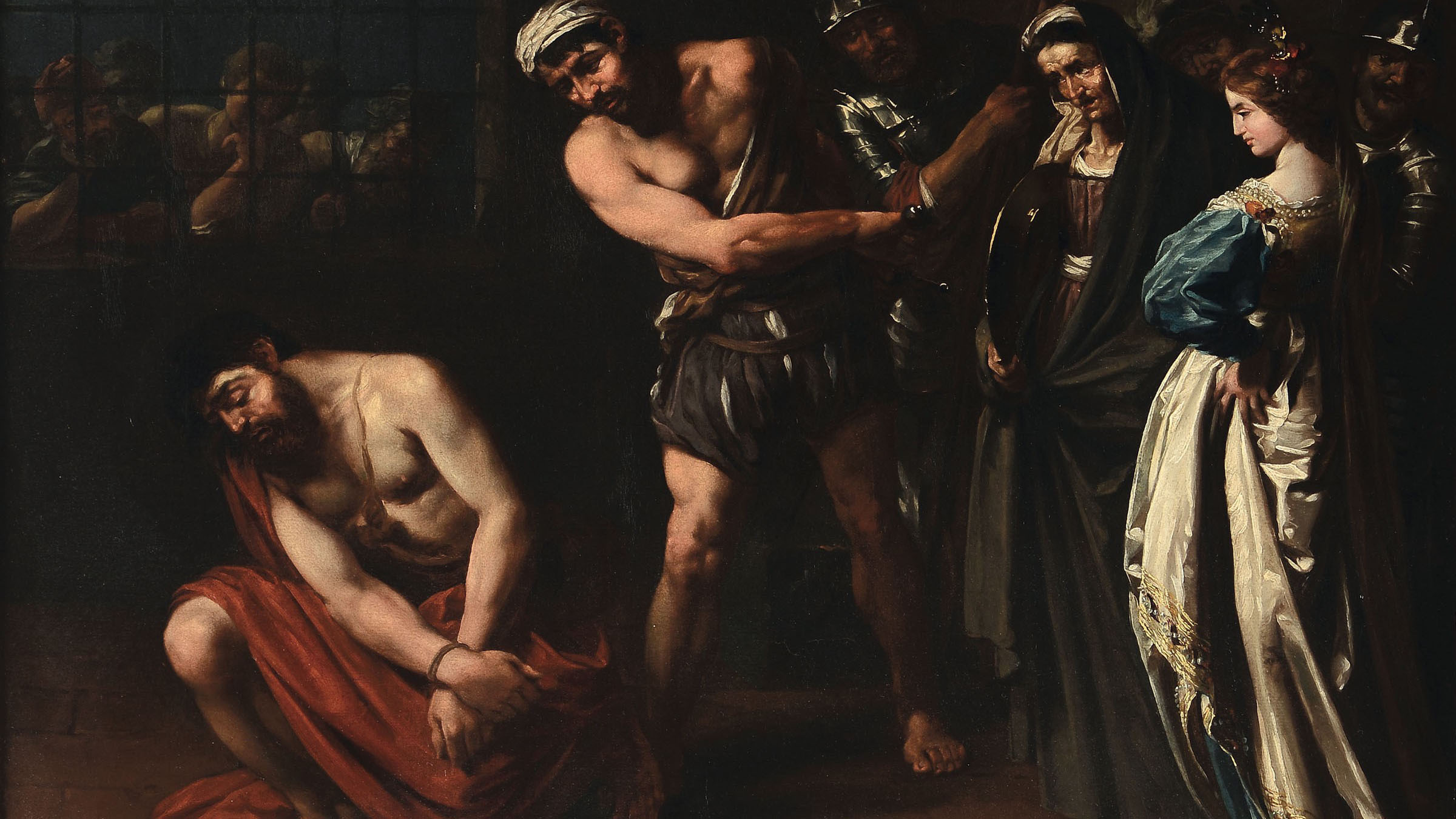
On August 29, the Church celebrates the Memorial of the Passion of St. John the Baptist. It is striking that in the liturgical calendar the Church uses the same language only for John’s death as it does for Christ’s: a passion. John’s death is indeed a grim scene. The story, which is recounted in the Gospel reading of the day, loses none of its dramatic power from its familiarity.
Herod lives with Herodias, the wife of Herod’s brother Philip, as if married. John publicly denounces the sin, provoking in Herodias a desire to kill him. She finds her opportunity when her husband is so pleased with her daughter’s dancing at his birthday banquet that he promises, “I will grant you whatever you ask of me, even to half of my kingdom.” Herodias pounces, having the girl request: “I want you to give me at once on a platter the head of John the Baptist.”
John dies because he refuses to let the sin of infidelity, on display by the powerful, go unnamed. His death, however, is more than the denouement of a story of moral outrage against one couple’s public sin. John’s death is a martyrdom. A martyr “bears witness to Christ who died and rose” (Catechism of the Catholic Church 2473). While St. Stephen is the first to die for Christ after the completion of Christ’s death and resurrection, and so is known as the protomartyr, St. John, as the forerunner of Christ, is at the forefront of the martyrs in the Roman Canon. In the Office of Readings for the day, Venerable Bede declares of John that “by his own suffering he showed that Christ also would suffer.”
But is John a martyr? Did his death bear witness to Christ’s death and resurrection, or did it just foreshadow it? Venerable Bede takes up this question:
There is no doubt that blessed John suffered imprisonment and chains as a witness to our Redeemer, whose forerunner he was, and gave his life for him. His persecutor had demanded not that he should deny Christ, but only that he should keep silent about the truth. Nevertheless, he died for Christ. Does Christ not say: I am the truth? Therefore, because John shed his blood for the truth, he surely died for Christ.
The Church reveres John’s memory because, in Bede’s words, “He stamped with the seal of martyrdom the testimony which he delivered on behalf of our Lord.” This testimony is deeper than one passion pointing to another. True, John’s passion points to Christ’s passion. But John points to Christ by conforming himself to Christ’s death in the very reason for which John lays down his life. In other words, John dies for the dignity of marriage. This is the doctrine for which he sheds his blood. In the Canticle of Zechariah, John’s father prophesies that John will go before the Lord “to give his people knowledge of salvation by the forgiveness of their sins.” Herod and Herodias are called to repent of their infidelity because repentance is the path to salvation; the way of the Lord is salvation itself, and this is what John prepares Israel for—first through his preaching of repentance and ultimately through his death in defense of marriage. Fidelity and forgiveness in marriage, John’s death insists, is itself a path to salvation. John’s rebuke of Herod is not merely a moral objection but a demanding teaching he enacts in his own unmarried flesh: Marriage is an arena in which spouses learn to die to self through the forgiveness of one another. John is the Church’s great defender of marriage.
John dies for the dignity of marriage. This is the doctrine for which he sheds his blood.
There is a still deeper layer beneath John’s defense of marriage, one that his own path through life was fashioned to disclose. St. John is the forerunner of Christ’s Passion; he is, uniquely among the martyrs, the one whose life and death prepared the way for the Lord’s death. He lived ascetically—a life of decrease—in order to point to the increase, the fullness, of Christ. The Gospel of John records his own account of this, given soon after Jesus’s first sign at the wedding at Cana: “He who has the bride is the bridegroom; the friend of the bridegroom, who stands and hears him, rejoices greatly at the bridegroom’s voice; therefore this joy of mine is now full. He must increase, but I must decrease” (John 3:27–30).
Read in this light, John’s passion is, subtly and wonderfully, a defense of Christ’s own mystical marriage to the Church. In defending the sign of marriage between man and woman, John defends the reality it signifies: the union of Christ and his Bride. He is the friend of the Bridegroom, and the friend of the Bridegroom lays down his life for his friend. His death is therefore a striking and unique profession of fidelity to Christ himself—a martyrdom that proclaims, in the very act of dying, the mystical marriage of Bridegroom and Bride, of Christ and his Church. This is the depth to which John is the friend of the Bridegroom: not merely an admirer pointing from afar, but a witness to Christ’s Passion by conforming himself to that Passion. Dying by defending the fidelity at the heart of marriage, John points in his death to Christ’s fidelity to the Church, laying down his life for his Bride. John’s is a martyrdom that witnesses “to Christ who died and rose” with a love as strong as death. The fidelity of Christ’s love for the Church makes sense of John’s death and makes possible a death-to-self fidelity in our own marriages.
At first glance, John dies for confronting the infidelity of Herod and Herodias. More profoundly, his death brings “knowledge of salvation” by defending marriage as a path of salvation. Even more profoundly, his martyrdom is a witness to Christ’s own mystical marriage to the Church, offered by the one who could call himself the Bridegroom’s friend. John’s passion is a sign to us of the path by which we become friends of the Bridegroom and by which our own marriages become signs of the marriage of Christ and his Bride: by a fidelity so serious, and a logic so strange, that we decrease—we die—so that Christ and his Bride—the union we become part of through this very way of salvation, this path of decrease—may increase.
St. John the Baptist, friend of the Bridegroom, defender of marriage, pray for us!