
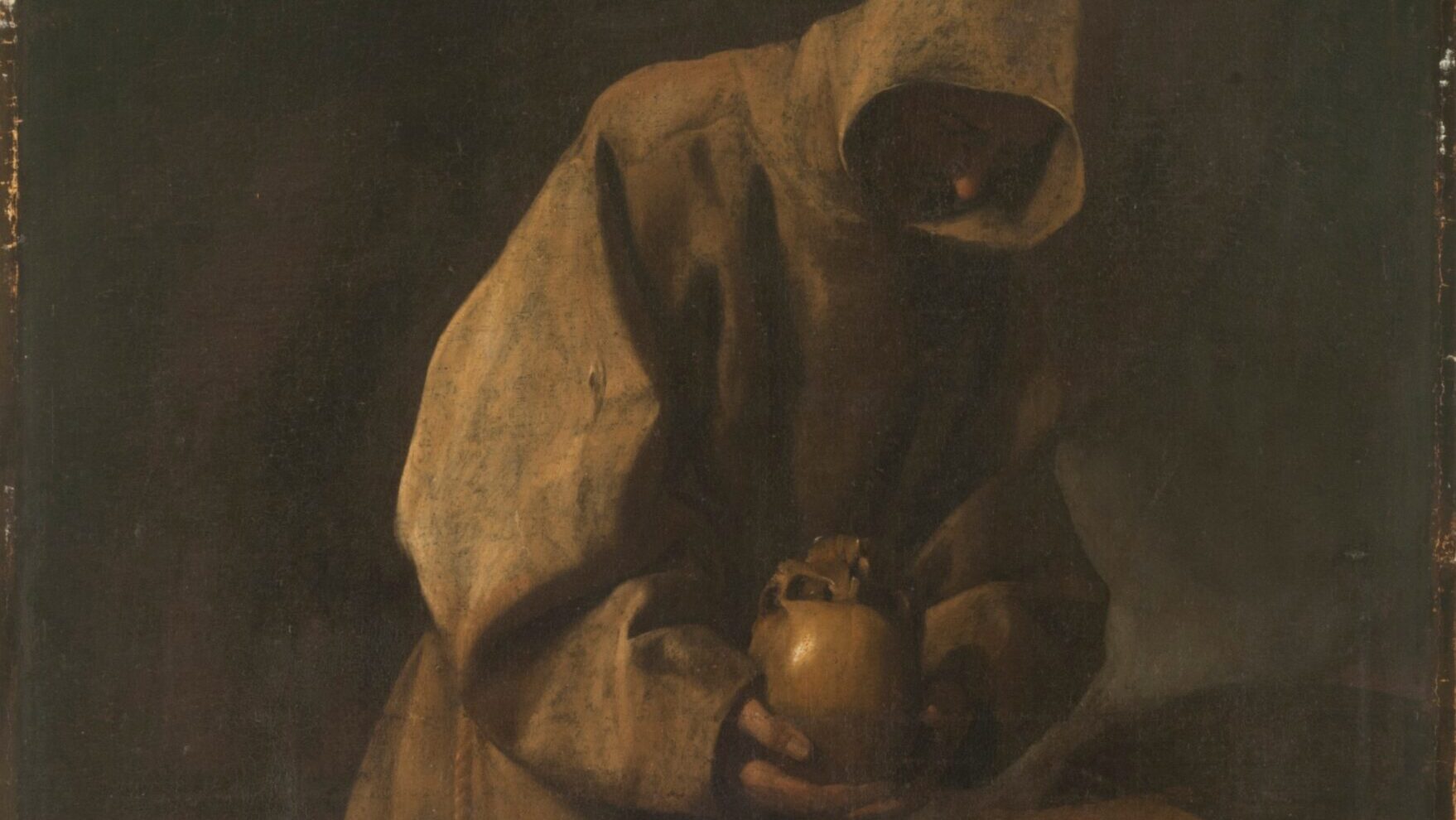
This year, the Church celebrates the 800th anniversary of the death of St. Francis of Assisi. While Pope Leo XIV proclaimed the entire year a jubilee in Francis’s honor, we approach a high point of celebration with his feast day on October 4. In his humility, St. Francis may appreciate that the Twenty-seventh Sunday in Ordinary Time supersedes the liturgical celebration of his feast day on the 800-year mark, with the Church’s weekly celebration of Christ’s resurrection superseding the saint’s death. But Franciscans around the world will still commemorate the death of their spiritual father, beginning the evening of October 3 (the anniversary of his death) with a memorial service called the Transitus—the “passing over” of Francis from this life to the next. This time in the Jubilee year is an apt moment to pause and note the remarkable death of this even more remarkable saint.
The early biographer Thomas of Celano reports that at the hour of his death, Francis encouraged his brothers to read the Gospel story of Christ’s washing the feet of his disciples, to recite Psalm 142 (Francis’s favorite), and to sing “The Canticle of the Creatures,” which Francis had composed in pieces at the end of his life. The service of the Transitus involves these elements and recollections from Francis’s life as well as his final words, reported in the biography composed by St. Bonaventure: “I have done what was mine to do; may Christ teach you what is yours.” But St. Francis was still in the midst of his final task: that of dying well.
We see this most poignantly with the addition on his deathbed of a final verse to his “Canticle of Creatures.” After praising God through Brother Sun and Sister Moon, Brother Wind and Sister Water, Brother Fire and Sister Mother Earth, and through peacemaking, Francis turns to face death:
Praised be You, my Lord, through our Sister Bodily Death,
from whom no one living can escape.
Woe to those who die in mortal sin.
Blessed are those whom death will find in Your most holy will,
for the second death shall do them no harm.
Because Francis praises God through “our Sister Bodily Death,” death is sometimes interpreted, for Francis, as another part of God’s family of creatures. But the Catechism of the Catholic Church teaches that death, while natural, is a consequence of sin (CCC 1008). It is the undoing of life in two respects: a separation of body from soul and bodily decay (CCC 997). It entails separation from loved ones. There is no need to mince words about the tragic nature of death, even for those who long to be with the Lord and hope for a Christian death (CCC 1010). Death is repugnant to the creation through which Francis praises God. Why, then, in the “Canticle” does Francis approach death—“from whom no one living can escape”—as a sister, a figure typically seen as comforting and caretaking? Francis’s manner of dying, as well as the “Canticle” itself, may provide insight.
Each of us will follow Christ into death, but will we imitate him in death, as Francis did, by embracing Christ in his humiliation?
Francis’s sequela Christi—“following of Christ”—included the stigmata. This participation in the physical wounds of Christ’s passion manifests an astounding conformation to Christ in his suffering and love. But death was Francis’s final step in the sequela Christi of this life. While dying, Francis asked to be placed naked on the earthen floor to draw nearer to Christ in his passion. The dynamic of Francis’s ardent desire to conform to Christ here reaches its depth: from wealth to poverty, from health to a broken body, and, finally, from life to death. Each of us will follow Christ into death, but will we imitate him in death, as Francis did, by embracing Christ in his humiliation? While the stigmata is a gift given to few saints, participation in death as a sequela Christi is a gift offered to all souls. It is God’s final offering in this life to conform ourselves to Christ. For Francis it becomes a comfort that death—sisterly death—offers the possibility to cling more closely to Christ in this final act of life.
Francis knows that his final act of conformation to Christ will be sisterly if he is found in God’s “most holy will”—as Christ obeyed the Father’s will in Gethsemane. What does Francis’s death teach us about conforming ourselves to God’s will in the face of death? In singing the “Canticle,” Francis provides another template for a holy death: praise of God. Eight times throughout the “Canticle,” Francis proclaims, “Praise be You, my Lord.” He first praises God through six elements of creation, calling to mind the six days of creation. This prepares his seventh proclamation, recalling the peace and rest of the seventh day:
Praised be you, My Lord, through those who give pardon for Your love,
and bear infirmity and tribulation.
Blessed are those who endure in peace
for by You, Most High, shall they be crowned.
Having asked to lie naked on the earth, touching the dust to which he would return, Francis offered forgiveness and blessing to his brothers. Pope Leo opened the Jubilee Year of Francis with a prayer that we, like Francis, might become “unarmed and disarming witnesses to peace.” This is the witness of Francis, even in his final hour. Unarmed in the face of death and disarming his companions with a peace that is ushered in through praise of God, he offers a praise that bears ills and wrongs with forgiveness.
This leads St. Francis to his eighth proclamation of praise: “Praise be you, My Lord, through our Sister Bodily Death.” After six praises through creation and a seventh praise through peacemaking that brings rest, Francis’s praise of God through death recalls the Church’s celebration of the eighth day. This refers to the new creation initiated by Christ’s resurrection and bears the hope of our own. Praising God through Sister Death is Francis’s cry of hope to cling to Christ through his transitus into the eighth day.
The one who has sung these eight praises—who has let praise become his school of hope in Christ at the hour of death—can sing of death as a sister, knowing she gives a hand to the one passing over from life into new life. While not part of creation, death does become a cause of praise of God.
It is striking that Pope Leo proclaimed the Jubilee of St. Francis just days after the Jubilee of Hope declared by Pope Francis came to its end. It was St. Francis’s hope in Christ, manifested in his sequela Christi at the hour of death and cultivated in his praise of God, that lets us pause and thank God for his holy death—an unarmed and disarming death that witnesses to the peace of Christ.