
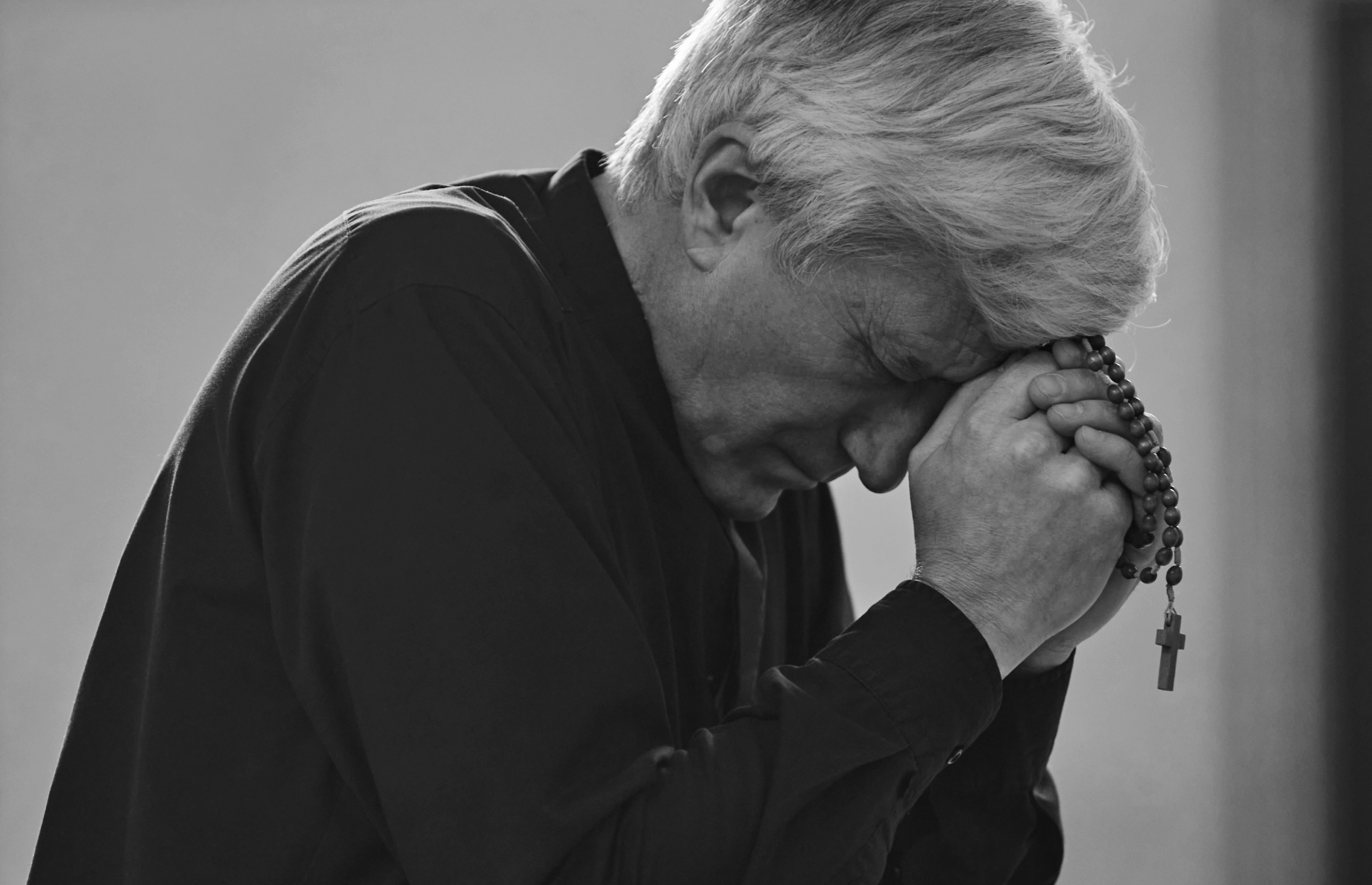
Fr. James Pierce Cavanaugh, OP serves as Promoter of the Confraternity of the Most Holy Rosary in the Dominican Province of St. Albert the Great – the Dominican Province of the Midwestern United States. He joined Nell O’Leary to discuss his new course in the Word on Fire Institute in which he teaches about the evangelical power of the rosary.
Nell O’Leary: Fr. Cavanaugh, thank you for taking time to share about your new course on the rosary for the Word on Fire Institute. It’s called “The Evangelical Power of the Rosary,” and it offers a really beautiful, in-depth education on the prayer and meditative practice of the rosary, its history, and its evangelical impact. We will walk through it with our Course Community beginning on October 13th. Can you start by sharing a little about your background as a Dominican priest?
Fr. James Pierce Cavanaugh: It’s absolutely great to be able to share the course with the Institute, and I’m hopeful amazing fruit comes from it. We don’t have to go too far to consider my background as a Dominican priest (I was only ordained in 2021), but there are some things to point to, especially as far as connection with Word on Fire goes. We had lined up a summer internship with the Word on Fire Institute just as it was getting going; unfortunately, that was summer 2020 and COVID scuttled that. I had a love for Bishop Barron and the work of Word on Fire all throughout my formation and was present at the address that made for one of the first episodes of The Word on Fire Show.
I have spent the last three years working at Fenwick High School, which Bishop Barron still speaks of highly in his vocation story, and actually now live with the priest—Fr. Tom Poulsen—who taught him the proofs for God’s existence. I have a degree in sports communication from Indiana University, so I taught a class at Fenwick on the history of media, where it looks to be going, and where the Church can capitalize on it through the rest of the twenty-first century. I’ve also been promoter for the Confraternity of the Most Holy Rosary for our province for the last couple of years, and this year I went full-time in that position. I was sad to leave the school, but it has gotten to a point where promoting the rosary pretty much needs to be a full-time position.
How incredible that this is your full-time position as promoter for the Confraternity of the Most Holy Rosary. Please tell us more about this. What is the history of the rosary? What do you say to people who wonder why Catholics “worship” Mary and don’t understand what the rosary actually is?
I could be mischievous and tell people they should check out the course for more! This question is one of the things I was most excited about with the course: diving into the history of the different aspects of the rosary. People mean different things, whether it’s the beads, the prayers, the mysteries. In putting this course together, I really hoped to arrange the history in an organized way and show us the rosary to the present day. The confraternity, insofar as this can be said about any group, is basically the official rosary group of the Church, and certainly has been since being confirmed by St. Pius V back in the 1500s, so we’ve got a nice track record there. Basically, people can pray as a member of this group, and their prayers are united with all other members of the confraternity and with all the sainted members who have passed on. For it having such a designated place in the life of the Church, not a lot of people know about it.
I think we’re due for a massive revival of Marian devotion, even among our Protestant brothers and sisters.
The only requirement is that someone resolves to pray fifteen decades of the rosary according to the traditional mysteries—Joyful, Sorrowful, and Glorious—over the course of a week. I love the Luminous Mysteries, but they’re not part of the requirement. There are no dues, and the benefits are massive. There’s been a lot of great interest whenever I’ve told people about the confraternity.
As for the question of people who think we worship Mary, they always have the wrong end of the stick one way or another. I think the most basic way to start a conversation with somebody in that spot is to be rooted in knowing that fundamental truths about Mary are actually contained in the Scriptures and have been held from the earliest days of the Church. I think we’re due for a massive revival of Marian devotion, even among our Protestant brothers and sisters. Maybe this is just hopeful, but I see signs that this devotion has simply been dormant and waiting to break loose.
An angle you explore in your course is the profound impact of the rosary on significant historical events. How do you see that impact playing out in the nineteenth and twentieth centuries through the lives of the saints and Marian apparitions?
Well, this is a fun question, and it does lead right up to us today. Here would be a way to frame it: In the middle of the nineteenth century, Pope Pius IX was a monarch over a sizable section of what is now Italy. That is a very different understanding of what the Church in her fullness has seen as the proper role for the authority of the pope. Pope Benedict XVI was very clear about this: The Church is not at her best when she’s occupying that kind of role. But the transition from that to where we are now was painful in a lot of places; great swaths of property were frankly stolen, and the reparation the Church later accepted represented pennies on the dollar from what was taken. But from that, I think we saw a spiritual retrenchment, and that’s where—in the time of Pope Leo XIII—we see a revival of St. Thomas Aquinas. The rosary was again promoted, and I think we see the effects of that down to the present day.
The apparitions are another big thing; Bishop Barron’s got his great course on Balthasar, and it’s actually Balthasar who has something very interesting to say about the apparitions, even in relation to the Church of the time. Mary is both the image and archetype of the Church—St. Paul VI proclaims her as Mother of the Church—and Balthasar says we can see in approved apparitions the voice of Mary, recognized by the successors of the apostles, speaking to the modern day. He thinks it was especially appropriate that many of these occurred in the nineteenth and twentieth centuries as people of the world, and even Christians, focused on trying to remake the Church in their own image. Balthasar would say a rich understanding of the Virgin Mary keeps us accountable to authentic Christian faith.
You have an entire lesson on Pope St. John Paul II and the rosary. Can you speak to why this particular pontiff demonstrated such a devotion to our Lady and what was given to him in connection with the rosary’s mysteries and meditations?
Without giving too much away, there are strands of this Marian devotion that run through his life. In some ways, it’s as simple as saying he gave himself to the Virgin Mary because he felt the need for a mother from a young age and pursued that according to these excellent methods provided by the Church—Marian consecration, the rosary—and never let it fade. In some ways, it was a miracle he was the pope at the time he was; people forget the state of the world in the mid ’80s and how close to disaster we were. He was the pope who consecrated the world to the Blessed Mother; he proclaimed shortly afterward the Marian year and just kept that kind of thing going for the rest of his pontificate. There are ways in which I think the shoots we are now seeing have to do with the seeds sown during his pontificate. He loved the Blessed Mother and let her lead him by the hand to grow closer to Christ, and I think he would say anybody would benefit from exactly that program. We owe a lot to him in terms of Marian devotion in the Church today.
We face increasingly dark times, with political tension dominating the news and threats of violence to vulnerable persons around the world. In many ways, we are more argumentative, divisive, and polarized than ever, perhaps due to the continual stream of information and entertainment from our devices and a lack of interior stillness. How does the rosary factor in as a powerful part of evangelization once we have truly turned to its rhythm and meditation to refocus our lives on Jesus Christ?
I would say there’s no “perhaps” about it; there is no question that a continuous stream of media is impacting our interior disposition. I want to take a detour for a second and say this is somewhat a cause, but I think it’s mostly a symptom of societies that are increasingly secular, more and more cut off from our roots. Just in our country, this is a tendency many smart people have said cannot continue forever. I’m thirty-three years old, and my grandparents’ generation is going away; the generation after that and my own generation have sustained a steady loss of faith for basically the whole time I’ve been alive. Even the renewal we’re seeing now is a comparatively slight reversal of that trend; there is a lot of help needed in Western societies, and media usage is a big part of that problem. I think we can look at the rosary as one way of helping to arrest that at an individual level, person by person.
The Church teaches that conformity to Christ brings about inner peace and then turns us into peacemakers.
I think about what St. John Paul II would say and do; it is clear, now more than ever, that the world does not offer solutions to the problems we worry about most, many of which are man-made. The Church teaches that conformity to Christ brings about inner peace and then turns us into peacemakers. Summed up, our world is absolutely starving for Christ and the rosary is a privileged means to encountering Christ, guided by our Blessed Mother. When we are faithful to that practice, we can’t help but have our lives reflect Christ, even in and amid so much trouble.
Your course is titled “The Evangelical Power of the Rosary.” As a member of the Dominican Order—the order of preachers and teachers—can you speak to the power of the rosary as a means of evangelization? How can Catholics grow as evangelists by drawing close to Jesus Christ and our Lady in the rosary?
I think this answer is closely tied to the last one: If the world is starving for Christ, and the rosary is a means to encountering his life, the connection to evangelization is straightforward. I’ll drop one more thing from Balthasar I came across recently: Back in the very early stages of St. John Paul II trying to reemphasize the rosary in the life of the Church, Balthasar and Cardinal Ratzinger (who became Pope Benedict XVI) coauthored a book in German, Mary: The Church at the Source. The whole book is well worth reading, but one of the things Balthasar said about the rosary—at a time, mind you, when people saw it as just a very old-fashioned, outmoded prayer—was that it is an almost infinite field of prayer that could be traversed in all directions, with Mary as the compass.
We draw close to Mary so we can draw close to her Son. Because there is a Jesus-shaped hole in everyone’s heart, the more we reflect and shine his light, the more we just can’t help but be evangelists. In the course, I talk about this through the lens of developing the virtues of the Blessed Virgin Mary. That’s another way of saying we’re becoming more open to God and sharing his life with a world that desperately needs him. Drawing close to Jesus is the most important thing we can do, and the more we do that, the more we share his life with everybody.