
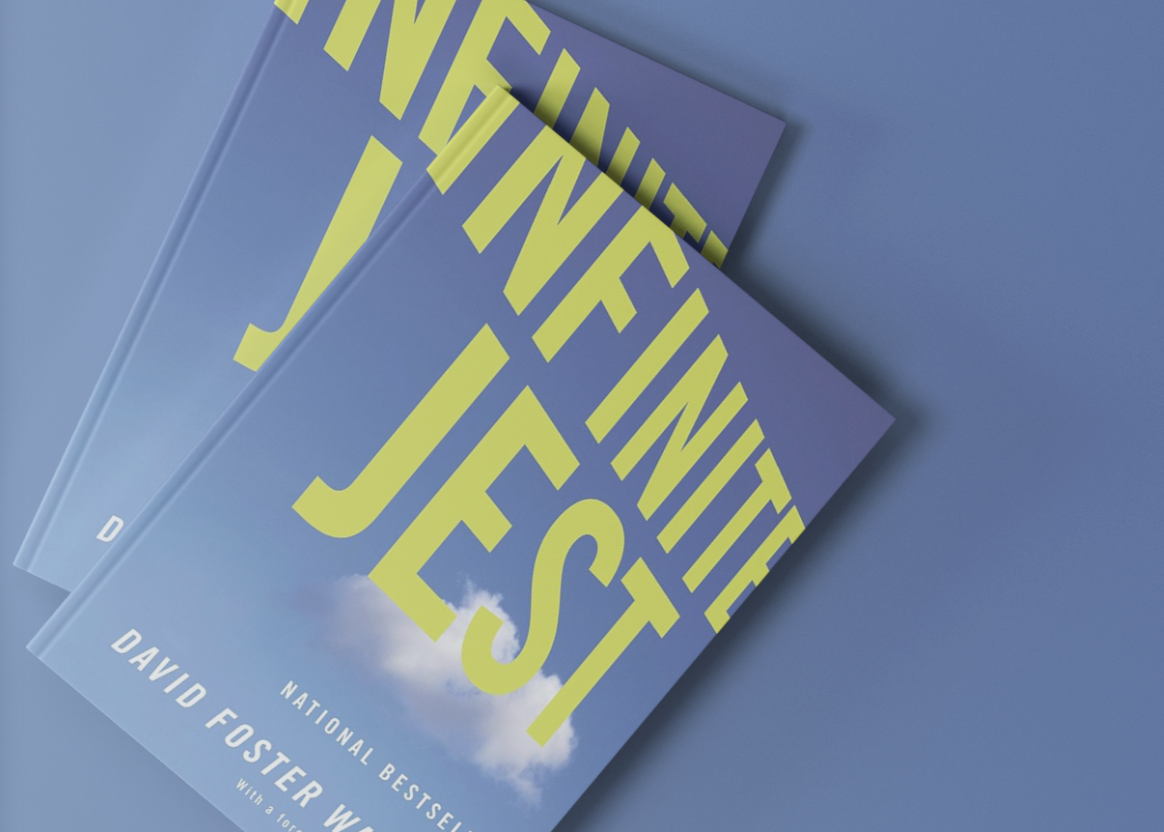
Thirty years ago this month, David Foster Wallace published Infinite Jest, a strangely tender novel despite almost seeming to troll the reader with its sheer length and procedural tedium. Today, amid a wave of ’90s nostalgia—Princess Diana, Clueless, MTV—the story feels prescient. Young people on TikTok in bucket hats and cargo pants seem to understand the ’90s as a turning point when postmodern life became ambient: when media saturation, corporate speech, managerial logic, and information overload stopped being novelties and became background noise. It was the decade that began to give meaning to what Fredric Jameson called “hyperspace”—environments so vast, optimized, and systematized that individual subjects can no longer intuitively locate themselves within them. Think edge city office parks, big-box power centers, freeway-linked subdivisions, and cities that behave less like cities and more like networks of circulation. These places are closer in spirit to shipping container warehouses and logistics corridors than to traditional urban centers with their quirky pockets and ethnic enclaves. Such spaces erode human dignity and chip away at a sense of rootedness and ancestral continuity.
Jameson’s emblem was the Bonaventure Hotel in Los Angeles, with its elevators and atriums displacing bedrooms—where biological human functions like sleep and sex take place—as the building’s true center. But Wallace’s own lived emblem of hyperspace is more banal, more American, and more devastating: the fluorescent supermarket, the parking lot, the highway commute. One gathers in Wallace’s delivery that for him, such concepts give new meaning to the term soul-sucking. In his Kenyon College commencement address, later titled “This Is Water,” he describes the end of a white-collar workday that shuttles the exhausted wage-slave into a giant, over-lit grocery store with its “soul-killing muzak,” its endless aisles, its malfunctioning carts, its long checkout lines, its scripted “Have a nice day” delivered “in the absolute voice of death,” and finally its “crowded, bumpy, littery parking lot” and “SUV-intensive, rush-hour traffic.” It’s a landscape designed for throughput, not dwelling; for logistics, not presence; for efficiency, not interiority—lanes, queues, metrics, scripted affect, bodies processed by technocratic systems that prize optimization over attention.
This “crowded, hot, slow, consumer-hell type situation” is Jamesonian hyperspace come to life. And it sets the stage for the central struggle of Infinite Jest: how to perceive another human being as a soul inside an environment engineered to reduce everyone, including oneself, to a unit of flow. In the middle of his speech, Wallace imagines the inner life of the overworked cashier, “whose daily tedium and meaninglessness surpasses the imagination of any of us here at a prestigious college.” The moment is almost violent in its moral force. Like something from Flannery O’Connor, it’s an unwanted flash of recognition inside a space designed to sedate recognition altogether.
Wallace is the great postmodern formalist trapped inside this dawning algorithmic world, straining—almost violently—to insist on the reality of the soul in systems that no longer know how to recognize it.
Seen this way, Wallace appears as a writer who is formally postmodern (almost quintessentially so) but temperamentally incapable of stomaching postmodernism’s anti-anthropomorphic world. He lives inside hyperspace, pirouettes effortlessly through postmodern techniques, and builds its architectures in prose, but he cannot stop forcing moments of human reckoning into spaces designed to make such reckoning unnecessary, inefficient, and embarrassing. Jameson’s “hyperspace” today looks less like a single hotel than like the landscapes and lifestyles engineered by a McKinsey PowerPoint: Amazon warehouses, frictionless logistics, algorithmic scheduling, quantified selves, lives optimized for scale and productivity rather than for depth. Whole cities and towns begin to look interchangeable: Walmart, McDonald’s, Starbucks, Dollar General, indistinguishable from those same four establishments the next town over. These environments—both physical and psychological—are the products of a technocratic order that treats human beings as variables in a system to be streamlined, their interior lives as distractions in the data. Wallace is the great postmodern formalist trapped inside this dawning algorithmic world, straining—almost violently—to insist on the reality of the soul in systems that no longer know how to recognize it.
The structure of Infinite Jest itself enacts this tension. The novel is not, at its core, a continuously developing realist narrative. It is a chain of short story–like crucibles—moments of grotesque, bodily, irreversible consequence—linked by vast corridors of information, routine, and transit. Scenes such as Don Gately’s accidental killing of Guillaume DuPlessis or Randy Lenz’s murder of a dog unfold with the compressed fatalism of O’Connor’s fiction: Small coincidences converge, the ordinary tips into catastrophe, and a character is forced into humiliating self-recognition. These are not ironic spectacles. They are encounters with finitude, guilt, and moral fact—almost refreshing in their grotesquerie because they at least cut against the pervasive apathy, the “waning of affect” that defines the novel’s more drone-like characters and torments the ones who remain painfully, inconveniently sentient.
What surrounds them, however, resembles the supermarket aisles and parking lots of “This Is Water”: tennis drills, bureaucratic procedures, pharmacological data, entertainment systems, institutional schedules. The reader is always moving, rarely arriving. One is carried through systems rather than grounded in scenes. The novel is built like a power center: enormous expanses of connective infrastructure linking a few small, enclosed rooms where something genuinely human and irreversible can still happen.
This opposition between corridor and room is embodied in Hal Incandenza. Hal begins the novel as a virtuoso of systems: linguistically dazzling, rhetorically flawless, perfectly fluent in the codes of an algorithmic, technocratic culture of metrics, rankings, optimization, and performance. He can manipulate signs with postmodern ease. Yet inwardly he is hollow, “robotic,” unable to feel. He can circulate but not inhabit. By the novel’s chronological end, the situation reverses. Hal is flooded with interior life—“I am in here,” he insists—but loses the ability to translate it into socially functional speech. Communication collapses; subjectivity returns. The system breaks; the soul strains to reemerge.
Wallace’s affinity with O’Connor, then, is not a matter of surface influence but of metaphysical allegiance. When Wallace once listed the writers who, in his words, “rang his cherries,” the list included the lupus-ridden Southern Catholic writer who died two years after he was born. O’Connor—a master of spiritual pressure, bodily extremity, humiliation, revelation, and misshapen, freakish characters who defy not only realism but the very logic of optimization—stands in stark contrast to the focus-grouped personalities that populate so much of today’s culture, and that were beginning to torture Wallace as he looked around at contemporary consumer life.
O’Connor was a prophet of what she called the “terrible speed of mercy,” a theological vision in which divine action arrives violently, suddenly, and irresistibly. That theology of collision—of mercy and grace breaking in through catastrophe—seems to have offered Wallace a way to speak about souls in a world increasingly organized against them, through sneering irony, emotionless systems, and cold, managerial reason. In this sense, O’Connor offered Wallace not just a literary model but a metaphysical counterweight. Her fiction helps him confront a culture organizing itself around efficiency, entertainment, and expressive individualism, yet unable to make sense of suffering, vulnerability, or grace. It is the same algorithmic, technocratic order Wallace anatomizes from the inside—one that smooths over pain, outsources attention, and treats interior life as an inconvenience. O’Connor’s vision of mercy breaking in through catastrophe gave him a way to resist that anesthesia: to insist, against the systems, that souls are real and that grace does not arrive politely but with “the terrible speed of mercy.”
The current wave of 1990s nostalgia may reflect an inarticulate recognition of this same tension. It is not only a longing for analog but for the last moments when hyperspace had not yet become total, when one could still imagine stepping out of the disorienting corridors and into a room, perhaps wood-paneled, split-level, and devoid of millennial gray. Wallace was already writing from inside that narrowing passage, already sensing that the architecture of everyday life—corporate, managerial—was becoming hostile to sustained, examined inner life.
Thirty years after its publication, Infinite Jest endures not merely as a high artifact of postmodern form but, paradoxically, as a conscientious objection to its slow erosion of human dignity. The novel’s world is one of aisles, queues, screens, systems, and flows. But its deepest loyalty is always to the moments when the system falters and a person is forced—like the tired shopper in the checkout line, the addict on his knees, or the boy who can no longer speak but can finally feel—to confront the irreducible fact of being a soul.