
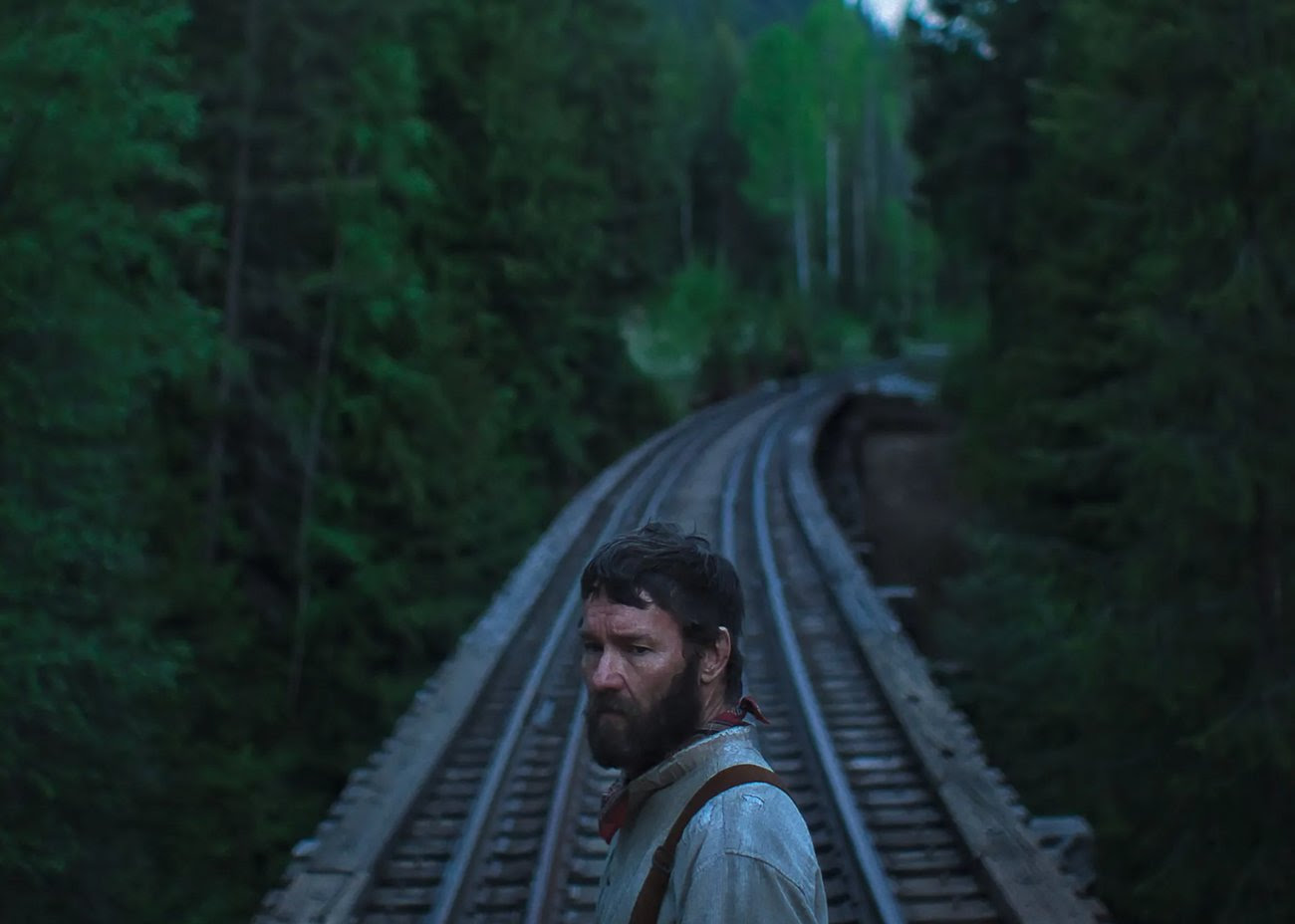
Movies these days tend to overexplain themselves, telling viewers how to feel while flattening characters into lazy, uncomplicated archetypes. Train Dreams—directed by Clint Bentley and nominated for Best Picture—bucks the trend, refusing to domesticate the audience. Instead, its scenes and characters are saturated with mystery—not “whodunnit”-type suspense but deeper, quieter questions, like “Why am I here?” and “What does any of this mean?” The result dazzles.
Adapted from a 2011 novella by Denis Johnson, Train Dreams sits squarely in the twentieth-century American literary tradition, specifically what one might call the 1880s–1960s “late-frontier” genre: stories permeated by railroads, rural towns, itinerant labor, and dusty, eccentric drifters. Think “bunkhouse wisdom” shared over hot, early morning coffee in tin cups.
The story shares this lineage, for example, with A River Runs Through It, adapted from Norman Maclean’s 1976 novella. Both Johnson and Maclean were literary scholars who taught in universities—Maclean earned his doctorate at the University of Chicago and taught English there, while Johnson studied and taught at the Iowa Writers’ Workshop—and their literary training sings in the subtle but gorgeous prose. Both stories unfold in the first half of the 1900s, in the mountain West—Montana and Idaho—landscapes of rivers and railroads, logging and labor, and of men whose inner lives are historically small but spiritually enormous.
“Eventually, all things merge into one, and a river runs through it,” explains Maclean’s narrator, reflecting on life in primitive Missoula, where rivers, formed by glaciers, run over ancient rocks. “Under the rocks are the words, and some of the words are theirs,” he says, of departed relationships. “I am haunted by waters.”
This line could just as easily belong to Robert Grainier, the solitary laborer protagonist of Train Dreams. Both men are haunted—by memory, landscape, and loss—and both leave the audience similarly haunted. In each, the setting is not just a gorgeous, expansive backdrop but a moral atmosphere, with mountains, rivers, and forests holding the weight of lives that have passed through them, quietly and without record. The stone-faced male characters in both have a hard time discussing feelings, yet the audience is keenly aware that many simmer beneath the surface, just as “words” lurk beneath the rocks in Maclean’s vision.
The film also calls to mind the fiction of another former Iowa Writers’ Workshop professor, Marilynne Robinson. Indeed, the premise of her Pulitzer Prize–winning novel, Gilead, is almost identical: Like Train Dreams, it centers on a gentle man born in the 1880s—Reverend John Ames—who lives for decades suspended in the quiet, lifelong grief of an early loss. Ames loses his wife and child around 1910, the same year that Grainier loses his. Both men are unable to remarry or even form new relationships for decades, remaining kind and observant but inwardly altered, their lives permanently marked by loss.
The stories communicate the quiet accumulation of days and the unspoken density of interior life but with the sense that something profound and unspoken is occurring just beneath the surface.
Robinson’s Lila offers another close parallel. Like Robert, Lila emerges from mysterious, parentless origins, spending her early years on trains, drifting from town to town, laboring itinerantly, and camping in temporary shelters with impermanent communities. And Robinson’s earlier novel, Housekeeping, similarly set in an Idaho town built around a lake and rail line, echoes Train Dreams in its sense of transience, its pine-wooded ambience, and its use of a train-related tragedy as a central plotline.
In all these works, largely taking place in the American West of the late-frontier era, presence almost supersedes plot. The stories communicate the quiet accumulation of days and the unspoken density of interior life but with the sense that something profound and unspoken is occurring just beneath the surface.
Texturally, much of Train Dreams also evokes Flannery O’Connor. While O’Connor (another Iowa Writers’ Workshop student) is known as a quintessential writer of the American South rather than its Mountain West, the towns and townspeople in the later scenes of Train Dreams resemble those of Wise Blood: The people are peculiar, traumatized, dusty, spiritually exhausted, and a little kooky. Train Dreams’ camps, rail towns, and settlements feel provisional and worn, populated by people who don’t quite belong anywhere else, much like Hazel Motes, the Wise Blood drifter who lives out of his car, preaching itinerantly.
The lives in both are tinged with the faintly grotesque, whether it’s a forest growing through decaying work boots nailed to a tree to mark a deceased logger or Enoch Emery stealing a mummified creature from a museum, wandering the streets in a gorilla costume. Many of the people Robert encounters feel spiritually displaced and emotionally off-kilter—lonely figures moving through a world that offers little explanation or permanence. Others simply seem eccentric, as if a screw is loose: superstitious, gently strange, as if the world has worn them down at odd angles. They bear wide-brim felt hats, loopy memories, and social misfires, like playing the harmonica at the wrong time or preaching the Gospel manically while hiding shady pasts. They walk around bewildered, in rickety towns with jarring neon signs meant to lure broken, lonely people to distract themselves with strange curiosities.
The resemblance to O’Connor is visible not just in atmosphere but in moral logic. O’Connor is famous for her violent “action of grace” concept—moments when reality intrudes abruptly and permanently into a character’s life. Train Dreams shares this. Life-altering events occur without sentimentality or explanation: no therapeutic arc, no emotional processing, hardly a lesson drawn. Only a profound reminder of how reality works—often cruelly and indifferently—and the faint, subtle suggestion that grace and beauty can still linger within it.
His perspective shifts from surface-level mundaneness to multidimensional comprehension.
And still, the film never overexplains any of this. Robert’s inner life is dense but verbally sparse—rare, crucial lines delivered with restrained torment. Much is happening beneath the surface, but the film respects the fact that a character can’t always articulate it, whether because of a traditional masculine stoicism (as in Maclean), a lack of formal schooling (as in Lila), or because of a temperament hilariously suspicious of book-learning and abstraction (as in many of O’Connor’s characters). In this way, Train Dreams resembles its late-frontier counterparts once again: characters whose emotional worlds are vast but largely inaccessible through language—and whose authors are masters at expressing much with very little.
Eventually, the film’s climax comes about not through action but through perspective. For most of his life, Robert’s world is defined by horizontal movement. Trains cut across the landscape, east to west, bound to the earth. His dreams and nightmares operate similarly: linear attempts to process his life without ever gaining distance from it. But then, in what might be an O’Connor-esque “action of grace” (albeit a happy one), something unexpected happens. Robert is invited, on a whim, to take a touristy ride on an aircraft—and, with a bemused chuckle, he accepts.
The ensuing scene is key. For the first time, Robert is no longer traveling through the world one-dimensionally but looking down upon it. His perspective shifts from surface-level mundaneness to multidimensional comprehension. He receives the redemptive virtue of clarity (albeit a mysterious, paradoxical form of it). And just as his mode of travel graduates from flat to 3D, his perception likewise graduates from temporal dream to mystical insight. It’s in the biplane that the words of logger Arn Peeples’s take on their full meaning: “Beautiful, ain’t it? Just beautiful.” What is, Arn? “All of it. Every bit of it.” Not because Robert’s life is painless, but because, seen from above, it possesses a coherence that could never be perceived from within it.
It would be tempting to read Train Dreams as a testament to rugged American individualism—or, alternatively, as a convenient parable about xenophobia, immigration, and labor (especially given current political tensions). But both would be far too reductive.

Instead, Train Dreams offers something closer to O’Connor’s brutal grace: a meditation on the expendability of ordinary men—the men who fought wars, laid rail, felled forests, and built the infrastructure of the modern world, often living and dying without fanfare, let alone the ability to express their experiences. Their lives look unremarkable on the surface. But when closely observed, there is oftentimes an enormous density of grief, love, memory, and beauty beneath the surface—and a quiet decency.
Despite the loss and trauma that Robert experiences (without any way to discuss or process it), he never sedates himself with vice or bitterness. He remains decent—sensitive, kind, and good—in the most unshowy way. This is a testament to the best of what America can be—especially with the intimation, through Robert’s witnessing on television of John Glenn’s flight into space, that both progress and perspective will keep expanding: from train to aircraft to rocket ship.
“Under the rocks are the words,” Maclean says in A River Runs Through It. In almost the same time and setting, Train Dreams shares this concept. Beneath the hardship, the silence, and the unremarkable surface of an ordinary life, “there lives the dearest freshness deep down things,” as the priest-poet Gerard Manley Hopkins writes. In Train Dreams, it’s a freshness that only patience—and new perspectives—can reveal.