
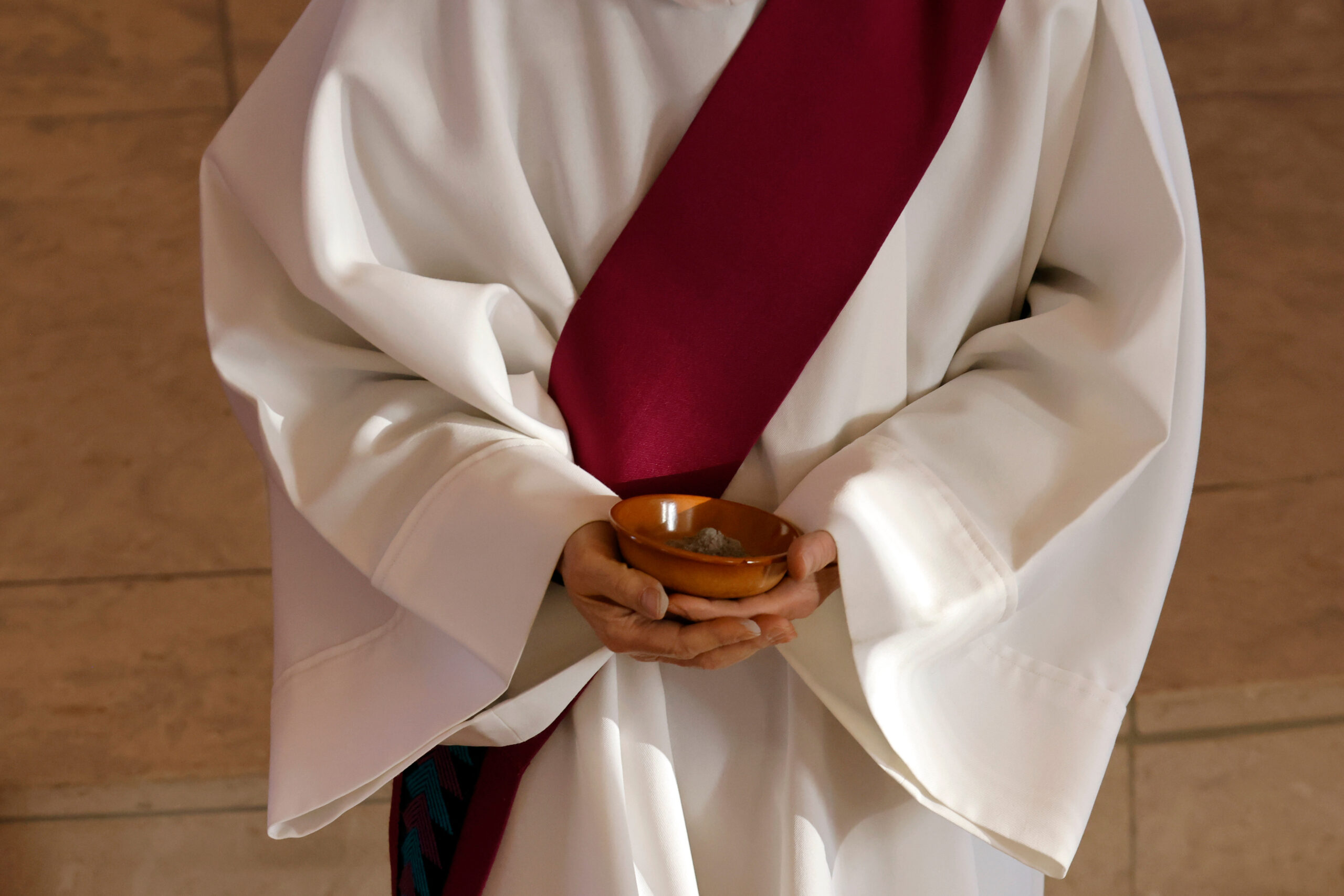
Way back in 2020, Pope Francis established a commission to study the question of the history and possibility of ordaining women to the diaconate. This was not the first committee tasked with this purpose. Rather, this commission, composed of five women and five men, “continued the work of a previous group,” as Gina Christian reports.
The commission finally issued a summary report in the form of a letter to Pope Leo XIV. It was submitted to the newly elected pontiff in September but was published at the pope’s request on December 4, 2025.
Unsurprisingly, based on its study of the question, the commission voted against admitting women to the sacrament of holy orders via the diaconate. Famously, Pope Francis himself gave an emphatic no to ordained female deacons in an interview with CBS’s Norah O’Donnell, which aired on May 20, 2024. That clip has become a meme across social media.
In this study report, the commission’s president, Giuseppe Cardinal Petrocchi, gives a summary of major points of discussion, including details of votes taken at various stages in the process for or against certain statements. Back in 2021, the commission unanimously voted on this thesis: “In the current state of historical research and of our knowledge of the biblical and patristic testimonies, it can reasonably be affirmed that the female diaconate, which developed unequally in the different parts of the Church, was not understood as the simple female equivalent of the male diaconate and does not seem to have had a sacramental character.”
This issue is a prime example of the difference between dogma and theology.
This summary report does not present the data upon which the conclusions were reached. Nevertheless, the commission is ostensibly responding to the evidence that there were women called “deacons” in certain parts of the early Church. However, the meaning of that appellation is what is in question. Referring to Romans 16:1, Charlotte Allen notes, “We know of Phoebe, the ‘deacon of the church,’ whom Paul mentions in his letter to the Romans. But the Greek noun ‘diakonos’ that Paul uses—which in classical Greek had no specific female gender—meant ‘servant’ during the first century. The same noun is used in John’s Gospel [2:3, 9] to denote the servants who filled up the water jars during the wedding feast at Cana.”
Charlotte Allen continues by naming one of the more well-known duties of such women: assisting in the baptism of adult women. The main reason for this was the fact that baptism was done by immersion and while in the nude. Thus, “it would have appeared scandalous for a male priest to immerse a naked woman.” Regarding divine liturgy, she notes that “deaconesses sometimes assisted priests at the liturgy—a not uncommon practice among nuns whose only male contact was their priest.” But this does not mean that they were the equivalent of male deacons as we know them today, who proclaim the Gospel during the liturgy and preach, act as officiants at weddings, etc.
Hence, the summary report quotes the words of the commission on this matter: “When the sources are evaluated as a whole, according to the hermeneutic criterion of the organic unity of Tradition, it can be concluded that, in general, the female diaconate was conceived as a ministry sui generis [i.e., of its own kind]. This ministry—unlike the episcopate, the presbyterate, and the diaconate conferred on men—is not placed in the line of apostolic succession.”
In July 2022, the commission held another vote with the result of seven in favor and one against the following statement: “The status quaestionis [state of the question] surrounding historical research and theological investigation, considered in their mutual implications, excludes the possibility of proceeding in the direction of admitting women to the diaconate understood as a degree of the sacrament of Orders. In the light of Sacred Scripture, Tradition and the ecclesiastical Magisterium, this evaluation is strong, although it does not currently permit the formulation of a definitive judgment, as in the case of priestly ordination.”

In its final session (February 2025), the commission accepted written arguments from external sources for and against ordained female deacons. “At the Synod’s request, anyone who wished to submit a contribution was allowed.” Yet, “only twenty-two individuals or groups submitted their papers, representing only a few countries.”
The summary then goes on to give a brief description of the arguments submitted in favor of ordaining women to the diaconate. Mostly focused on questions of “theological anthropology,” the summary letter states that “these beliefs often conflict with the Tradition of the Catholic (and Orthodox) Church to admit only baptized men to the sacrament of Holy Orders.”
Yet, as Luke Coppen reports, “Commission members were asked to vote on a statement that Christ’s masculinity was ‘an integral part of the sacramental identity.’ They were evenly split, with five in favor and five against.” The precise statement they were voting on reads: “The masculinity of Christ, and therefore the masculinity of those who receive Holy Orders, is not accidental, but is an integral part of the sacramental identity, preserving the divine order of salvation in Christ. Altering this reality would not be a simple adjustment of ministry but a disruption of the nuptial meaning of salvation.” In other words, they could not come to an agreement on whether the basis for the male-only admission to the sacrament of holy orders is based upon the fact that Jesus was a man. Or, at least, they could not agree on whether to issue a statement to this effect, whether or not they agreed with the logic.
Toward the end of the report, Cardinal Petrocchi offers his own reflections. He begins by describing two competing theological perspectives. “One of them insists that the ordination of the deacon is ‘ad ministerium,’ not ‘ad sacerdotium’: this factor would open the way to the ordination of deaconesses. The other, however, insists on the unity of the Sacrament of Holy Orders, along with the spousal significance of its three degrees, and rejects the hypothesis of a female diaconate.” The latter perspective basically rejects the former by pointing out that there are three levels or degrees of the holy orders (diaconate, presbyterate, episcopate), not three separate sacraments.
There is broad agreement that women are not to be admitted to the diaconate, but the precise explanation as to why needs to be further elaborated.
Cardinal Petrocchi then encourages “a rigorous and broad-based critical examination of the ‘diaconate itself,’ that is, of its sacramental ‘identity’ and its ecclesial ‘mission,’ clarifying certain structural and pastoral aspects that are currently not fully defined.” He then added that any service to the Church—ordained or otherwise—ought to be rooted in baptismal “diakonia” and perceived as containing a “Marian dimension.”
My overall takeaway from reading the report is this: There is broad agreement that women are not to be admitted to the diaconate, but the precise explanation as to why needs to be further elaborated. Accordingly, this issue is a prime example of the difference between dogma and theology. On the one hand, there is the revealed truth itself; on the other, there is the scholarly and rational process of trying to understand and explain that truth. Acceptance of the former does not always equal univocal explication of the latter.