
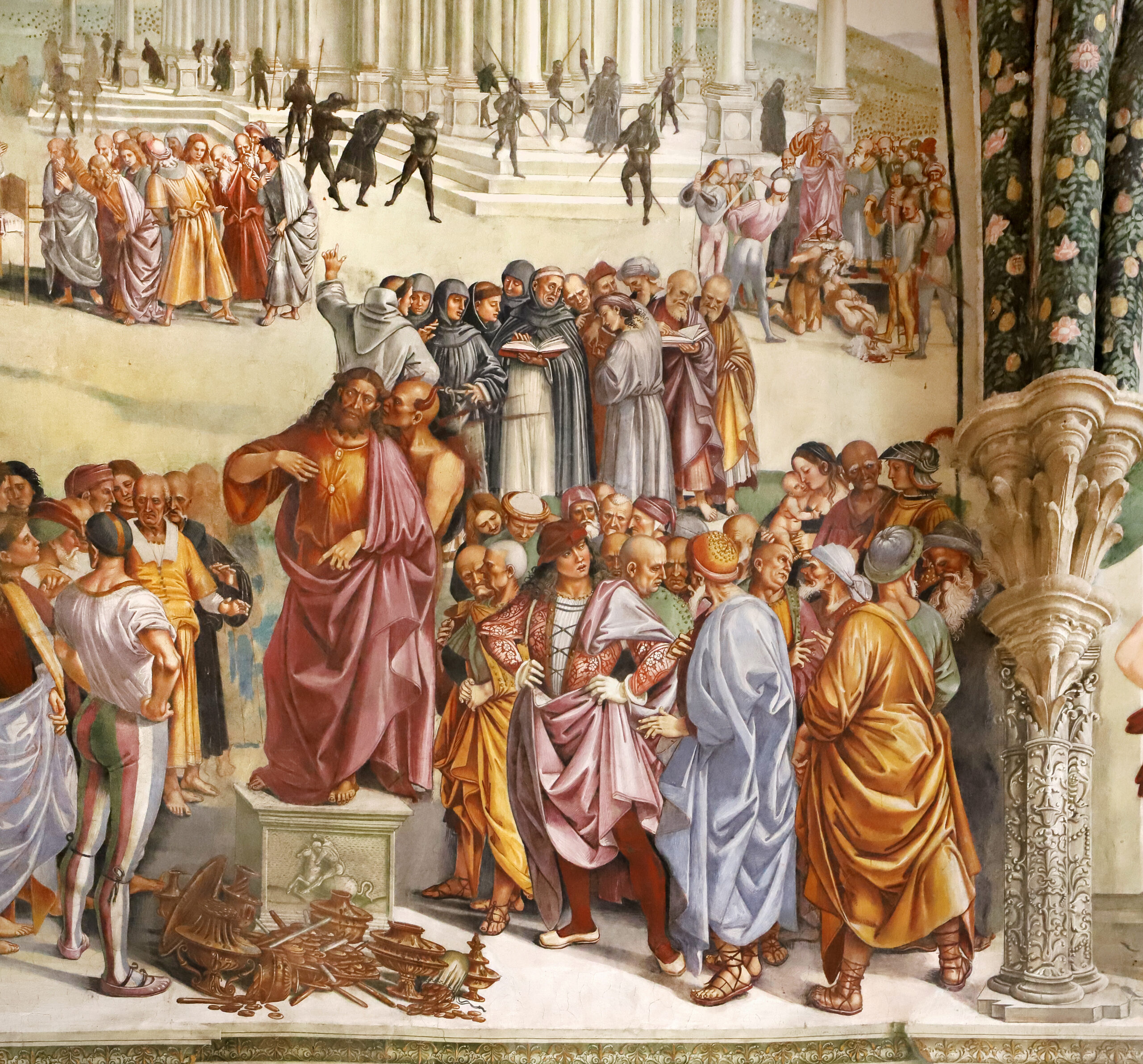
Congratulations if you had “the antichrist” on your bingo card for 2025. You are this year’s surprise winner. Since 2016, the fever swamps of the internet have produced crackpot theories identifying Donald Trump as the antichrist, as they did eight years earlier when Barack Obama burst onto the national stage. Last year, it was TikTok and Facebook’s algorithms serving up stories about Travis Kelce and Taylor Swift teaming up to beget the antichrist. Discussion of the antichrist has now gone mainstream, with major media outlets such as The New York Times and The Wall Street Journal devoting space on their editorial pages to tech mogul Peter Thiel’s musings on artificial intelligence and what—or who—poses the most serious threat to humanity. Just to make sure no one misses the trend, the current season of South Park makes fun of Thiel for his purported obsession and gives viewers a cartoon Trump literally in bed with the devil.
The more things change, the more they stay the same.
Attempts to identify the antichrist have a long and notorious history. The list of candidates is a veritable who’s who of the last two thousand years: Nero, Muhammad, Martin Luther, Peter the Great, Napoleon, Friedrich Nietzsche, Adolf Hitler, Ronald Reagan, and Mikhail Gorbachev have all been nominated for this dubious honor. Belief that the pope (any or all of them) is the antichrist was for centuries a staple of Protestant anti-Catholic invective. Of course, it occurs to shrewd observers that if all of these illustrious men can’t be the antichrist, perhaps none of them are. (Sorry, ladies, it’s still a man’s world when it comes to the ultimate embodiment of evil.) When I asked ChatGPT if it is the antichrist, it said no, but I suppose that’s exactly what it would say if it really were the antichrist.
Leo Tolstoy lampoons the whole enterprise in a hilarious passage from War and Peace. When Pierre Bezukhov fiddles with the math, he “discovers” that, when rendered into French and assigned various numerical values, the letters of his own name add up to 666, the “number of the beast” from the book of Revelation. How, exactly, he was connected to the events foretold in the Bible Pierre did not know, but “he did not doubt that connection for a moment” and reveled in the knowledge that he was somehow involved in affairs of world-historical importance.
Mostly overlooked is the way in which modern talk about both Christ and antichrist flips the very earliest assumptions on the topic on their head.
The Antichrist: Anti-body?
It is a common mistake, however, to associate the antichrist exclusively with speculation about the end of the world. When this mysterious figure first appears, it is not in the apocalyptic visions contained in the last book of the Bible. Rather, it is mentioned a few pages earlier, in two short letters traditionally attributed, like Revelation, to the apostle John. The author condemns those who “do not acknowledge Jesus Christ as coming in the flesh,” explaining that “any such person is the deceiver and the antichrist.” Later Christian tradition and popular culture—including horror classics like Rosemary’s Baby and The Omen as well as bestsellers like The Late Great Planet Earth and the Left Behind series—combine the beast of Revelation and the antichrist into a single infernal personage. The biblical text is not entirely clear on this point, so any confusion is understandable. Add to this equation Jesus’s warnings about “false messiahs” and the apostle Paul’s enigmatic reference in 2 Thessalonians to a “son of perdition,” and the possibilities for mistaken identity multiply.
Mostly overlooked is the way in which modern talk about both Christ and antichrist flips the very earliest assumptions on the topic on their head. Today, most people take for granted that a flesh-and-blood human named Jesus walked the earth sometime in the first century. His status as a divine being of the highest spiritual significance is what gives many people pause. From what the apostle John says in his letters, however, it appears as if his readers took it in stride that Jesus was a divine spirit. Remarkably, it was the claim that Jesus had come “in the flesh” that many found preposterous.
Jesus’s corporality was a scandal to the unnamed skeptics John had in mind, as well as to a number of second- and third-century authors often labeled “Gnostic.” Docetists like Cerdo of Syria and the anonymous author of the Gospel of Peter claimed that Jesus had only seemed or appeared to become human but had actually remained aloof from the created order in life and in death. Marcion of Sinope, an influential teacher who provoked vituperous responses from Irenaeus of Lyons, likewise found the notion of a physical Jesus repugnant, asserting that he had come to earth merely in “the likeness of sinful flesh” (alluding to and, according to many Church Fathers, distorting the meaning of Romans 8:3). According to Tertullian, “it is more easy to believe that Jupiter became a bull or a swan, if we listen to Marcion, than that Christ really became a man.”
Marcion took this view a step further by teaching that the God of Jesus was an entirely different deity from the wrathful God of the Jews, an inferior demiurge whose first and most lamentable act in the Bible was to create the earth, from which humans must be redeemed in order to have any hope of eternal life. The Second Treatise of the Great Seth portrays an incorruptible Christ descended from on high who borrows a body from a human mortal, only to abandon it before his illusory “passion” and “death.” In the Coptic Apocalypse of Peter, a sardonic “spirit Jesus” laughs sneeringly at his enemies, mocking them for their ignorance of his incorporeal essence as they nail his physical form to the cross. Polycarp of Smyrna, a second-century disciple of the apostle John, reaffirmed the judgment of his teacher that anyone making these claims about Jesus was himself the antichrist.
Antichrist or Anti-human?
I hold no brief for the view that artificial intelligence will destroy us nor for Peter Thiel’s worry that AI skeptics will pave the way for the antichrist by retarding the technological progress humanity needs to avoid stagnation and survive as a species. Such unorthodox speculation nonetheless brings certain contemporary dispositions into sharper focus. In particular, the notion that the physical world is so mutable and malleable as to be of little or no consequence is making a comeback. While doctrinaire materialist perspectives on what it means—or doesn’t mean—to be human are still going strong, they have provoked an equal and opposite reaction. This radically subjectivist sensibility, sometimes bordering on solipsism, can take various forms, be it an insistence on divorcing gender entirely from biological sex, the substitution of screen-mediated relationships for face-to-face encounters (what Christine Rosen has called “the extinction of experience”), or bizarre claims we are all “living” in an elaborate computer simulation carried out by an advanced civilization, perhaps from another galaxy.
Each in its own way, these cultural currents manifest an impatience with the seemingly brute facts of the material world. The messy, embodied givenness of the physical is regarded as a puzzle or a problem to be solved. Based on their prevalence, these perspectives are clearly not without their appeal and are perhaps a necessary corrective to reductionistic claims that the human brain is nothing more than a “meat machine.” Maybe, for the sake of argument, in a better, more just world, it would be possible to alter one’s sex or race or species by fiat, or online relationships would reliably satisfy the most basic human desires. But wishing doesn’t make it so. There is an old philosophical truism that says you can’t derive an “ought” from an “is.” It is just as true that you can’t derive an “is” from a putative “ought.”
To be sure, artificial intelligence exhibits qualities that at times seem an awful lot like consciousness and the types of intelligence possessed by humans. But that “like” is doing a lot of work in descriptions of AI. To say that X is “like” Y is to say that X is, in fact, not Y. No one says that an apple is like a fruit, or that a triangle is like a polygon, or that a Reuben is like a sandwich. An apple is a fruit. Triangles are polygons. A Reuben is a sandwich. Similarly, in The Republic when Socrates describes the state as being like a very large family, he glosses over the obvious fact that the state is not actually a family, whatever shared functions both may serve.
The potentialities and the limitations that come with somatic experience are not the only or the most important things that make us human. Yet they cannot so easily be ignored or transcended. Homo sapiens is more than an astonishingly complex data processing system. It will never become possible to attain personal immortality by “uploading” oneself into the cloud. Insofar as techno-optimists pretend otherwise, they are missing the proverbial forest for the trees when it comes to the crooked timber of humanity.
But this doesn’t make them demonic. It’s perfectly possible to be anti-human without summoning the antichrist.