
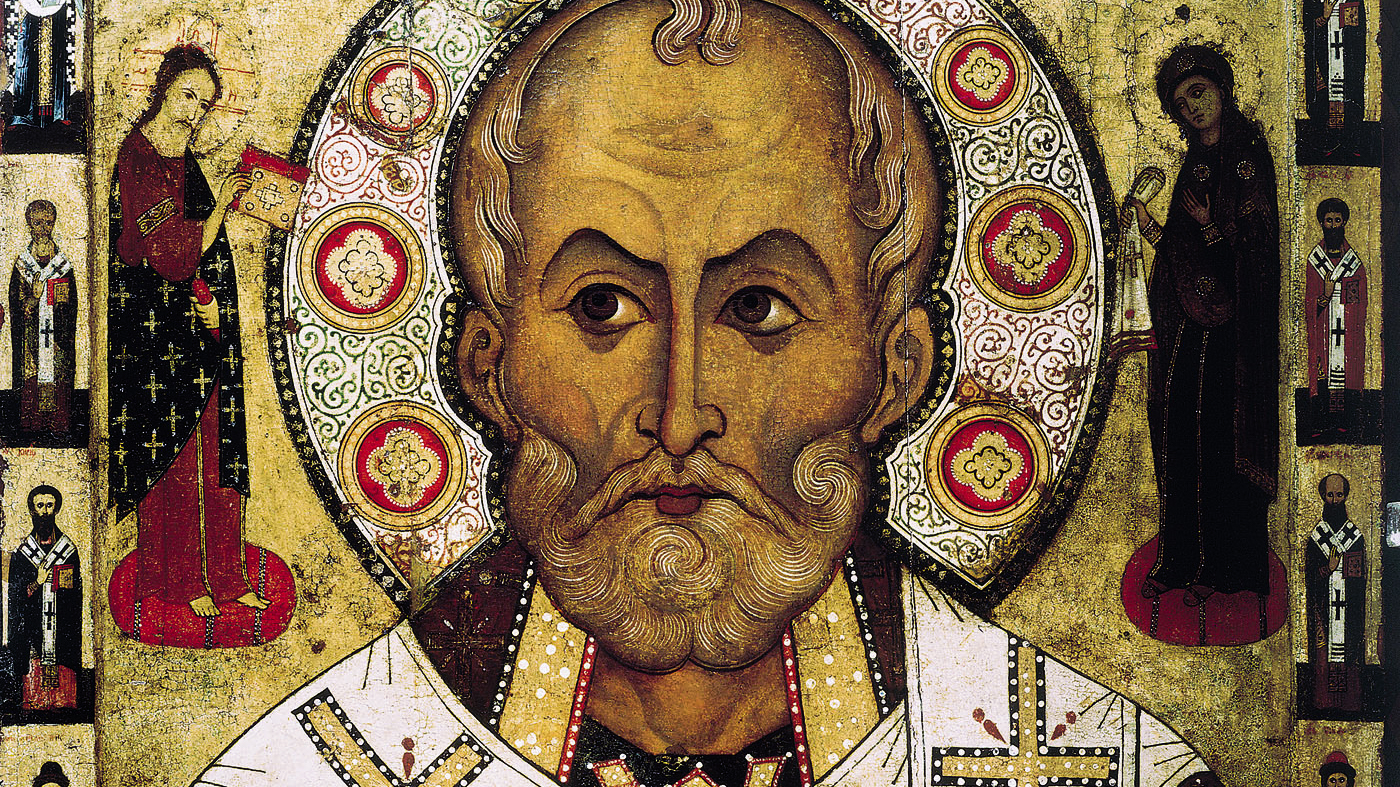
On Saturday, December 6, the Church will celebrate the Feast of St. Nicholas. Nicholas is reverenced by both the Orthodox Churches of the East and the Catholic Church, as well as by some Protestant denominations. He is invoked as the patron saint of sailors, merchants, archers, boxers, repentant thieves, reformed prostitutes, children (naughty and nice), pharmacists, pawnbrokers, fishermen, and still more. The Christians of the Orthodox East know the saint as “Nikolaos o Thaumaturgos,” or Nicholas the Wonderworker. Tradition holds that his wonders include saving children from being murdered by an evil butcher and made into meat pies, rescuing three young ladies from a life of prostitution, multiplying grain at a time of famine, and guiding sailors safely into port by appearing in a halo of light over the mast of their ship—all this as well as numerous cures and miraculous interventions.
There is much that is memorable concerning St. Nicholas. My favorite story is his legendary encounter with Arius, or an Arian bishop, at the Council of Nicaea in which Nicholas decked his interlocutor. (Remember, Arius caused a great deal of mischief by asserting that Christ was a godlike being lower in divine status than God the Father.) The story goes that Nicholas later apologized to his brother bishops for his conduct but insisted that Arius was wrong in his construal of the relationship of Christ’s divine and human natures. The Council of Nicaea sided with Nicholas, not in terms of the brawl but the orthodox understanding of Christ’s identity.
St. Nicholas’s generosity is ritually reenacted each year by children who place their shoes out the night before his feast day so that they can discover gifts left there by the saint.
In the year 1087, the relics of St. Nicholas were “appropriated” for safekeeping by Italian sailors and taken from the saint’s shrine in Myra (located in Turkey) to Bari, a town in southeast Italy. In the 1950s, the reliquary containing the saint’s remains was opened and the contents revealed a nearly intact skeleton of a man about five foot tall with a broken nose. (Maybe Arius was able to get in a good right jab before Nicholas cleaned his clock.) The government of Turkey requested the return of his relics to Myra, citing that the circumstances by which they came to Bari was illegal. I don’t know the current status of this complaint, but I think the relics should remain in Bari until the circumstances regarding the legality of the “appropriation” of Hagia Sophia are part of the negotiations.
St. Nicholas’s generosity is ritually reenacted each year by children who place their shoes out the night before his feast day so that they can discover gifts left there by the saint the following morning. Children with large feet are particularly excited about and observant of this custom, but with the development of the gift card, even children with small feet now eagerly anticipate the saint’s appearance. In some European countries, a costumed version of the saint—complete with miter and crozier—makes his rounds bringing gifts to the children. However, there is a dark side to this visitation, as the costumed saint is accompanied by a person dressed as a demonic imp who is there to mete out punishment to unruly children. Some children will receive a switch of wood in their shoe as a warning of what is to come if behavior does not change. Children who are particularly disruptive are to be placed in a large sack and taken to parts unknown. The manner in which grace and retribution are juxtaposed in all this must be received by the children as positively delightful. Had I known about this custom as a child, I would have spent December 6 hiding behind a locked door.
The combination of a Protestant aversion to saints and Catholic reverie along with secularist ideology created a mutated version of St. Nicholas called Santa Claus (you can hear a lingering hint of “Sanctus Nicholas”). Santa Claus is not a bishop, saint, or real person but a symbolic representation of American culture’s annual winter gift exchange (I would use the term “holiday” here, but I am sensitive to the fact that the word is derivative from “holy day,” and I fear giving offense to those who are offended by the idea that there is something sacred or holy other than the experience of being offended). Santa Claus brings gifts as St. Nicholas was formally allowed to do, and he has some kind of magic list of children that distinguishes the naughty and the nice, but he no longer employs a demonic imp as an assistant. I imagine elves are cheaper and reindeer more docile. The famous cultural narrative that explains the association of Santa Claus to retail culture is a film entitled Miracle on 34th Street. I wonder what that film would have been like if the character played by Natalie Wood had discovered that one of the employees at Macy’s department store was actually a fourth-century Greek bishop. Now that would be a miracle!
Each year around this time, I hear stories concerning the war against Christmas, which seems to me to be about Christian resistance to the secularization of one of the holiest days of the Christian year. The popular culture hosts an annual festival of wintry themes that coincides with the Church’s observance of the birth of Christ and tries its hardest to maintain the secular observances without disclosing the true reason for all the fuss. In fact, much of what the popular culture seeks to accomplish from the day after Halloween (I mean, Thanksgiving) until December 25 is fueled by the vapors of an inherently Christian—or more specifically Catholic—cultural phenomenon. Somehow, in a culture so influenced by the starkest forms of Protestantism and secularism, the Catholic festival of Christmas (Christ-Mass) has gained a great deal of cultural prominence. Unbeknownst to many, Christmas did not receive much attention prior to the nineteenth century in either Britain or the United States, thanks to Oliver Cromwell seeking to stamp out the observance because of its evident “popery.” Many of those who express a contemporary aversion to Christmas are the heirs of Cromwell, the only difference being his objections were crudely theological while modern forms are crudely ideological. Charles Dickens did much to overcome the lingering cultural aversion to Christmas, and he also created the Christmas fantasia that fills so many with thoughts of holiday (am I allowed to say Christmas?) cheer.
The secularization of Christmas is also the result of more than a century of clever marketing and brand building by retailers who have discovered the celebration to be one of the greatest financial windfalls in history. Secularizing the occasion makes good business sense; it permits many who could not care less about the birth of Jesus of Nazareth to share in the benefits of gift receiving and take advantage of all the sales and discounts. If it was all just for Christians, the narrowing of the market would make the celebration much less profitable, thus the conscious and deliberate strategy to tone down the Christian specifics of the celebration.
The real substance of Christmas is rooted in the liturgical observances of the Church’s year of prayer and worship.
The real substance of Christmas is rooted in the liturgical observances of the Church’s year of prayer and worship, in which the mysteries of salvation are displayed and remembered among the faithful. This calendar was once the basis for the popular culture of our European forebears. Protestantism rejected most of this calendar and the festivity that accompanied its practice, viewing it all as being bound by the “law” and far too pagan for their sensibilities. I remember a few years ago a rather prominent suburban megachurch announced it would be closed for Christmas. Reports of outrage followed, but I shrugged and thought they were just being good Protestants. Secularism completed the work of the Protestant reformers by further clearing the calendar of “religious” commemorations and insisted that the public festivities of the Church be sequestered from view by being placed behind closed doors. The festivities of December 25 have curiously endured, though it seems that the hold of Christmas on the culture’s imagination grows more and more tenuous each year.
Liturgically, the date of Christmas is calculated nine months from the Solemnity of the Annunciation on March 25, which commemorates the incarnation of Christ in the womb of his mother. It is because of this ancient feast, one even more ancient than the liturgical and cultural observances associated with Christmas, that the Church celebrates the birth of Christ on December 25. The liturgical calendar also includes a day honoring St. Nicholas the Wonderworker, a real person whose love for Christ became the meaning and purpose of his existence.
As Catholics, we remember Nicholas not just for his mighty deeds but his continued participation in the life of the Church as a member of the communion of saints. Through our participation in the Eucharist, we celebrate his life and witness while he celebrates with us from his place in heaven; together we worship the Lord who took flesh in the womb of the Virgin Mary. There is therefore a spirit of St. Nicholas that transcends the boundaries of heaven and earth, a spirit greater than Nicholas himself; for it is truly the Holy Spirit, sent by Christ, whom every saint bears into the world. This Holy Spirit reminds us that while many in our culture wage a war against Christmas, we know that Christ’s victory has already been accomplished, and his triumph is evident in not only the witness of saints like Nicholas but in the willingness of Christ’s followers in every age to proclaim boldly, and even defiantly, that the child born in Bethlehem is truly Christ the Lord.
This article first appeared on Evangelization & Culture Online on December 6, 2010.