
Whatever other superlatives it might also cherish or lament, New Orleans is surely among the most odorous of our cities. This is as much a fact of climate as it is of culture. Slouched between the brackish wavelets of Lake Pontchartrain and the muddy roiling of the Mississippi, the city is saturated in such scents as the sun sucks up from marsh and swamp and bayou. In the heat and humidity, each environ exudes its peculiar miasma, with sea breezes and alluvial funks contending for supremacy. Then, too, as gardenia, crepe myrtle, and magnolia give way to sweet olive and azalea, the city’s cycle of festivity rolls on. Corpus Christi processions incense the avenues. The stoops and portals of our churches exude hints of holy water and chrism. Assumption arrives, and the Blessed Sacrament steams downriver from Baton Rouge as perfumed clouds unfurl from gigantic censers. Passing through the unabating revels of the Vieux Carré, one chances now on the sweet waft of rum, now on a draft of body odor, of weed, of beer, of urine, of étoufée and oysters and fried shrimp, of whatever it is that’s pooled between those bricks. Mardi Gras arrives, and the plastic scent of the beads and the doubloons mingles with the char of fat that drips from roasting flesh. This last spreads richly once again across the city like the aura of a hecatomb when, in the fall, Saints football gets underway.
There looms ever, and especially at the outset of football season, the possibility that all these smells will give way to the flood reek, the rampant stink of mold a hurricane can leave in its wake.
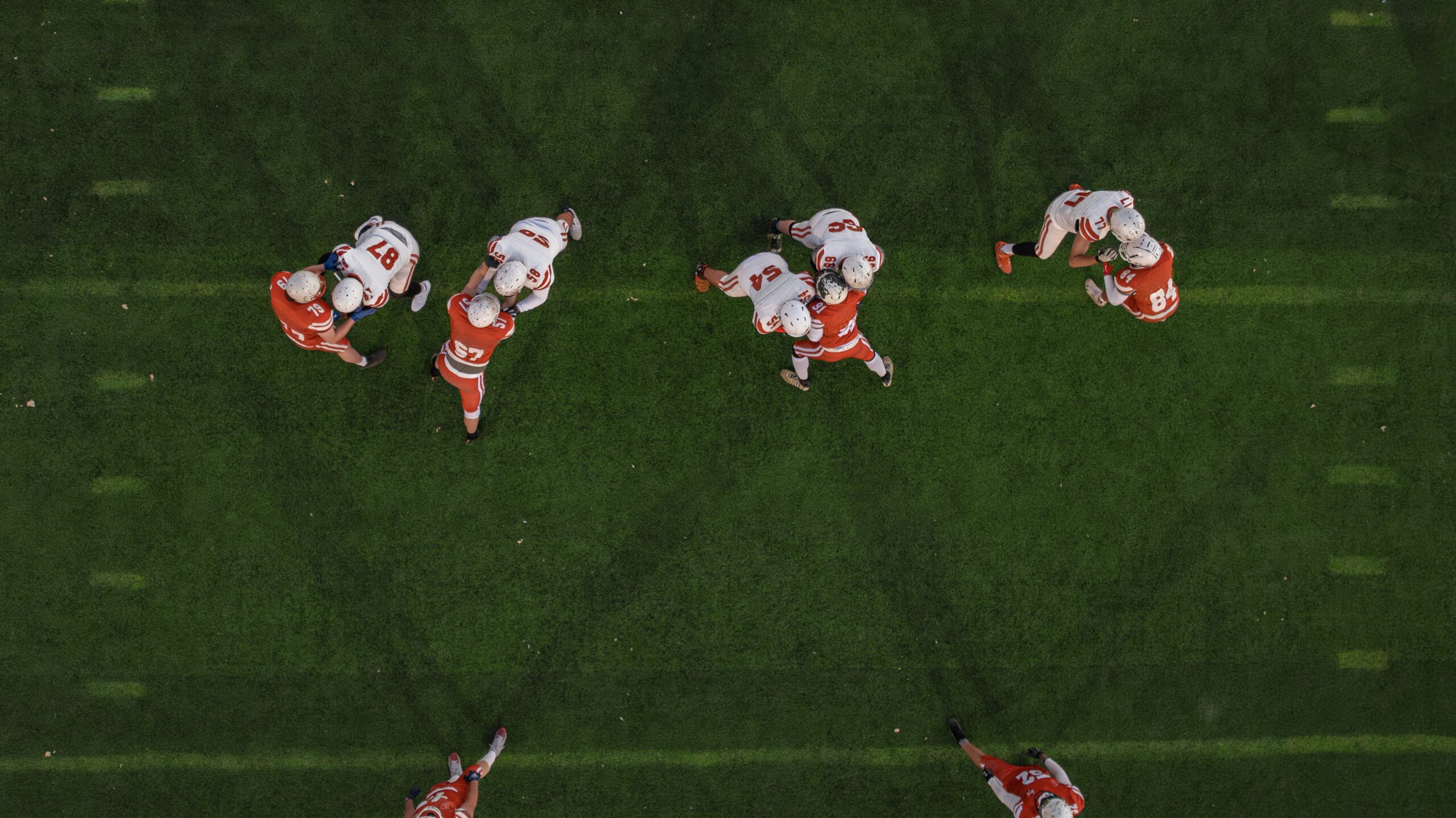
Whatever the scent in the ascendant now at the end of summer as I write, the NFL season approaches, and millions are dressing the altars of their televisions, garlanding their kitchens in sausages, strewing chips and dips across counters. Something like religious fervor arises, a quality perhaps especially prominent here in New Orleans, where our team, a band of almost perennial disappointments, is called the Saints. Fandom here demands astonishing depths of faith. The outset of the season is a hopeful time too, when at last some respite from summer’s inferno whispers its promise. We love this spectacle, though it end so often in heartbreak. It reminds us, like Melville’s pale usher, dusting his lexicons, of our own mortality and braces us in the face thereof.
Great athletes show us the beauty and power of the human body at the limits of its activity.
Sport does present, after all, a great spectacle not without the capacity to inspire proper wonder. It was not by accident that St. Paul employed his sports metaphors or that many glories of the Old Testament—like Elijah outstripping on foot the chariot of Ahab—comprise feats of athleticism. Great athletes show us the beauty and power of the human body at the limits of its activity. They show us ourselves as we could be—not perhaps as we could be in sports, but as we could be according to the excellence God has in store for us.
Sports also, in the way they have come to inhabit the American imagination, provide us with an image, albeit a corrupted one, of what liturgically oriented living could look like. Pope John Paul II reminds us in Dies Domini, with reference to Origen, that the true Christian is always living in the Lord’s Day, always enjoying the resurrection. True Lord’s Day engagement has fallen so far in our world that we might wonder if it is even possible anymore. Yet the NFL has successfully trained great swathes of America to live always in Game Day, and the example—if, again, a corrupted one—might offer us means of hope for restoration of greater things.
Consider, for instance, how Game Day has tended to permeate the entirety of the week. Sunday is game day, certainly. But Saturday offers the serene delight of college football, while Friday collects its crowds beneath the lights to watch the high school boys at play. There is Thursday night football, and there is Monday night football. And the sports networks host round-the-clock replays and highlights and analysis so subtle as to boggle the imaginations of the uninitiate. The season goes on. Attention sharpens or subsides according to the way our teams acquit themselves. Heartache. Outrage. Jubilation. And the betting increases and multiplies. And for those who desire it, the joy of game day is available at every moment on the fields and the screens and in the apps.
This love of the game speaks to the innate desire of the heart to rest in contemplative activity of the highest sort. We want to gaze with friends and family forever on the sum of all beauty and power. We want to belong to something greater than ourselves, something which delights our hearts and gives us back our own being restored and made whole and magnified. And God offers us this in the Lord’s Day, which is not simply a day to be free from work but rather a day to engage in our highest activity—contemplative union with God of the sort we hope to experience in eternity.
We want to belong to something greater than ourselves, something which delights our hearts and gives us back our own being restored and made whole and magnified.
If the mercenary play to which—in the industrial football complex—our culture has devoted itself is the palest shadow of a shadow of the contemplative union of play and prayer offered to us in the Mass, this false American liturgy can nonetheless offer several insights as to how to live always in the Lord’s Day.
The latter, as John Paul II insists, should permeate all of life, and the capacity for that permeation abides already in many places. Mass is not, in most American cities, offered only on Sundays. The sacrifice is available daily. The Liturgy of the Hours and the Rosary, too, train the heart to gather up the experience of time in the light of eternity. And the study of Scripture and the works of the spiritual masters down the centuries offer endless edification to those who seek to learn, in the midst of time, to attend to the God who is always attending to man.
The NFL and its concomitants are instructive, too, with respect to the lavish possibilities of worship. A culture which dedicates billions of dollars annually to a sport makes plain what it values by such sacrifice. Nor do Americans lack examples of the kind of beauty that flourishes when such sacrifice is dedicated instead to worship, to painting and sculpture and mosaic, to incense and gold and all those things that cry this—this! The Lamb’s Supper and Heaven and the salvation of souls—is what we value above all else. From St. Vincent Ferrer in Manhattan to St. Patrick’s Cathedral in New Orleans to the Cathedral Basilica of St. Louis, in a thousand lovely spaces across America, ecclesial beauty abounds, awaiting prayerful attention and recovery and emulation.
Then, too, the joy of the game can recall anew the joy of the Mass. It is easy to live in game day because the delights of game day are obvious. To catch a pass, to score a touchdown, to eat a burger and drink a beer, to see the play of beautiful bodies and rejoice in the capacities of the person—these are joys made simple, the joys of the will at home in itself. The joys of the Lord’s Day arrive often in hiding: joy at the sight of the Eucharist aloft above a simple altar; joy in the presence of family; joy in the prepared meal and the changed diaper and the toddler carried far afield in an evening’s walk. Such joys approach, at times, in secret, in the slow process of recognizing the whisper of the divine will in the people and places and tasks which form the shape of daily life. Such joys come by taking up the cross and allowing for the hard correctives of grace. But the issue is the resurrection, when the scent of the tomb where death lies defeated oozes into nature and makes the sheep to smell at last like the shepherd.
The medieval poem “The Panther” recalls more than once the odor of holiness, the scent of the Resurrected Lord that flows over the world. That, the poem tells us, was a good stench! Now, with the outset of a new school year, at the end of the summer, the scents of things are specially poignant, bringing with them the ache of what was and the hope for what might be. It is a time for remembering and for being re-membered in the One who draws all to himself, a time for hearing the call to his goodness in the lesser goods, a time to turn from the game of our making to the triune play of God who breathes the odor of salvation.