
The following article is a featured column published in Issue No. 26, “Saints,” of the Evangelization & Culture journal of the Word on Fire Institute.
There were four of us seminarians eating with Mrs. Wanda that evening. She had Polish roots but was living in Rome at the time. We shared family stories throughout the meal, seasoned with laughter and tears. We were all homesick, but we were grateful for the opportunity to share family stories with someone outside the seminary walls. Her English was impeccable and her European accent made it all the more mesmerizing. Most of her stories concerned her uncle who died an untimely death when he was only twenty-four. Although the tragedy of his early passing was sad, his short life was so inspiring. Sounded like he was a guy I would enjoy spending time with.
As a farm boy, I was intrigued with the fine tableware we were using. The plates were so delicate and the silverware looked like it belonged in a museum. Nearing dessert, I asked Wanda, “Where are these dishes from?” She didn’t skip a beat, answering, “They were from my grandparents. These are the dishes my mother and her brother used when they grew up.” Quality moments with quality people are hard to forget; they do something to one’s heart.
* * *
I had a similar quality moment over a meal with Father Tomas a few weeks ago. He was in town for a couple of weeks and stayed at the rectory with me. The bishop knew him and asked if I could put him up. He was from Guatemala. Like the evening with Wanda, Father Tomas and I shared stories over the meal marked with moments of sadness and great joy and hope. We both talked about our parents and all they taught us. Multiple memories of Father Tomas concerned his father’s best friend, who was tragically murdered one evening. As I heard the stories of his father’s friend, I couldn’t help but think about Wanda’s uncle.
These memorable moments changed my soul in some magical and mysterious way. A virtuous and holy life lived by another person stirred a thirst for virtue and holiness in my own. This hunger for virtue and holiness was a common topic of discussion in seminary formation.
Oddly enough, when I was in seminary, I cut hair. I would never charge my brother seminarians. I’d just ask them to pray for specific intentions. It was a good business. Ironically enough, one day when I was cutting hair, a seminarian told me about an old Capuchin priest from Detroit who also cut hair. He lived a long life and people came from long distances just to seek his counsel. I did some searching and found some interesting information about him. Like the individuals above, his life was marked with virtue and holiness and it stirred something in my heart.
I have always been inspired by people who struggle to be the best. I appreciate people with some “dog” in them, men and women who are willing to dig deep and push hard. Those who are willing to face challenges head on. Those who don’t run from opportunity or struggle. I am inspired by people who live life to the fullest. Nothing half-hearted and never lukewarm.
* * *
Our faith tradition gives us countless individuals like that for us to look up to, people for us to emulate. They are called the saints. They weren’t perfect, but they never threw in the towel. They fought the good fight and ran the race to win. All of them crashed and burned, but they all crossed the finish line. Among the saints, I have a particular devotion to the servants of God and blesseds, those who aren’t yet officially declared saints by the Church. I fondly refer to them as the “not quites.”
The servants of God and blesseds inspire me to keep my head down. Head down in adoration to the Lord. Head down into the storm of life.
The process of canonization takes time. I won’t go into detail, but a long process of investigation takes place. Over the course of years, the person’s life is investigated by the Vatican through interviews with a slew of individuals, from bishops and doctors, to family and friends, even the “devil’s advocate.” Over time, the individual is considered servant of God, blessed, and finally a saint. The “not quite” I mentioned above refers to the first three categories. They inspire me, because they aren’t quite officially declared saints. I’m not quite to the finish line. Life is a race. It’s an adventure. It’s also a struggle. I believe the struggle part is what makes us saints. The Lord never promised us an easy life, but he promises us a good life, if we follow him. The servants of God and blesseds inspire me to keep my head down. Head down in adoration to the Lord. Head down into the storm of life.
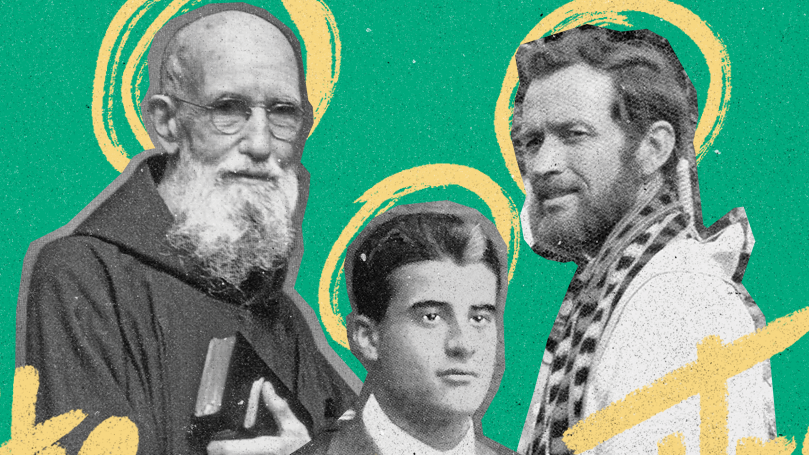
Wanda’s uncle, the best friend of Father Tomas’s father, and the Capuchin all fall into the category of the “not quites.” Wanda’s uncle is the beloved Pier Giorgio Frasatti. Born and raised in Turin, Italy, to his political-elite father and his faithful mother, Pier Giorgio was the “Man of the Beatitudes.” He wanted for nothing in his short life and intentionally chose to do without for the sake of those in need around him. He would give his bus money to the needy of his town and run or ride his bike to where he wanted to go. He would sneak out of the house to attend Mass. He would challenge his friends to billiards: If he lost, he would pay them; if he won, they would have to go to adoration with him. He never lost. (I do this sort of thing with my school kids and youth from the parish, often challenging them to a race or pushup competition.) He would smoke pipes with buddies. He would hike to the tops of mountains with his friends. This last thing reminds us of his famous words, “Verso l’alto”—“To the heights.” Reminding us to always strive for something greater. Pier Giorgio was certainly a man of the beatitudes and certainly someone that inspires me to strive for heroic virtue and holiness.
The best friend of Father Tomas’s father is another individual that has made my starting lineup. Blessed Stanley Rother was a priest from Okarche, Oklahoma—just a few hours from where I live. He was born and raised on a family farm and grew up in a strong German Catholic family, much like myself. He was a very simple, hard-working man. Shortly after his ordination, he went to Guatemala to serve the faithful of Santiago Atitlán. It is a small village on the Lake of Atitlán. Father Tomas was born and raised in that village. When Father Stanley arrived, Juan Pablo, Father Tomas’s father, took him under his wing. He helped him learn the Tz’utujil dialect and the ways of the culture. Learning this dialect is ironic, because this priest was dismissed from the seminary for a time for his inability to learn Latin. While in Guatemala, Father Stan taught the people how to farm more efficiently and helped them built a radio station and established a clinic. Father Tomas also shared that he would go to parishioners’ houses unannounced to join them for a meal. They would often be embarrassed about how messy the house was or how scant the meal was. He always said, “I don’t care about the house or food. I want to be with you.” Father Stan inspires me to heroic virtue and holiness.
Father Solanus Casey was a Capuchin who spent most of his life in the Detroit area. He was a very simple man who was full of love. He was known for his gentleness and availability, two areas about which I pray for his intercession. Much like Father Stan, Father Solanus didn’t do well in his studies. He was ordained to carry out simpler tasks of priesthood and wasn’t entrusted with preaching or administration.
He played the violin. He didn’t necessarily play it well, but he played it. He cut hair for a time. He is most known for his duties as porter. A “porter” refers to someone who tends the doors of a monastery, much like a receptionist. Over time, the faithful flocked to Father Solanus. On a regular basis, lines would form out the door, as people patiently waited to hear words of counsel from him. Father Solanus inspires me to heroic virtue and holiness.
* * *
As Christians, we have one task: to be saints. This is not something we do solely by our own willpower. Rather, it is something we do in cooperation with God’s grace. We do this through relationship. All of us carry wounds of some sort. The greatest wound is that tragedy of original sin. After that, we have problems from family and life choices. Just as we are wounded through relationships, so we are healed through relationships. The primary relationship is with our Lord. After that, our Blessed Mother, the angels, and the saints. Amongst them, I often default to the “not quites.” There’s something about the venerables, servants of God, and blesseds that really get me going. They aren’t quite saints, but they are close. I’m not quite yet to my final judgment, but I’m close. They inspire me to live a life of heroic virtue and holiness. Hopefully, when the clock ticks its last second for me, they will be there waiting for me, along with our Lord. Hopefully, echoing Christ, they say to me, “Well done, good and faithful servant; you have been faithful over a little, I will set you over much; enter into the joy of your master” (Matt 25:23).