
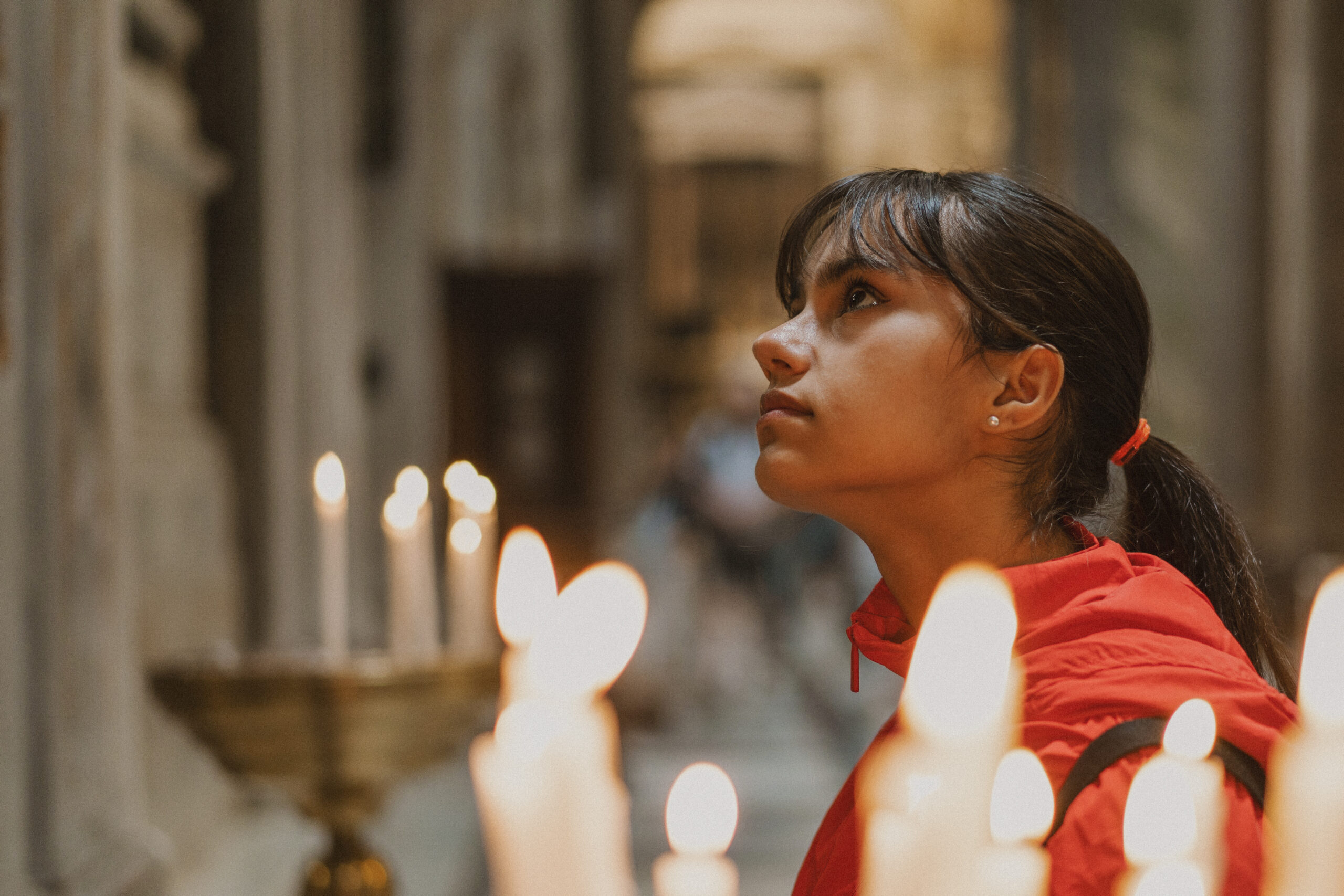
In a cultural context marked by fickle trends and sensational claims, a skeptic’s lens has become an unfortunate yet necessary adaptation against misinformation. So, when headlines suggest that Gen Z and millennials—long touted as highly secular cohorts—have started turning toward Christianity, and Catholicism in particular, one’s natural reaction, understandably, might be skeptical. However, despite the surprising nature of such a development, data seems to indicate a marked shift that would compel even hardened skeptics to look twice and perhaps consider that something is taking root in the pews.
Beginning with Christianity more broadly, Barna Group—a Christian research organization—reports from a 2025 study that 66 percent of US adults have “made a personal commitment to Jesus that is still important in their life today.” This marks a 12-point increase from the same metric in 2021, translating to approximately 30 million more Americans who now say they’ve made Jesus a priority in their lives. While this metric may be a bit nebulous for the Catholic palate, it nonetheless reflects a significant rise in individuals who have at least considered placing God at the center of their lives.
Broken down by age, millennial and Gen Z men are at the forefront of this movement: Between 2019 and 2025, the number of Gen Z men reporting a personal commitment to Jesus increased by 15 percent, while millennial men showed a 19 percent increase.
Across the pond in Britain, similar phenomena have been observed. According to YouGov, a London-based polling organization, belief in God among 18–24-year-olds has climbed from 16 percent in August 2021 to 45 percent in January 2025. Further, 4 percent of 18–24-year-olds attended church monthly in 2018 whereas that value stands at 16 percent today, with young men increasing from 4 percent to 21 percent.
Engaging with the faith online essentially allows a young person to engage on their own terms and at their own pace.
As for Catholicism’s popularity in Britain, the trend is even more pronounced. Among churchgoers aged 18–34, 41 percent now identify as Catholic compared to 30 percent Anglican—a notable shift from 2018 when Anglicans comprised 41 percent of all churchgoers while Catholics made up 23 percent. Among the 18–34 demographic broadly, 35 percent claim they’re Catholic while only 25 percent self-identify as Anglican.
In the US, the Church is also seeing unprecedented interest, even relative to the broader trends of Christian conversion. The Diocese of Cleveland, Ohio, saw conversions climb by 49 percent in 2025, jumping from 545 to 812 individuals. The Archdiocese of San Francisco followed closely with a 47 percent increase, growing from 444 converts in 2024 to 653 in 2025.
Beyond mere conversions, which are noteworthy but possibly reflective of nominal commitment rather than lived faith, there’s also some data on Bible usage. The American Bible Society found millennials experienced a 29 percent increase in Bible use from 2024 to 2025, while men saw a 19 percent increase—the first of such developments since 2021. This translates to 10 million more American adults reading the Bible outside of church at least three times yearly.
These developments defy convention for a couple reasons. First, the evident revival of Christianity is being driven by young people—millennials and Gen Z, which is out of the ordinary; the historical norm is that older generations represent the predominant share of religious fervor. Second is the gender piece. While there’s an evident increase in religious commitment among young people, the lion’s share of that interest is coming from young men. As young people have historically been less religious than old, and men less so than women, this is a noteworthy shift.
From a higher-level view, and at the very least, all this data suggests the long-declining trend of religious affiliation in the US is showing signs of stabilizing or potentially even reversing. The Pew Research Center, perhaps the most trusted authority on the nation’s pulse, documented steady erosion of religious identification among younger Americans for years but released a report this February indicating declining rates of Christianity have begun to taper off and stabilize.
Young people are increasingly engaging with the faith not through institutions or parental influence but through decentralized, self-directed exploration.
Why any of this is happening is up to conjecture; however, there are some decent causal theories worthy of consideration. The first is social media and the online sphere more broadly. There are a number of Christian and Catholic influencers who’ve amassed significant followings online. This is noteworthy because engaging with the faith online essentially allows a young person to engage on their own terms and at their own pace.
Unlike prior generations, young people are increasingly engaging with the faith not through institutions or parental influence but through decentralized, self-directed exploration—often via short-form content that feels native to their digital context. What’s novel isn’t the presence of evangelists online—such have existed for decades—but the peer-to-peer, algorithmically amplified way in which faith-based content now spreads and resonates.
Interestingly enough, the dimension of social media cuts both ways. While the viral potential of short-form content is likely to credit in getting more young people interested in religion, it may be religion itself that they’re seeking in order to avoid the sort of surface-level interaction social media provides. Looming in the background of all this is the apparent “loneliness epidemic” plaguing Americans young and old. Religion of any kind—and Christianity in particular—may exist in the eyes of the unaffiliated as a means to circumvent these feelings of isolation: It’s an opportunity to connect with others and to something outside of themselves.
There’s also the potential that the surge in religiosity is the result of reactions to perceived or actual negative world states. It’s a well-documented phenomena that religious affiliation tends to ebb and flow congruent to world events. Typically, the more hardship—pandemics, war, economic turmoil—the more people are inclined to start believing in a higher power.
While it’s beyond the scope of this article to discuss whether the status quo truly represents an unprecedentedly disordered world compared to times past, there’s little question that much of the modern context—hyperconnectivity, sensational media, and the like—is able to make it at least seem like the world is burning. As young people are those in the position to inherit the world—both literally and as they perceive it—such anxieties may be to credit for their current propensity to Christianity.
The obvious looming question in light of all this, at least in my mind, is whether the observed phenomena represent a flash in the pan or whether they are reflective of systemic, lasting change. I don’t think there’s much doubt that one’s arrival to the faith can often require some sort of external impetus: a personal tragedy, a mounting sense of emptiness, and the like; however, the critical piece is that one’s faith remains beyond and despite that impetus. Whether young people’s increasing commitment to Catholicism has that staying power remains to be seen.