
In this Year of Our Lord 2025, we celebrate both the Jubilee Year of Hope and Flannery O’Connor’s one hundredth birthday. No doubt more Catholics are celebrating the former, but the two are related, as O’Connor was a devout Catholic, and although her fiction is dark, violent, grotesque, and unsettling, her ultimate vision is one of hope. America’s greatest Catholic writer—born on the feast of the Annunciation—would be honored to share her centenary with the Jubilee Year, and I think she would be delighted by Jack White’s new music video that subtly, but most intentionally, celebrates her hopeful narrative art.
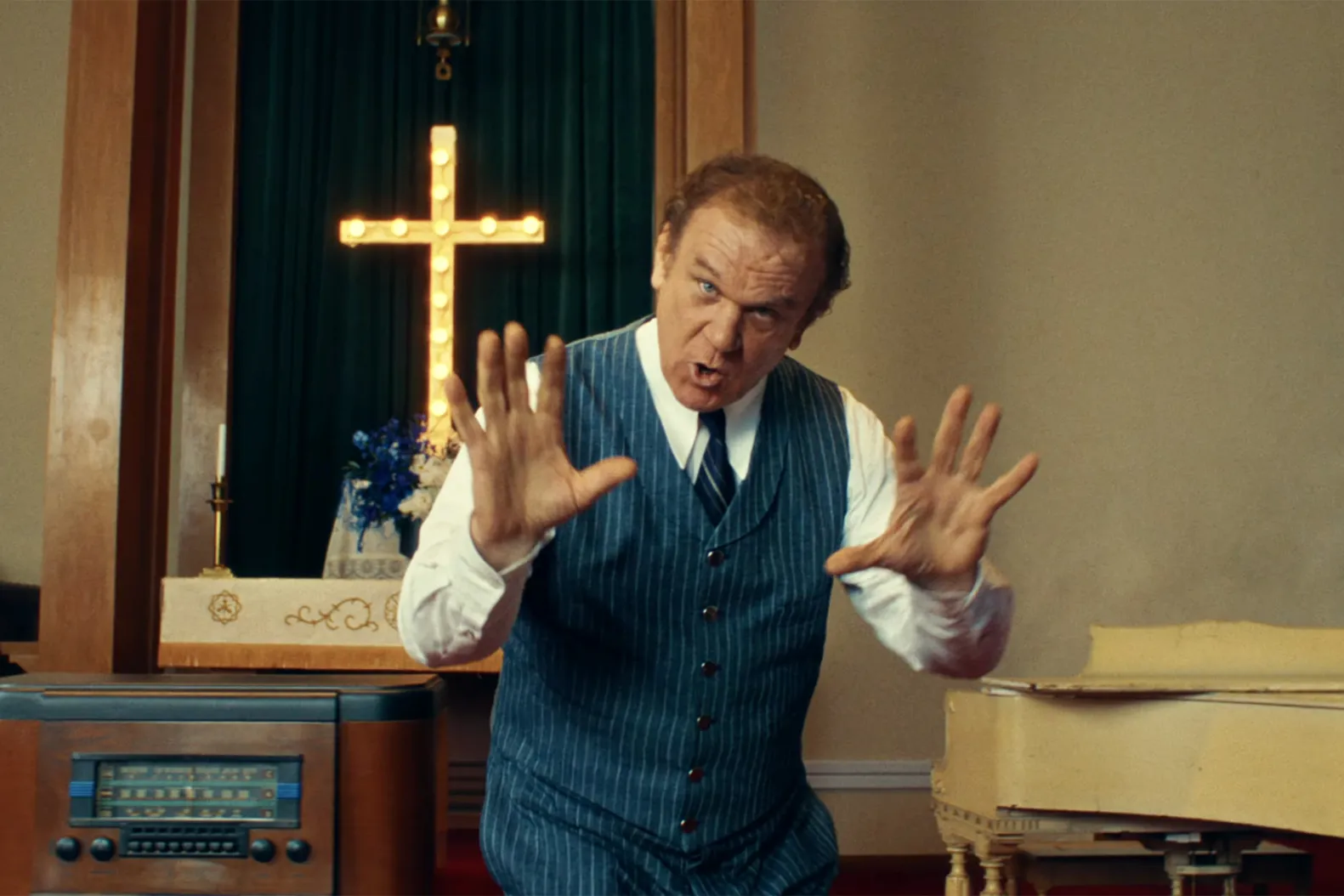
“Archbishop Harold Holmes” is the fifth track of Jack White’s No Name album, which was released last summer on July 19, 2024. The new music video for “Archbishop Harold Holmes,” starring John C. Reilly, dropped June 17, 2025. The video begins with a tight shot of the blue-eyed Reilly dressed in a blue pin-striped suit, loading a single sheet of paper into a blue “Made in USA” Corona manual typewriter. Although he makes no appearance in the video, Jack White’s signature blues-driven guitar accompanies the action, audibly reminiscent of Sweet’s 1974 hit “Ballroom Blitz.” After briefly observing Reilly peck the typewriter keys as he composes his supposed divinely inspired thoughts, we move into a small church where Reilly stands in the sanctuary behind a pulpit with an old-time radio built into the facade and begins to deliver his sermon to a small but ecstatic gathering of well-dressed congregants. We soon discover that Reilly is Archbishop Harold Holmes, and the remainder of the less-than-three-minute music video features him preaching up an electric storm.
O’Connor, White, and Reilly were all fully initiated into the Catholic Church. Flannery O’Connor was a daily communicant, and although Jack White and John C. Reilly don’t appear to share O’Connor’s faithfulness and devotion, they do share her high standard of artistic excellence and an old-school Catholic aesthetic. Jack White’s baptismal name is John Anthony Gillis, and he is the youngest of ten children, born and baptized in Detroit. His mom and dad were both employed by the Archdiocese of Detroit; his mother was the cardinal’s secretary, and his father was the building maintenance superintendent. White briefly discerned the priesthood, but when he realized he would not be permitted to take his electric guitar and amplifier to the seminary, he took it as a sign that his vocation was to be a musician. John C. Reilly was born and baptized in Chicago, the fifth of six children, and he credits his Catholic upbringing as significant to his life and acting career. To date, it is uncertain how White and Reilly decided to collaborate to make the music video for “Archbishop Harold Holmes,” but the concept for the video is credited to Reilly, who must be familiar with Flannery O’Connor, as we shall soon see.
Archbishop Harold Holmes is not a Catholic cleric but a Protestant preacher, which is consistent with O’Connor’s fiction, as most of her characters (especially the preachers) are Protestant, not Catholic. There is no crucifix in his church, but there is a cross, arrayed with soft white light bulbs. Above the cross, there is a sanctuary candle; under the cross, there is an altar with two unlit candles at each corner and some mysterious veiled box behind a floral array. An organ sits to the left of the altar and a piano to the right, although both ecclesial musical instruments defer to the dominant sound of Jack White rock ‘n’ roll genius.
“You need to see me right away so I can fix this.”
As Reilly embodies the character of Archbishop Harold Holmes, we the viewers are taken in by his deep and expressive conviction and zeal, as he is so worked up that he quickly removes his suit coat and cajoles his congregants: “Dear friend, if you want to feel better / Don’t let the devil make you toss this letter / If you’ve been crossed up by hoodoo voodoo / A wizard or the lizard. . .” Who doesn’t have trouble? Who hasn’t sinned? Who isn’t in need of some healing? Holmes has diagnosed the problem that plagues the human race, and he offers a solution: “Well, I’m coming to your town to break it all down / And help you with all of this [. . .] God spoke to me, said, ‘Listen to me / I anoint you with the power that’ll get ‘em all movin’.’” Sparks and blue lines of electricity flow from the archbishop as he preaches and even promises financial blessing to his energized assembly. He explains, “Hate is trying to take someone else’s love for yourself / But I’m here to tell you that love is trying to help someone else / I realize that you have tried and tried / and are just about ready to give up,” until he moves into the memorable chorus, “You need to see me right away so I can fix this.” (Interestingly and likely not unintentionally, there are twelve verses to this song and the chorus is only sung once. Jack White, like most Catholics, understands the significance of numbers, especially one, three, seven, ten, and twelve.) At this point, the congregation is now standing, hands raised, praying, dancing, and gathering around their charismatic archbishop preacher, and everyone is feeling the power of his preaching. But then it happens. Reality breaks. And we realize we’ve been trusting an unreliable narrator.
In the last twenty-five seconds of the video, as the archbishop sings, “And if you are suffering a strange sickness / Or someone is blocking up all of your success,” we learn that Reilly’s character is, in fact, a patient in a mental institution and that the entire church scene has been his imagination presented to us, the now-surprised viewers. We see how his fellow patients and the orderlies in the mental ward have been imagined as his congregants. In the final scene, as he is pecking away at his blue typewriter, one of the orderlies begins to pull him from his desk and carry him off to a room marked “AUTHORIZED PERSONNEL ONLY” for what one presumes (from the foreshadowed blue electric currents on display throughout the video) is his electroshock therapy treatment. But before the song and video end with Reilly’s character trailing off with an almost inaudible “Signed, sincerely yours in faith, hope, and peace / Your friend, Archbishop Harold Holmes,” we have witnessed four quick shots of a young male orderly with a mustache sitting in a chair, paying no attention to his surroundings because he is fully immersed in reading a copy of Flannery O’Connor’s first novel, Wise Blood.
It’s the piece of pop art made thus far in 2025 that is apropos for the Jubilee Year of Hope.
There is absolutely no way the placement of O’Connor’s comic novel in Jack White’s video for “Archbishop Harold Holmes” is unintentional. Reilly and White are trying to tell us something, and they are calling on Flannery O’Connor to help us understand their artistic vision. I won’t dare claim to be the definitive interpreter of their art, but I can offer three helpful insights.
First, God matters, and belief in God matters. By our fallen nature, we are all sin-sick and in need of a redeemer, a good word, the good Word made flesh, a Savior. Second, hope matters. We all desire a reason to keep moving, to keep living, and we want a reason to believe that our suffering has meaning and that things will get better. Reilly’s character in the “Archbishop Harold Holmes” video (both imagined and in reality) desires to be a bearer of hope and is able to deliver on that desire, at least to some degree. Finally, art matters and music matters.
When I first saw this music video, I shared on X and Instagram that I thought it was the most Flannery O’Connor thing I’ve seen in 2025, and that was almost a week before I watched it closely enough to recognize the appearance of Wise Blood in the video. I’ve had some great conversations with priest friends and lay friends and people online I’ve never met about this wonderful music video that have been challenging, comforting, and edifying. That’s what good art is supposed to do—make us think about our humanity deeply, wonder about reality and our place in it as men and women, consider God in one way or another, and have good conversations. The music video for “Archbishop Harold Holmes” has done all these things well. To my mind, it’s the piece of pop art made thus far in 2025 that is apropos for the Jubilee Year of Hope.